

Welcome to a Monday edition of Progress Report.
I’m back at the desk after a crazy week: First I went to LA to film long report on the 50-year right-wing influence campaign that led to MAHA and the anti-science “wellness” movement. I arrived home at after midnight on Friday, then spent the weekend helping and celebrating my brother’s wedding. Now it’s back to the grind.
Announcement: I’m interviewing Florida Rep. Anna Eskamani live here on Substack on Tuesday, 7/22 at 8:30 pm EST. We’ll talk about her recent visit to so-called Alligator Alcatraz, exciting campaign for Mayor of Orlando, fighting Trump and DeSantis, and much more.
Note: I’ve got a lot planned for this newsletter, including weekly live videos, regular activism spotlights, and a new focus on policy to shape a progressive platform. We need big ideas and both the courage and strategy to pursue the power necessary to implement them.
Together we can build an independent media and new base of power, but Progress Report needs your help to survive and make it happen. It costs just $5 a month — every subscription helps!
Thank you to our latest crowd-funding donors: Deniece, Lauro, Valerie, Jacqueline, Ted, Nathan, Robert, James, Elizabeth!


Missouri: Last week, Gov. Mike Kehoe signed a repeal of Proposition A, the ballot initiative that successfully raised the state’s minimum wage and allowed workers the right to earn paid sick leave.
Within days, the main sponsor of that initiative filed a new version — but this time, as a constitutional amendment, which would make it almost impossible for a majority of bought-off Republican legislators to repeal.
The language of Von Glahn’s initiative is similar to Proposition A. It would require most employers with 15 or more employees to offer an hour of paid sick leave for every 30 hours worked.
The measure would also enshrine the state’s $15 minimum wage in the constitution and guarantee future increases based on inflation. In addition, the initiative would also allow cities and counties with populations of more than 10,000 people to enact their own minimum wage and sick leave requirements.
Prop A passed with nearly 58% of the vote despite opposition from Republicans and the business lobby. Industry groups sued at the state Supreme Court, which did not indulge the specious attempt to disqualify the initiative. While they didn’t spend much to fight the proposition last time, no doubt they’ll pour money into opposition if the amendment makes it to the 2026 ballot.
Washington: In one of the state’s with the most protections for workers, the city council in Olympia will vote on enshrining even more rights for service industry and other blue collar jobs.
UFCW Local 367 sponsored and collected signatures for a ballot initiative that would create a Worker’s Bill of Rights in the city, with three major prongs:
A $20/hour minimum wage for large employers, with a timed phase-in for medium and small businesses.
A set of minimum safety requirements on the job
Right to fajr scheduling that provides schedules at 14 days ahead of time and right to an overtime penalty if that changes.
The Olympia City Council can vote to adopt the measure immediately or send it to the November ballot for voters to decide.
Education: It’s summer vacation across the country, but the battle over every level of education continues to intensify.
The Trump administration has two main overarching goals: re-segregating the K-12 system and dismantling what it considers a liberal stranglehold on higher education and its related institutions.
As I noted last week, the Big Beautiful Bill provides large tax breaks to individuals who donate to private school scholarship funds. That serves to siphon federal dollars to private (and often religious) education while reducing the number of public school students, which winds up reducing the amount of money that those schools receive. For the most part, this ultimately leads to an exodus of students from wealthier (and whiter) families who have connections to private or religious schools and leaves poorer, disabled, and rural students at defunded public schools.
A new report also finds that the work of civil rights enforcement within public schools — one of the main tasks of the rapidly diminishing Department of Education — has become a shell of its former self.
The database lists just 65 resolutions so far this year, on pace to fall far below previous years’ totals. Last year the office logged 380 resolutions in total, following 561 in 2023. During President Donald Trump’s first term, the office averaged more than 800 resolutions a year, including 1,300 during his first year in office.
Other internal data obtained by The Associated Press show a similar trend. Since Trump took office, the total number of resolved cases is down about 40% from the same time frame last year — including cases that were dismissed, mediated or reached a voluntary resolution. Compared with last year, there also has been a 70% decrease in the number of cases resolved through resolution agreements or action taken by a school to comply with federal law, the internal data shows.
And this isn’t a matter of fewer issues to resolve: civil rights violations complaints are up by 9% this year. Why the decline, then? The answer is twofold: obviously, the administration just doesn’t care about enforcing civil rights laws, and to that end, it fired half of the civil rights enforcement staff at the DOE.
Public schools are also in danger of losing billions in funding as a result of the administration’s crackdown on “DEI” programs (or the sorts of things that ameliorate and prevent civil rights violations and social inequities). The administration is swinging the same hammer at higher education, bludgeoning anything resembling DEI — and that’s a broad category — off of campuses.
You should bookmark this long, disconcerting list of the ways that universities across the country have responded to the demands and threats made by the Trump administration and state governments; they span from changing the names of programs and dismissing a few employees to defunding of LGBTQ+ and Black student organizations, ending programs, and elimination of whole offices.

Redistricting Rumble
The Texas legislature on Monday kicks off a special session in which it will try to further gerrymander the state’s Congressional maps. Republicans already control 25 of the state’s 38 Congressional districts; Trump, conscious of the threat to his House majority in next year’s midterm elections, has called on Texas to rearrange the map to create up to five new GOP-leaning seats.
There are a few uncertainties here:
Can Republicans draw more than a few new red-leaning districts without creating dummymanders, or seats with such diluted majorities that they flip blue?
Will Democrats pull out all the stops to prevent the gerrymander from happening?
And if so, do they actually have a chance of stopping the steal, so to speak?
During a press conference on Monday, Texas Democrats vowed to do everything in their power to thwart the GOP’s plan, including “filibusters, dragging out filibusters, and quorum breaks,” the last of which involves absconding from the Capitol and perhaps even the state. Democratic legislators have already been encouraged to bolt the state, a tactic they used in 2021 to the deep frustration of Abbott and state Republicans.
Democrats ultimately broke after well over a month away from their homes, and because Abbott can call as many special sessions as he’d like, Republicans ultimately got their gerrymanders passed. The GOP attached daily fines to future quorum breaks, making this a costly option that may not wind up stopping the redistricting. But it would, at the very least, draw national attention to the issue, and make it easier for Democrats to justify returning fire in other states.
They face a similar conundrum in Ohio, though they may have a bit more room to maneuver in the Buckeye State. Due to previous lawsuits, the legislature has to draw new Congressional maps, and with total control of state government, Republicans may try to squeeze another red seat or two out of an already-gerrymandered map.
State law requires Democratic buy-in during the first two attempts at drawing a new map, and while Republicans could pass one on a third attempt with just partisan support, Democrats have threatened to respond by pushing a ballot initiative that would block their maneuvers. It’s a bit of a game of chicken, and all because Republicans were able to successfully trick the public into voting against a constitutional amendment that would have created an independent redistricting commission last year.
Democrats in blue states are huddling over how they might be able to redraw some of their maps to counter the GOP’s new gerrymander drive. I’m told it’s not an option in Colorado, where Gov. Jared Polis has been bucking the party more and more and legislative leaders are uninterested in change. But it looks as if California, New York, New Jersey, and Washington are each considering their own gerrymanders.
New York Gov. Kathy Hochul is meeting with House Minority Leader Hakeem Jeffries in August to discuss the potential permutations. New York Democrats’ potential new map would have a much better chance of surviving than the last time the Empire State tried to gerrymander thanks to a change in the state’s top court. Most efforts to redraw districts are likely to face significant court challenges, but Democrats have the majority in each of the high courts where gerrymandering could occur.
Debating the Democratic Party’s Direction
Even if Democrats do wind up gerrymandering blue states, it’ll only matter if they can win elections. And to do that, the party desperately needs a significant change, both ideologically and culturally.
The fight for control of the party’s future has been raging since November, with every forum a battlefield. So far, the media narratives have favored more centrist Democrats, while elections have shown a thirst for change among voters. As the DNC works on its dishonest post-mortem of the 2024 election, the progressive organization Way to Win is out with new polling that indicates political pugilism and economic are the way forward.
Way to Win focused its poll on voters who cast their ballot for Joe Biden in 2020 and then skipped the 2024 election. These voters, who were predominantly young and nonwhite, constitute a big enough constituency that they could have swung the election had they turned out for Harris. Instead, they wound up sitting at home. (A new study of last year’s election data showed that Trump would have won non-voters, even though more of those non-voters were registered Democrats).
These non-voters are predominantly young and concerned with systemic inequality, as the numbers show. They had a wide range of reasons to explain why they didn’t go out to the polls, but they all trend in the same direction: Harris tacked too far to the center, ignoring the cost of living and deep poverty that has engulfed more Americans than since the Great Depression.
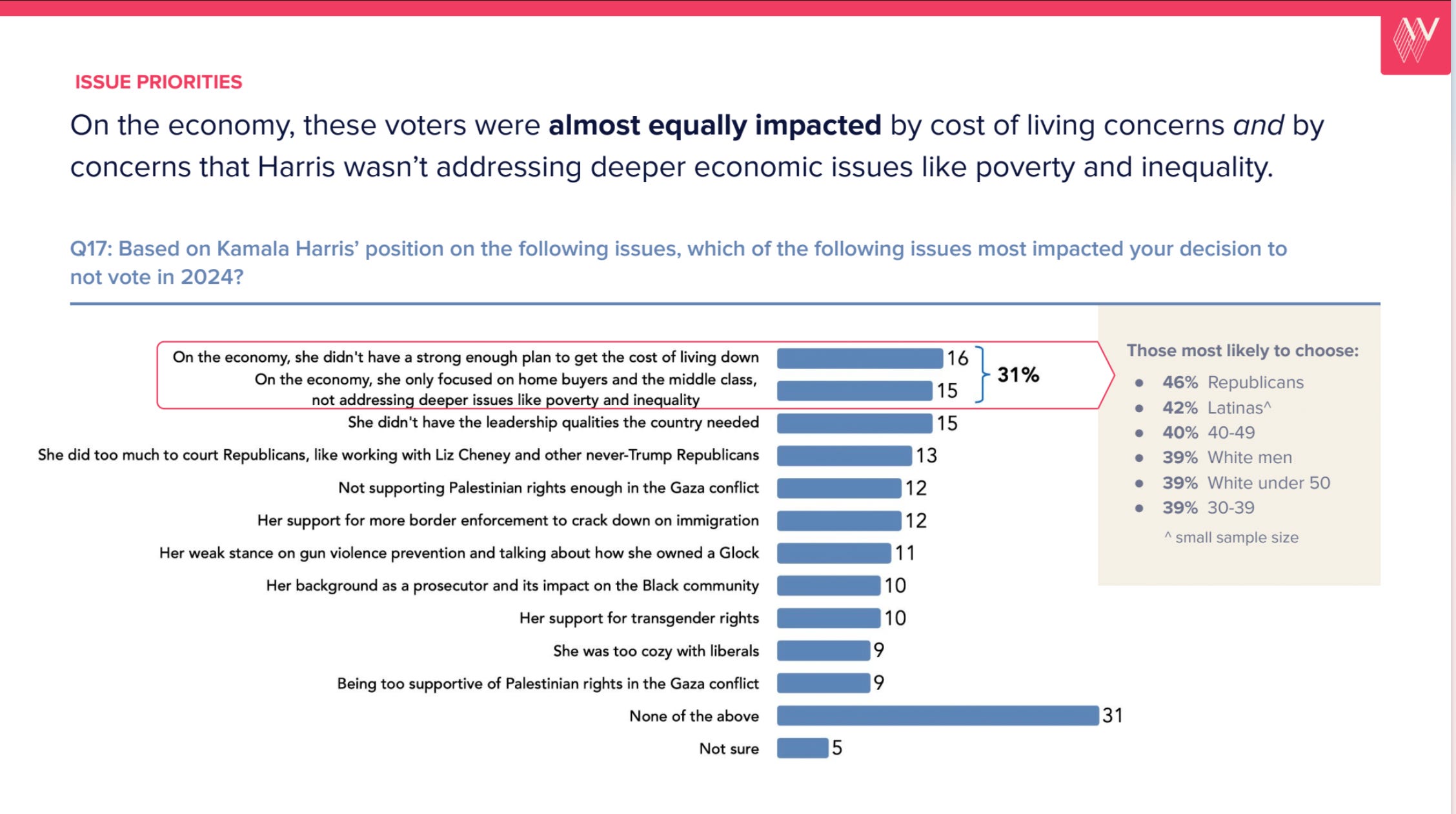
To put a finer point on it, these voters are skeptical of American capitalism and the outrageous inequality it has created. The campaign struggled with this issue, as Harris first proposed price controls on certain essentials and was then forced to abandon the idea when billionaire surrogate Mark Cuban insisted that she wouldn’t actually enact such a policy. Her association with tech billionaires also became a recurring theme, which also evidenced a double standard given the way Elon Musk and other Silicon Valley titans flocked to Trump’s campaign.
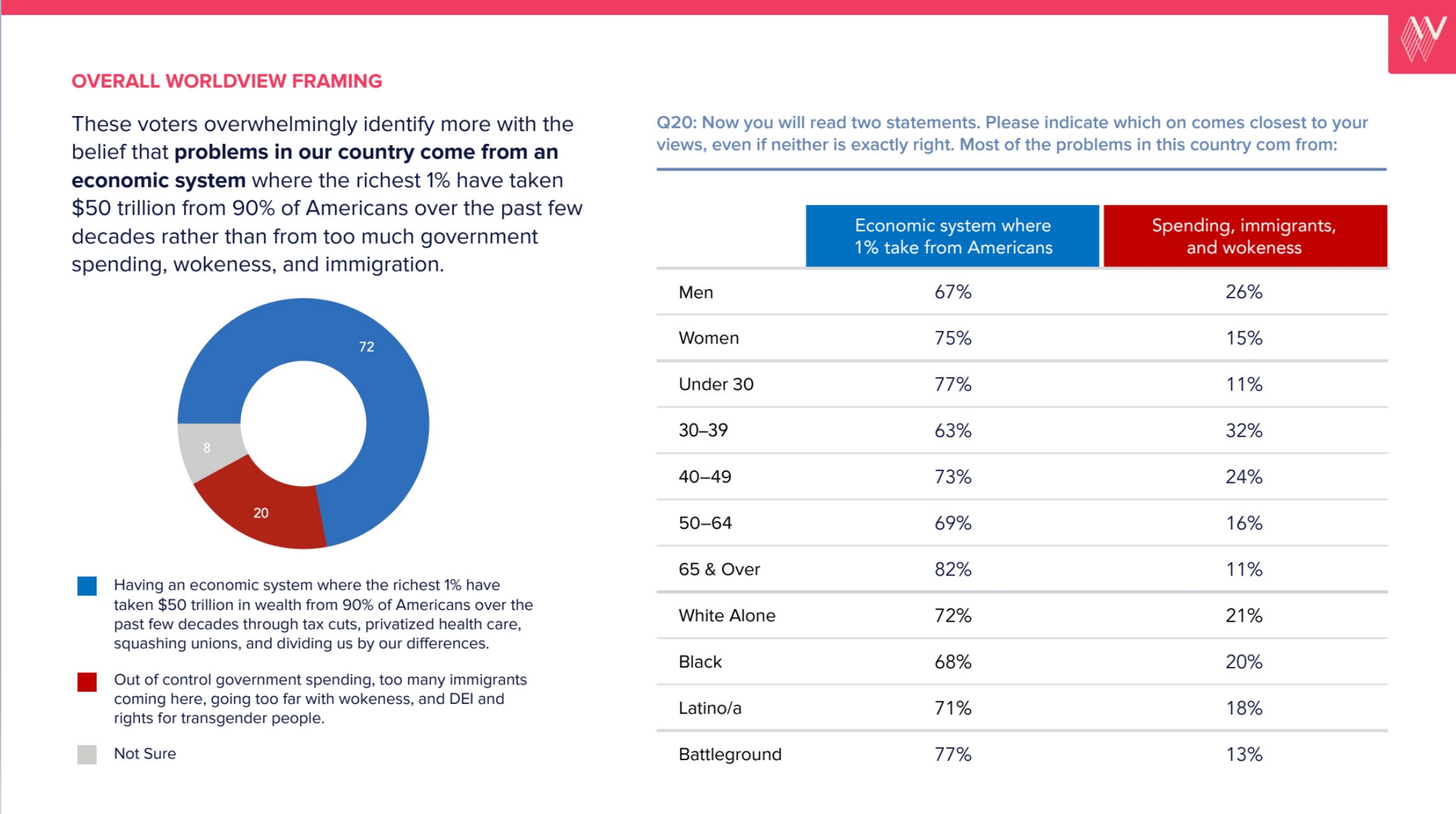
Like it or not, Republicans were able to portray Harris as a coastal elite who only cared about her friends and middle class homeowners, and it obviously had an impact on her standing. Nearly three-quarters of these surveyed voters said that they identify more with the belief that problems come from a rigged economic system that benefits the 1% over everybody else.
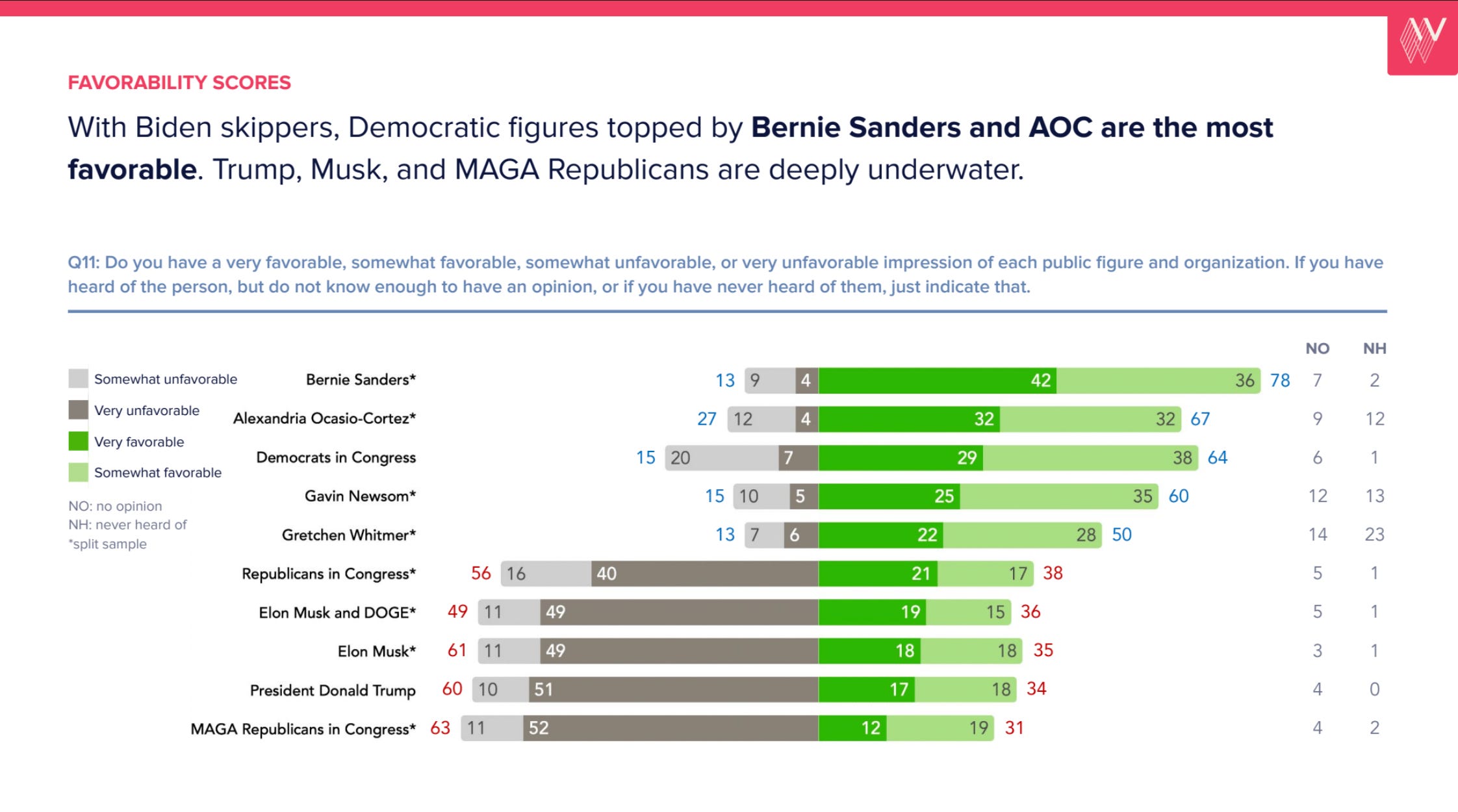
And to put an even finer point on it, when the survey went from the abstract to more real world questions, it was leftists like Sen. Bernie Sanders and Rep. Alexandria Ocasio-Cortez who garnered the most positive reactions.
What we don’t know is why voters decided to vote for Kamala, but what’s undeniable is that Democrats have to do better to appeal to working class populism and stop telling people that the economy is good, actually. The issues poll respondents care about most right now are all economic in nature: ensuring everybody has health insurance, making the rich pay their fair share in taxes, the cost of living, and housing affordability.
Ironically, the out-of-touch Democratic leadership criticism was best articulated by Hunter Biden of all people in a new interview with Andrew Callaghan, though his criticism of Democratic power players did come in response to their pushing his father out of the race.
He’s not wrong about the pundit class’s lack of any actual knowledge of what working people experience in this country.
Wait, Before You Leave!
Progress Report has raised over $7 million dollars for progressive candidates and causes, breaks national stories about corrupt politicians, and delivers incisive analysis, and goes deep into the grassroots.
None of the money we’ve raised for candidates and causes goes to producing this newsletter or all of the related projects we put out. In fact, it costs me money to do this. So, I need your help.
For just $5 a month, you can buy a premium subscription that includes:
Premium member-only newsletters with original reporting
Financing new projects and paying new reporters
Access to upcoming chats and live notes
You can also make a one-time donation to Progress Report’s GoFundMe campaign — doing so will earn you a shout-out in the next weekend edition of the newsletter!
You haven’t mentioned Harris’s commitment to continue genocide in Gaza and her brutal treatment of pro-Palestinian groups. That was the deal breaker. The Dems have to break with Zionism.