

Welcome to a Monday night edition of Progress Report.
There is no shortage of issues that Democrats can and should run on right now, chiefly the economy and the fascist in the White House. Those proved pretty effective earlier this month! But long-term, populism is about more than affordability — it’s about power. Big Tech billionaires understand this, so they’re already promising to spend big to cow Democrats on artificial intelligence.
As I write tonight — and I’m resending the below because Substack had some problems last night — the party needs to be defiant on this issue — for the sake of working class communities and the country’s political future.
Note: The far-right’s fascist takeover of this country is being aided by the media’s total capitulation to Trump’s extortion. It’s never been more critical to have a bold independent media willing to speak up against the powerful. That’s what I’m trying to do here at Progress Report.
For a limited time, I’m offering 40% off a paid subscription, so you can help keep Progress Report afloat for just $3.00 a month — every subscription really, really matters!


Back in early 2022, I wrote in this newsletter that the scarcity and skyrocketing cost of housing would be a defining issue of the next few election cycles. As a leading contributor to the cost of living crisis, the prediction about housing turned out to be pretty spot-on; unfortunately, it took years for Democrats to accept reality, make the issue a focus of their campaigns, and gain tenuous public trust.
As this month’s elections indicated, soaring rents, the hopelessness of buying a home, and the broader cost of living crisis will continue to dominate voters’ minds. Already on edge, voters will know who — or what — to blame for any upcoming recession: artificial intelligence, which I believe is poised to become the next major issue to reshape our politics.
Artificial intelligence increasingly feels like a manifestation of so many longstanding American paranoias: a fusion of Skynet and succubus, a top-down imposition on every aspect of Americans’ lives. That’s at least in part because while not inherently evil (I use it for research!), the technology is being most publicly deployed in unnerving and sinister ways, championed by massive corporations and cartoonishly evil men.
Whereas Americans were once optimistic about technology, public skepticism about AI has grown exponentially. A new Pew study found that 50% of Americans are more concerned than excited about the growing use of AI in everyday life, compared to just 10% of people who feel more excitement than trepidation. Similarly, 57% of Americans say that AI poses significant societal risk, whereas only 25% who see high potential upside.
It’s no great leap to believe that public trust would be even lower if the survey had asked people about the downstream effects of the technology’s rapid adoption. For our purposes, I’m looking at AI’s role in resource extraction, economic hardship, and the collapse of social cohesion, each of which is both well underway and subject to increasing grassroots resistance.
Both the concern and active opposition cut evenly across partisan lines, offering what could be a new and expansive coalition for whichever party is willing to buck powerful donors and pursue an agenda aimed at imposing tight guardrails on the industry before it’s too late.
Feeding the beast
How did New Jersey Rep. Mikie Sherrill wind up with such an overwhelming victory in the state’s gubernatorial election? The backlash to Donald Trump was key. But Sherrill also struck a cord with overextended voters by promising to declare a state of emergency and freeze electricity rates, which have soared by 21% year-over-year.
Abigail Spanberger, the governor-elect in Virginia, also took a firm stance on energy bills, which have gone up 13% in her state.
And in Georgia, the two Democratic candidates for the all-red Public Utilities Commission focused relentlessly on the cost of electricity, which proved key to their historic runaway victories.
All three are ultimately examples of affordability politics, but there’s an important twist: both Spanberger and the candidates in Georgia tied the cost of energy to their states’ massive rise in data centers, which provide the computing power for artificial intelligence processing.
Virginia is the national ground zero for data center construction, owing to its place right in the middle of the East Coast. In Georgia, regular commission-approved electricity rate hikes have coincided with a boom in data center construction in the state, with a particular concentration in the wider Atlanta metro area.
“The number one issue was affordability,” Peter Hubbard, one of the winning Georgia public utility candidates, told Wired. “But a very close second was data centers and the concern around them just sucking up the water, the electricity, the land—and not really paying any taxes.”
The energy required to run those computers is unlike anything in human history, placing an extraordinary burden on public resources that is ultimately subsidized by local residents. Initially wooed with tax incentives by state and local lawmakers that coveted promised construction jobs and eventual revenue, the reality of data centers has proven far different than promised.
As a result, the proliferation of data centers and the economic and environmental damage they cause has become a source of furious backlash nationwide.
Georgia is again instructive: In response to the 26 completed projects and 52 pending builds, the surrounding counties have passed moratoriums on data center construction, a temporary measure that should encourage activists to continue their battles.
More broadly, between March and June of this year, 20 data center projects — worth $98 billion in investment — were blocked or delayed by community opposition. These efforts continue to crop up almost weekly, often targeting lower-income communities near water sources. There are active fights in New Mexico, Michigan, Oklahoma, and nearly two dozen other states.
And so, a new pattern is emerging: Uninterested in local input, monolithic tech companies contract with developers that bury their owners in byzantine LLCs and quietly strike deals with municipal officials bound by NDAs. Once residents learn about the projects, and the outsized demands they’ll place on diminishing local resources, especially the water supply, the response is even angrier.
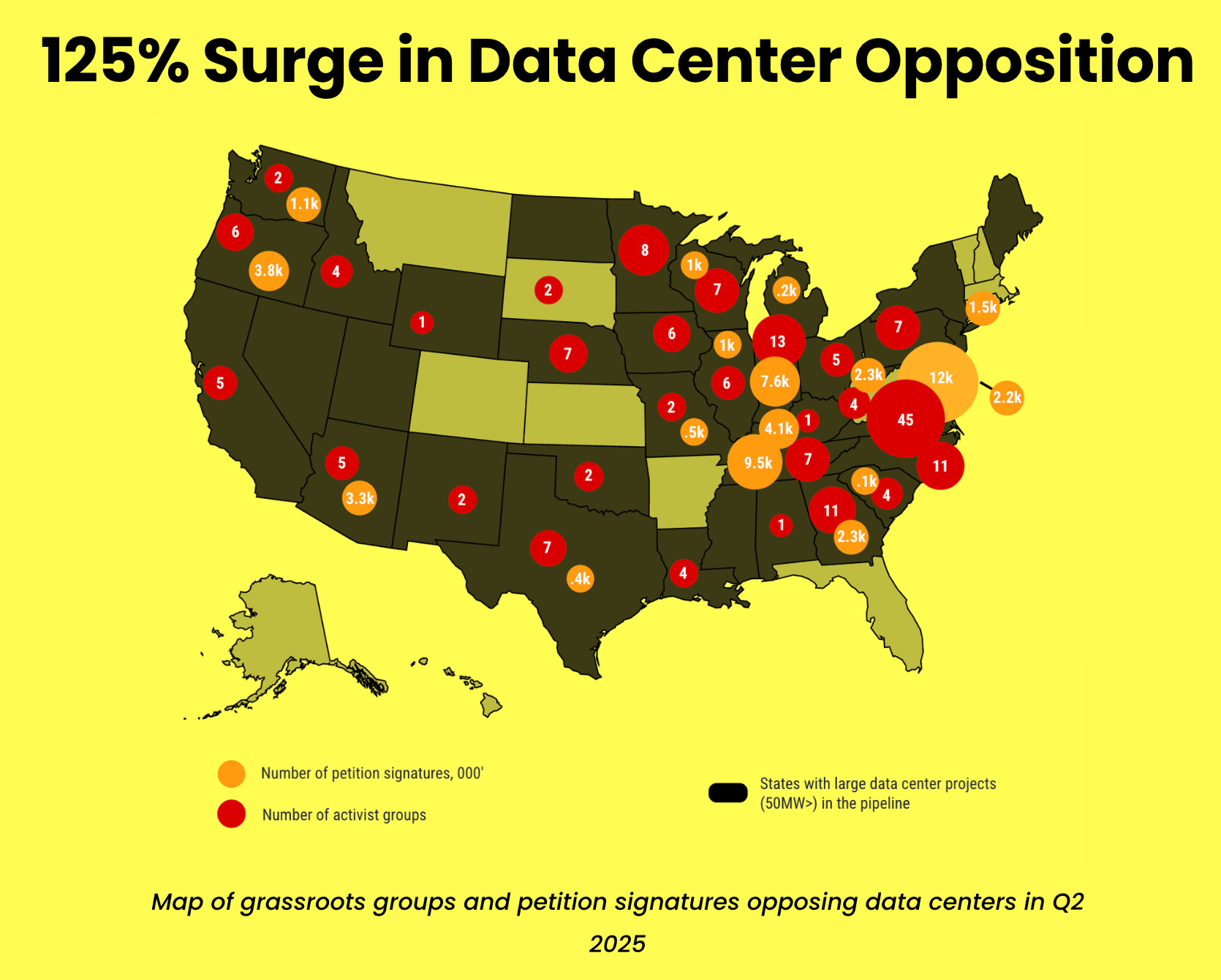
And unlike the conservative Tea Party backlash against Obamacare in 2010, there is no central dark money political organization or powerful interest group driving the resistance, nor is there a central coordinating infrastructure for town halls or cooperation. That may be because the issue hasn’t yet taken on an obvious partisan alignment: rural conservatives and suburban liberals alike are rising up against the construction of these data centers, which seem to only benefit increasingly reviled billionaires and their creepy plans for social engineering.
Data centers will continue to be built; there’s too much money and too many geopolitical implications for the US to abandon the technology. But Democrats do not have to play the enthusiastic dupes who invite the world’s most powerful tech companies to treat communities’ precious resources like buffet stations, much less stuff their coffers with taxpayer money.
On the local level, Democratic officials should be leading the popular resistance to these data centers, at the very least until they can extract enormous community benefit agreements, deep limitations on their energy inputs, and union labor guarantees.
And even in the event they can win all those things, they should still be pains in the ass about it, because for Democrats, it’s an opportunity to learn from the party’s biggest lingering mistake of the past 40 years.
That Big Sucking Sound
After working as a journalist through the rise of social media and this craven new iteration of Silicon Valley, observing one hype cycle after another incinerate billions of dollars with no tangible end product or societal advancement, I’m not keen on hyperbole or bold projections of societal reorganization. (I’ll never get back all the hours spent at multiple Sundances being pitched VR goggle entertainment experiences as the future of cinema.)
But artificial intelligence, I’m convinced, does have the potential to be the most broadly transformational development since the internet, with an economic reordering effect that could mirror the pain that followed globalization in the ‘80s, ‘90s, and 2000s.
Both NAFTA (1993) and the normalizing of trade relations with China (2000) were sold as great opportunities for American businesses and workers alike. Businesses would get access to new markets and cheaper labor, while the lost manufacturing jobs would be replaced by the boom in high-tech and white collar work. Only those first two things happened, and while they juiced many corporate profits, the devastation wrought by deindustrialization has never been fully recovered.
Though NAFTA was negotiated by George H.W. Bush’s administration and supported by more Republicans in Congress, Bill Clinton’s decision to push it through wrecked both American manufacturing and the Democratic Party in the textile-heavy South and industrial Midwest. As Gavin Wright summarized it, “the political-economic basis for a biracial coalition was undermined by deindustrialization.”
Lower-income white voters — the same people who once made middle class money at textile mills, factories, and the businesses that supported manufacturing — ultimately shifted heavily toward Republicans. The idea that it happened after the Civil Rights Act is a myth; the South regularly elected Democrats until the post-NAFTA era.
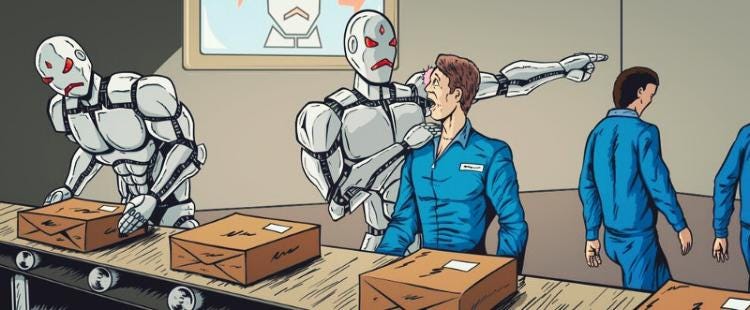
The party that welcomes AI with such open arms will be in a similar situation, because AI is analogous to the other main culprit for the collapse of industrial jobs: automation. In fact, you can think of artificial intelligence as automation writ large. Whereas advanced robotics has revolutionized manufacturing, AI does not stop at the warehouse floor or manufacturing plant.
There are few “white collar” productivity jobs that won’t be at risk of being fundamentally altered or essentially eliminated by AI. Even the most prestigious knowledge economy occupations are at risk. Why hire new lawyers or law clerks when you’ve got software that can scan every federal court case in history and quickly produce arguments and decisions that mimic the exact style and language of famed legal minds?
Training as a software engineer or web programmer used to be a surefire ticket to a lucrative career, but AI can generate more code at a faster rate than any human — ask engineers at Amazon how that’s going for them. Or, don’t, because Amazon plans to lay off 14,000 white collar workers as it continues to emphasize AI.
Journalism feels similarly doomed as companies impose AI on reporters and readers alike; generative AI is writing and copy editing articles for major publications with little-to-no disclosure while deepfakes and fully AI-generated videos are becoming more ubiquitous and harder to detect. These videos are swamping YouTube at an increasingly dizzy rate and being consumed by people who cannot tell the difference (or simply don’t care).
It’s becoming so prevalent that YouTube executives have actually said that they see AI-generated content as the future of the world’s biggest video site. It won’t be long before Hollywood makes the same decision; studios and unions clashed over the potential use of artificial intelligence in productions during the 2023 strikes, but the subsequent limitations in negotiated contracts did not prohibit the use of AI in script analysis, marketing, or in certain elements of production.
Sora, OpenAI’s generative video tool, has given fans the ability to create their own movies starring their favorite actors and characters, even if it violates copyright. Independent studios are making wholly “original” movies via AI. Last week, the top country song on the Billboard digital singles chart was generated by a fake AI artist. Entertainment is the US’s top export, and soon enough, its creation with a closed loop of machine generation, bloodless and inhuman.
No industry is immune: What is the point of hiring bankers when machines are infinitely better at assessing risk and know exactly how to upsell unsuspecting customers? Why hire teachers as anything more than proctors for personalized lesson plans produced by computers? Do we need translators if AI can spit out flawless interpretations almost instantly?
And it’s hardly just white collar work that’s endangered. UPS, which has long been a Teamsters shop, is also leaning into automation and correlating job cuts; the company has cut over 43,000 jobs over the past three years by deploying AI and other automation. Whereas employers usually announce layoffs with notes of regret, mass bloodlettings are now being introduced as triumphs of digital efficiencies and algorithmic implementation. Klarna’s CEO boasts that the company has cut staff by 40% thanks to AI efficiencies, and SalesForce’s newly MAGA billionaire CEO Marc Benioff bragged that he cut 4,000 jobs and replaced them with AI in September. The Teamsters are fighting a lonely battle against self-driving freight trucks, California Gov. Gavin Newsom having vetoed a requirement that a living person aboard.
Last month was the worst October for layoffs in more than two decades, and one after another, corporations were pairing the cuts with massive spending on some version of artificial intelligence. In some cases, the two are directly correlated; companies have bragged that they are replacing workers with AI, and in others, they’ve cleaned house in order to concentrate capital on the endless cycle of AI investment that is seemingly propping up the economy. Billionaires will be fine when the bubble pops, but the politicians who cheerlead it will be right in the front line of the blast radius.
Technological advances will always make some jobs easier, others harder, and some entirely redundant. That’s unavoidable. But any political party that sells itself as caring about workers would be front and center in the effort to place strict legal and social guardrails on how artificial intelligence is used in the workplace and the arts. The AFL-CIO recently released a first principles guide for AI in the workplace, which offers some tailored worker protections and enhanced rights in the face of algorithmic takeover. That can be a very basic starting point, but more is needed for a party to seem anything other than acquiescent.
Think modernized copyright law that discourages or penalizes AI content produced by machines trained on stolen work. Deep restrictions on the use of AI chatbots and algorithms in place of real healthcare professionals. New rules concerning mass layoffs and capital redeployment. An end to the ponzi scheme of the computing power ouroborous. Reviving the Biden administration’s efforts to ban algorithmic discrimination against certain subsets of workers (California has taken steps on this) and surveillance of employees. Preventing unrealistic quotas set by AI or standards comparable to computer output.
A new kind of Moral Majority
Americans have a strange relationship with moral outrages, and tend to be forgiving of all the worst people and institutions. But they also hate the idea of being tracked by the government, duped by con artists, and abused by corporations, and are already expressing real reservations about how AI will facilitate those things.
Last year, 77% of Americans expressed distrust in government and businesses to use AI in responsible ways. As the Trump administration funnels untold sums to Palantir to use AI to surveil innocent Americans, as ChatGPT continues to encourage young people to commit suicide, as hoax videos perpetuate and shatter any sense of reality, Americans will only grow more skeptical and resentful of the technology — even as they use it themselves.
The Sam Altmans and Elon Musks of the world have done little to assuage the public that these issues will ever get solved, which makes the politics of this moment all the more pivotal. Guarding against their left flank and enamored by the money in Silicon Valley, Democrats have for a long time been champions of tech innovation, fearful that they’ll appear to be impeding capitalism. But now is not the time for such concerns.
From office workers to obsolete Teamsters and concerned parents to farmers on the verge of losing their water, there is a broad new coalition just waiting to be adopted and activated. Whichever party is willing to take up that mantle to ensure that AI does not bleed Americans dry and upend their collective consciousness is going to win the right for the future.
Wait, Before You Leave!
Progress Report has raised over $7 million dollars for progressive candidates and causes, breaks national stories about corrupt politicians, and delivers incisive analysis, and goes deep into the grassroots.
None of the money we’ve raised for candidates and causes goes to producing this newsletter or all of the related projects we put out. In fact, it costs me money to do this. So, I need your help.
For just $5 a month, you can buy a premium subscription that includes:
Premium member-only newsletters with original reporting
Financing new projects and paying new reporters
Access to upcoming chats and live notes
You can also make a one-time donation to Progress Report’s GoFundMe campaign!