

Welcome to a Tuesday edition of Progress Report.
It’s now officially been two months since I underwent my latest open-heart surgery. The recovery has been slower (three in three years will do that) but with an historically important election just two weeks away, I’m determined to help where I can. Michael Bloomberg, feel free to lend a hand, I promise that I operate lean.
Today we’ll review some early voting totals, dig into lesser-covered ballot initiatives, and look at the stakes in swing states and red states alike. I’m hoping to publish more digestible newsletters at a more frequent pace (as health allows right now), so please let me know if you like this format.
Reminder: I’ve taken down the paywall, stopped normal billing, and made all Progress Report content — including new articles like the one below — free while I recover from open-heart surgery.
You’re invited support this work via donations to the newsletter’s GoFundMe, and every donation is very appreciated.


First: If you thought you couldn’t detest Vivek Ramaswany more than you already detest him, think again. Yesterday, the billionaire pharmaceutical fraudster and Ohio gubernatorial candidate released an ad featuring Donna Arthur, the estranged mother of Democratic rival Amy Acton, urging voters not to back her daughter. Not supporting Acton is Arthur’s favorite pastime: when Acton’s stepfather raped her as a 12-year-old, Arthur sided with her husband, paid for his legal fees, and left town with him. Acton and her siblings were removed from their care by the state. Arthur stayed married to the rapist stepfather until his death.
Arthur is clearly elderly and infirm, which makes a commercial in which she accuses her daughter of being a liar even more disgusting. DDHQ, an election data and projection outlet, today moved the race to leans Democratic, and I can’t imagine the firestorm over the ad will help, especially not after this piss poor response to the uproar. Republicans just can’t stop protecting pedophiles.
Early Voting Snapshot
Comparing early voting totals from year to year is the opposite of an exact science, but all caveats aside, the numbers are still looking good for Democrats in swing states.
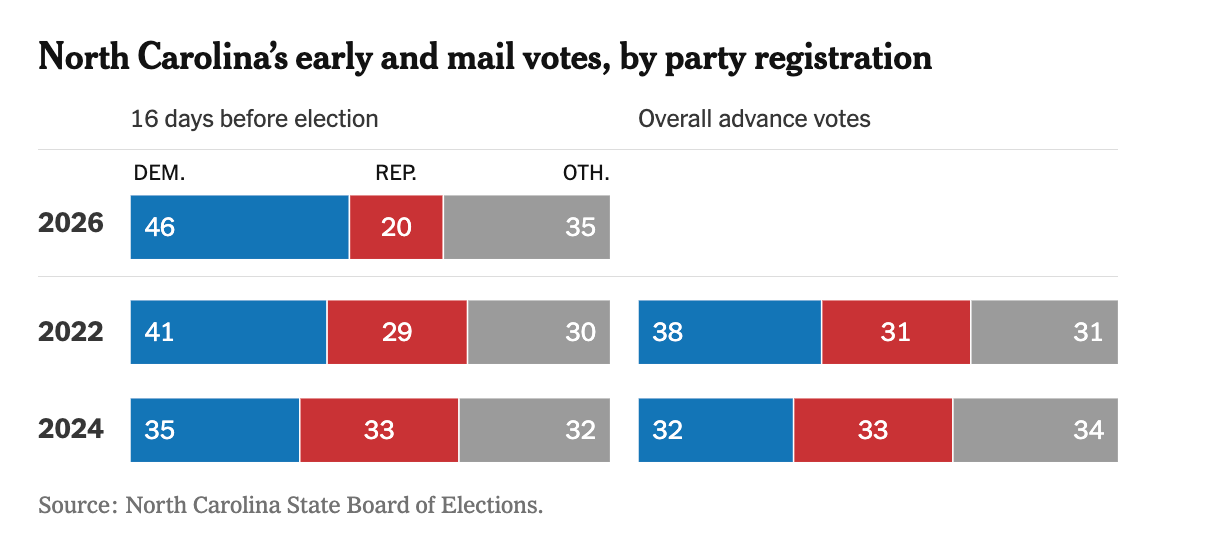
Nowhere does the the blue wave look more promising than in North Carolina, where as of Monday, Democrats had cast twice as many votes as Republicans. That boom, powered in large part by women and Black voters, has the overall number of early votes up by 37% thus far.
Here’s a breakdown of how those votes have been cast by party registration, chart via the NYT:
The boom is on in Georgia, too, where more than one million votes have been cast as of the close of business on Monday.
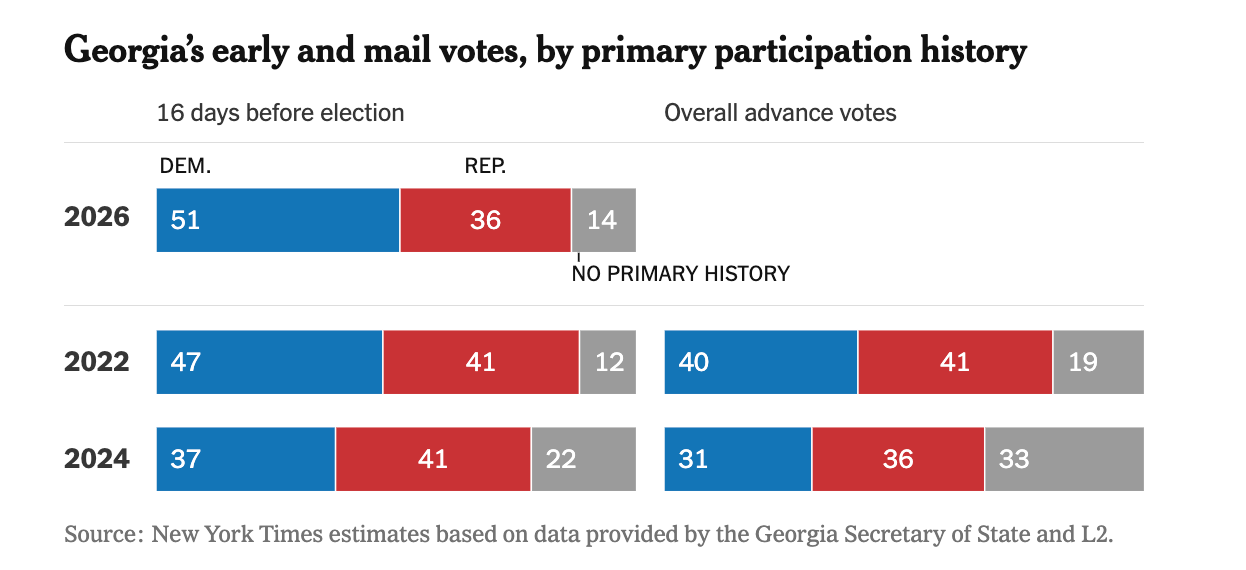
These numbers aren’t all that much of a shock: Georgia’s Sen. Jon Ossoff is expected to easily defend his seat in the upper chamber, while former NC Gov. Roy Cooper should flip the Tar Heel state’s Senate seat in a cakewalk. But there’s value in running up the score, because the more voters they turn out, the more likely it is that Democrats flip additional seats down ballot, in both Congressional races and state legislatures.
Early voting started on Monday in Texas, where the polls were flooded in prominent Democratic-leaning counties. Records for first-day turnout were broken in both Harris (Houston) and Dallas Counties.
On the heels of last Friday’s report in the NYT about the importance of state legislative races, ABC News just put out its own piece on each party’s prospects for trifectas. Pennsylvania once again leads the list of most enticing trifecta opportunities (donate to that cause here), and the story also gives some shine to Nevada, where flipping the governor’s mansion could lead to a repeal of the state’s odious “right to work” law.
The same was said about Virginia last year, but unlike Abigail Spanberger, who never endorsed a repeal and then broke her promise to sign other pro-union bills, Nevada AG Aaron Ford has made workers’ rights a central plank of his campaign for governor. Ford has been vocal about his intention to repeal “right to work,” which has helped mobilize Las Vegas’s sizable labor movement around his candidacy.
Secretary Mayor Pete is diving deeper into the state legislature game in his adopted home state of Michigan, endorsing 11 candidates in toss-up state Senate and House districts. As it so happens, each of those candidates is on our ActBlue list.
A blue wave could be just as valuable in traditionally red and Republican-controlled states, as activists seek to pass progressive ballot initiatives and Democrats hope to break long-held Republican supermajorities. Both goals are on the docket in Missouri, where Democrats need to pick up three House seats to break the supermajority and activists aim to both reject the gerrymandered Congressional maps and pass constitutional protections for ballot measures.
As I’ve written many times before, direct democracy is on the ballot in many states this year — here’s a good breakdown of where voters will have to grapple with conservatives trying to limit their voices.
As we get closer to election day, here are some of the more compelling ballot initiative fights playing out right now:
California: Prop 4 would allow state and local government to provide political campaigns with public matching funds that amplify the importance of small dollar donations. The program in NYC proved crucial to Zohran Mamdani’s ability to compete against and ultimately twice defeat corrupt former Gov. Andrew Cuomo. Every campaign I’ve helped out in the city has made unlocking public matching funds — they don’t just give it to anybody, you have to reach a fundraising threshold — a top priority.
Also in California: Unfortunately, those funds won’t be available to ballot initiatives: billionaires have poured hundreds of millions of dollars into the campaign to kill the state’s proposed one-time tax on the ultra-wealthy.
Washington: Interestingly, the biggest corporations — with the biggest earners — in the Washington are ostensibly sitting out of the fight over the state’s new millionaire tax. Conservatives want to repeal the surcharge, the first income tax of any kind in Washington history, but Microsoft and other tech powers are keeping their powder dry.
Why? They’re realists and thus well aware that it’d be a not just a waste of money, but leverage, too:
While not exactly cheering for the new income tax, major employers like Microsoft have focused on warding off other tax proposals they view as threats, like a “wealth tax” levied on stock holdings and other financial assets. They’ve also feared a statewide expansion of Seattle’s JumpStart tax on big company payrolls, which they view as a job-killing threat to their competitiveness.
When Democratic lawmakers broached the new income tax, big business groups like the Washington Roundtable, which includes Microsoft and other big private employers, were in the dealmaking loop, seeking other tax-policy trade-offs.
Lawmakers didn’t give them everything they wanted, but they did roll back some recent business tax increases—like a sales tax on services—that had been imposed a year earlier. They also rolled back a big increase in the estate tax on inherited property and assets, acknowledging it was leading wealthy people to consider moving elsewhere.
If it survives, advocates say the millionaire tax will raise about $3 billion per year, most of which will go to education, healthcare, and other critical services in the state’s budget.
Massachusetts: The state Supreme Court tossed the controversial rent control ballot initiative this summer, saving landlords, developers, and most Democratic politicians some serious heartburn. Now, affordable housing advocates are focused on passing an initiative that would rewrite the minimum size lot requirement for single-family homes.
Right now, the lot required is so big that it requires developers to build large — and thus expensive — homes to recoup their cost or make a profit. Reducing the size is intended to encourage smaller, denser developments that would bring back the smaller-scale starter homes that proliferated from the post-war period through the 1980s.
Idaho: Millions of dollars have been pouring into both sides of the state’s reproductive rights initiative, which seeks to overturn one of the strictest abortion bans in the country. More than $2.5 million came in over the past few weeks alone.
Wait, Before You Leave!
Progress Report has raised over $7 million dollars for progressive candidates and causes, breaks national stories about corrupt politicians, and delivers incisive analysis, and goes deep into the grassroots.
None of the money we’ve raised for candidates and causes goes to producing this newsletter or all of the related projects we put out. In fact, it costs me money to do this. So, I need your help.
You can make a one-time donation to Progress Report’s GoFundMe campaign!
Hope your recovery is going well really appreciate your articles but your health is the most important don't over do it
I didn't realize you had such heart problems. I hope everything goes well with that. As for format, I like information that is concise to get the basics with the option of getting more of something I'm really interested in.