

Welcome to a Thursday morning edition of Progress Report.
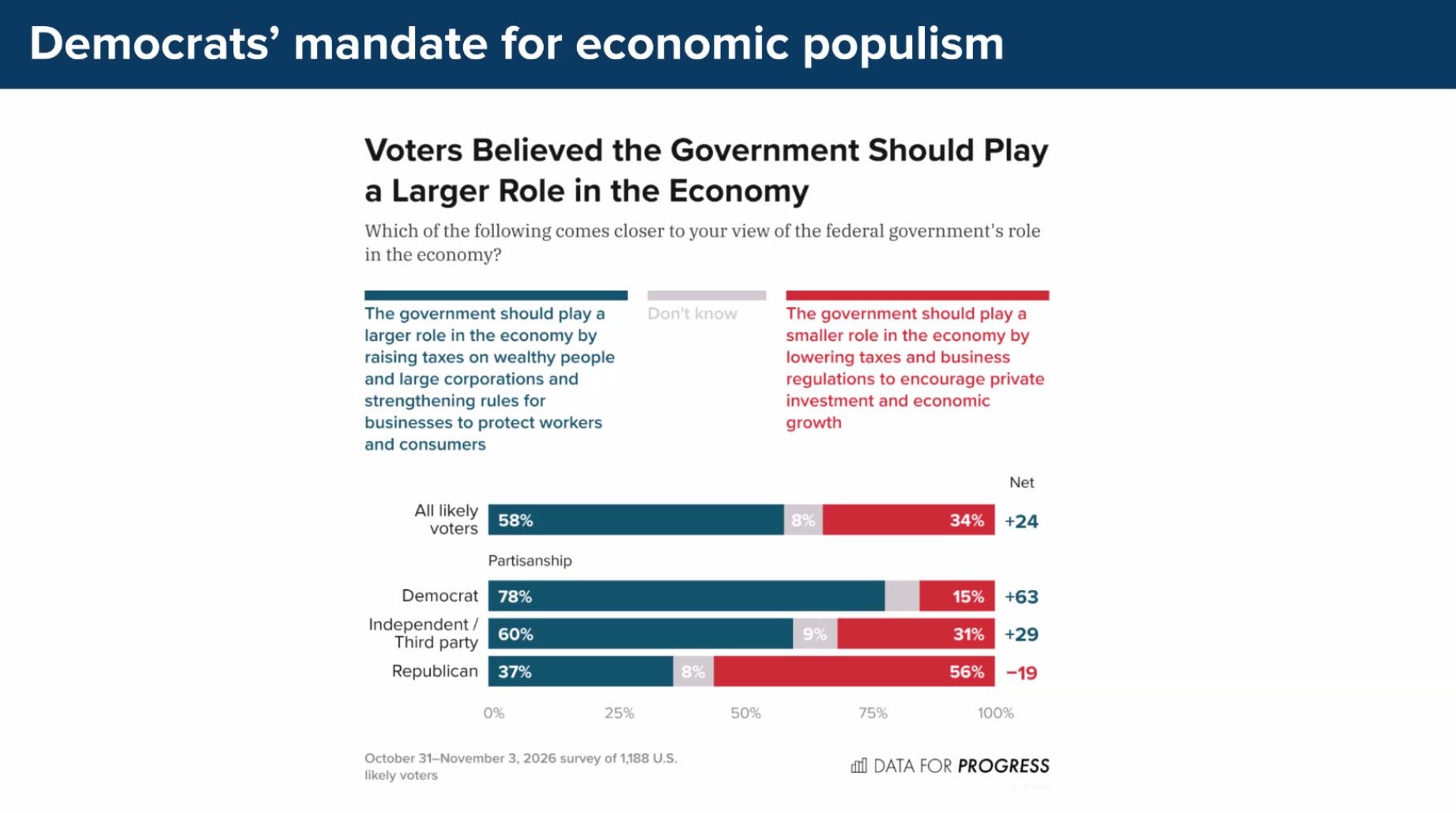
Voters didn’t just demand change on Tuesday, they demanded a dramatic new economic order.
It was an election as both exorcism and radical leap forward. Voters, disgusted with corruption, cruelty, and precarity, officially buried Donald Trump and his MAGA movement. The dire state of the nation made Democratic gains inevitable, while the combative populism of so many candidates turned the election into a landslide (as some of us predicted it would years ago).
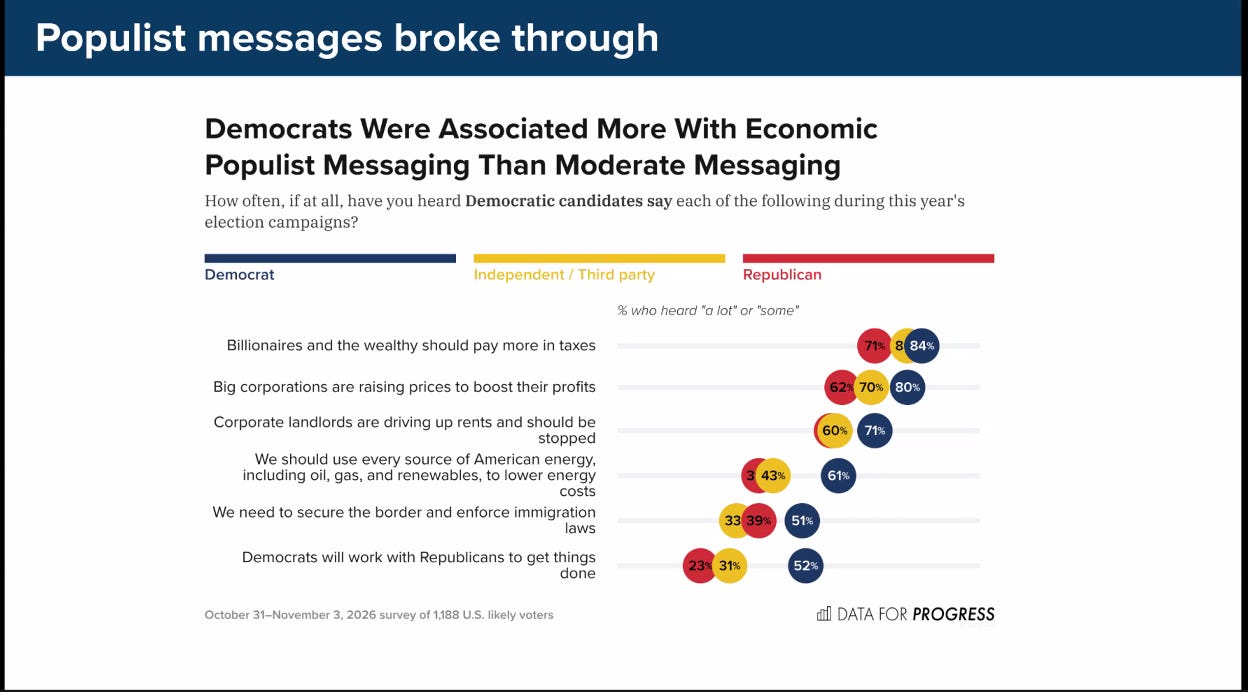
Dramatically outspent by Republicans, who had near exclusive backing of billionaires and businesses, Democrats’ countered by centering those billionaires as the source of so many of the problems facing working and middle class Americans. The tax cuts paid for by social austerity, egregious price gouging at the grocery store and gas pump, the turmoil being caused by AI — Democrats blamed corporations and billionaires for the most salient issues and promised a drastic rebalancing of society.
The landslide was about more than party ID; many of these unlikely flips would not have happened with the same bland centrist Democrats that have bungled so many elections in recent years. We’re no longer relitigating the 2016 primary, but mostly because it’s become clear that ideologically, Bernie Sanders won the debate over the future of the Democratic Party.
In some cases, voters had to intervene to prevent party leaders from falling back into old habits.
The DSCC backed the very moderate Rep. Haley Stevens in the Michigan Senate primary, arguing that she was more electable than former Wayne County health commissioner Abdul El-Sayed.
The DCCC, its House counterpart, spent money on a losing centrist candidate in MI-7, then fretted when progressive populist Will Lawrence took the nomination in a ruralish swing district.
Both El-Sayed and Lawrence won their elections, overcoming unprecedented dark money (and in El-Sayed’s case, unprecedented racism and sabotage) with a populist agendas: Medicare for All, controlling the spread of data centers, investing in schools instead of military contractors, and holding corporations accountable. Their victories typify a pattern that played out repeatedly on Tuesday night.
Down in Ohio, union-backed Sherrod Brown, long a critic of free trade and a champion of working people for decades, won back a seat in the Senate after a two-year absence.
Here’s another: The party’s official Senate campaign committee originally backed Maine Gov. Janet Mills in that state’s primary. When former state senate president Troy Jackson ultimately became the nominee, DC consultants did their best to blunt his populist instincts and promises. And still, the working class logger did what once seemed impossible: beat Susan Collins.
James Talarico ran explicitly against billionaires and income inequality, offering a gospel-driven populism en route to becoming the first Democrat to win a Senate election in Texas since 1988. He had the enthusiastic support of organized labor, backs a Medicare public option, champions public schools, and shrugs off culture wars by emphasizing the collective.
“We just sent a message to every billionaire megadonor, every trillionaire megadonor, every corrupt defender of this broken political system: in this state, in this country, power belongs to the people,” he said in his acceptance speech.
He got specific, too: “The people at the top divide us by party, by race, by gender, by religion, by culture, so we don’t notice that they are picking our pockets, that they are defunding our schools, that they are gutting our health care, that they are raising taxes on all of us while they cut taxes for themselves. It is the oldest strategy in the world, divide and conquer.”
Gina Hinojosa, the next governor of Texas, ran on a working class agenda that she couldn’t have been more explicit about in a big New York Times profile late last month. “I have been all over the state with all communities,” she said, explaining how she campaigns to a state as diverse and conservative as Texas. “To be clear, it is not a moderating message. It is reaching out to Democrats, Republicans, independents, with a populist message.”
I can keep going: Firefighter and union leader Bob Brooks flipped a seat in suburban Pennsylvania.
Popular Scranton mayor Paige Cognetti won the working class PA-08 back for Democrats with a platform focused on ending corruption, AI regulation, and remaking the health care system.
Rebecca Cooke, a waitress and activist, won her rematch with Derrick Van Orden in Wisconsin’s third district.
Populist retired military officer Richard Ojeda flipped a seemingly impossible seat in North Carolina, touting the pro-union PRO Act, ending Citizens United,
Sam Forstag, a populist union-leader and former smokejumper, flipped a seat in Montana (MT-1) that Trump won by 11 points in 2024.
Zach Dembo, who won a +26 Republican district in Kentucky by an astounding nine points, ran on taking on corporations and corruption.
Randy Villegas, who ran on Medicare for All, won in a landslide in a central California district (CA-22) that Trump won just two years ago. Further south, in Los Angeles (CA-34) the populist, labor-backed, anti-AI organizer Angela Gonzales‑Torres bounced tech industry favorite Rep. Jimmy Gomez.
I’ve taken down the paywall, stopped normal billing, and made all Progress Report content — including new articles like this one and the new Election Hub site — free while I recover from open-heart surgery.
You’re invited support this work via donations to the newsletter’s GoFundMe, and every donation is very appreciated.
And even Hakeem Jeffries, as he spoke during a victory last night, stood in front of a backdrop that said “Fighting for an Affordable America. It was a prop he could have borrowed from NYC Mayor Zohran Mamdani, who finally convinced at least some Democrats that the party needed to embrace everyday economic populism to win voters that had long since abandoned them.
Ballot initiatives told much of the same story.
While the billionaire tax in California could not overcome hundreds of millions of dollars in spending by tech moguls, bans on corporate money in politics passed with flying colors in Nebraska and Michigan. Data centers were almost unanimously rejected, with 43 of 44 proposed bans passing in communities across the country. Coloradans deferred tax rebates for investment in public education.
Here’s the catch: now they have to govern like populists, both at the federal level and in all of the states that they now control. This victory wasn’t so much an endorsement of the Democratic Party — which is still historically unpopular — as it was a demand for radical change. We’ve seen again and again what happens when a party campaigns on lifting up working people and restoring hope to the American public, then fails to deliver on it.

But already, anonymous moderate political operatives are trying to obfuscate the obvious message and lower expectations, pointing to the size of the incoming caucus as somehow a mandate for less change.
“Saying that candidate X happens to believe these progressive policies and won, that’s not a cause and effect, right?,” an anonymous strategist told the Washington Sun. “They didn’t run on their bold progressive agenda; they ran a fairly prosaic, center-left economic argument. There’s no mandate for that.”
The strategist pointed to ads by Will Lawrence and Sam Forstag, both of whom ran on lowering runaway prices and stopping data centers, and hammered away at billionaires and corporations again and again, blaming their outsized power as the source of those problems. If it wasn’t explicit enough, here’s what Lawrence said he’d tell Big Tech executives who try to make amends after spending millions against him.
“I’d say, ‘beware, because these tech oligarchs are dramatically unpopular,” he told the NY Times. “If we want to be a party of the working class, these are the Rockefellers and Carnegies of our day. These are the richest and most powerful people who are accustomed to operating with complete impunity, and they need to be brought to heel.”
If DC wants to believe that those stances are moderate, they’re more than welcome to do so; progress is achieved when big ideas become mainstream. But progressive populist policy has to follow, including but not limited to:
Immediately raising the minimum wage
Restoring healthcare and setting the stage for eventual Medicare for All
Strong guardrails on AI and data centers
Universal childcare
Extreme wealth taxes
Banning gerrymandering and limiting money in politics
New regulations on private equity and finance expansive new housing policy
Relentless investigations of corruption
Not all of it will get through Donald Trump’s veto, but that just makes it easier to run on populism in 2028.
Thank you. Hope you are starting to feel better. Maybe seeing the results from Tuesday helps us all feel a little better 🫂
Yes!