

Welcome to an Election Night edition of Progress Report and Happy Godzilla Day to all who celebrate.
Polls are closed in well over half of the states, and much to my excitement and relief, results flowing in at ElectionHub.org. Yes, it’s official: our all-in-one-place, automatically updated hub for tonight’s election results, chamber flips, and ballot initiatives is live and working. It’s going to be slower than the AP and other expensive services, but it puts everything in one place and digs deep up and down the ballot.
There are now four sites within ElectionHub, all of them accessible with one click:
Congress and Senate | State legislatures | Governors and other statewide elections | Ballot initiatives
Also: Doing these things is not cheap. Because I’ve turned off paid subscriptions to the newsletter while I recover from my heart surgery, I’m dipping into my own pocket to pay for this project, which is completely free to use and will not make a dime. As a result, I’ve started a fundraiser for the site’s operation, in case anybody wants to kick in to defray the cost. No pressure, though!
I’ve also made a cheat sheet for you, with all the relevant information you need for tonight.
Poll closings (ET)
The first big races land at 7pm (Georgia, Virginia), the heaviest hour is 8pm, and the West keeps things open past midnight. Times are when the last polls close in most of each state; split states are noted.
6:00 PM: Indiana, Kentucky (eastern parts)
7:00 PM: Georgia, Virginia, South Carolina, Vermont, Florida (most), Indiana and Kentucky (rest)
7:30 PM: North Carolina, Ohio, West Virginia
8:00 PM: Pennsylvania, Michigan (most), Maine, New Hampshire, Texas (most), Missouri, New Jersey, Alabama, Mississippi, Tennessee, Massachusetts, Maryland, Illinois, Connecticut, Delaware, Rhode Island, Oklahoma, D.C., Florida (panhandle), Kansas, North Dakota and South Dakota (most)
8:30 PM: Arkansas
9:00 PM: Arizona, Wisconsin, Minnesota, Iowa, New York, Colorado, Nebraska, New Mexico, Louisiana, Wyoming, Michigan, Kansas, Texas, North Dakota and South Dakota (rest)
10:00 PM: Nevada, Montana, Utah, Idaho (most), Oregon (most)
11:00 PM: California, Washington, Idaho and Oregon (rest)
12:00 AM: Alaska (most), Hawaii
1:00 AM: Alaska (Aleutians)
Congress: the math and the races
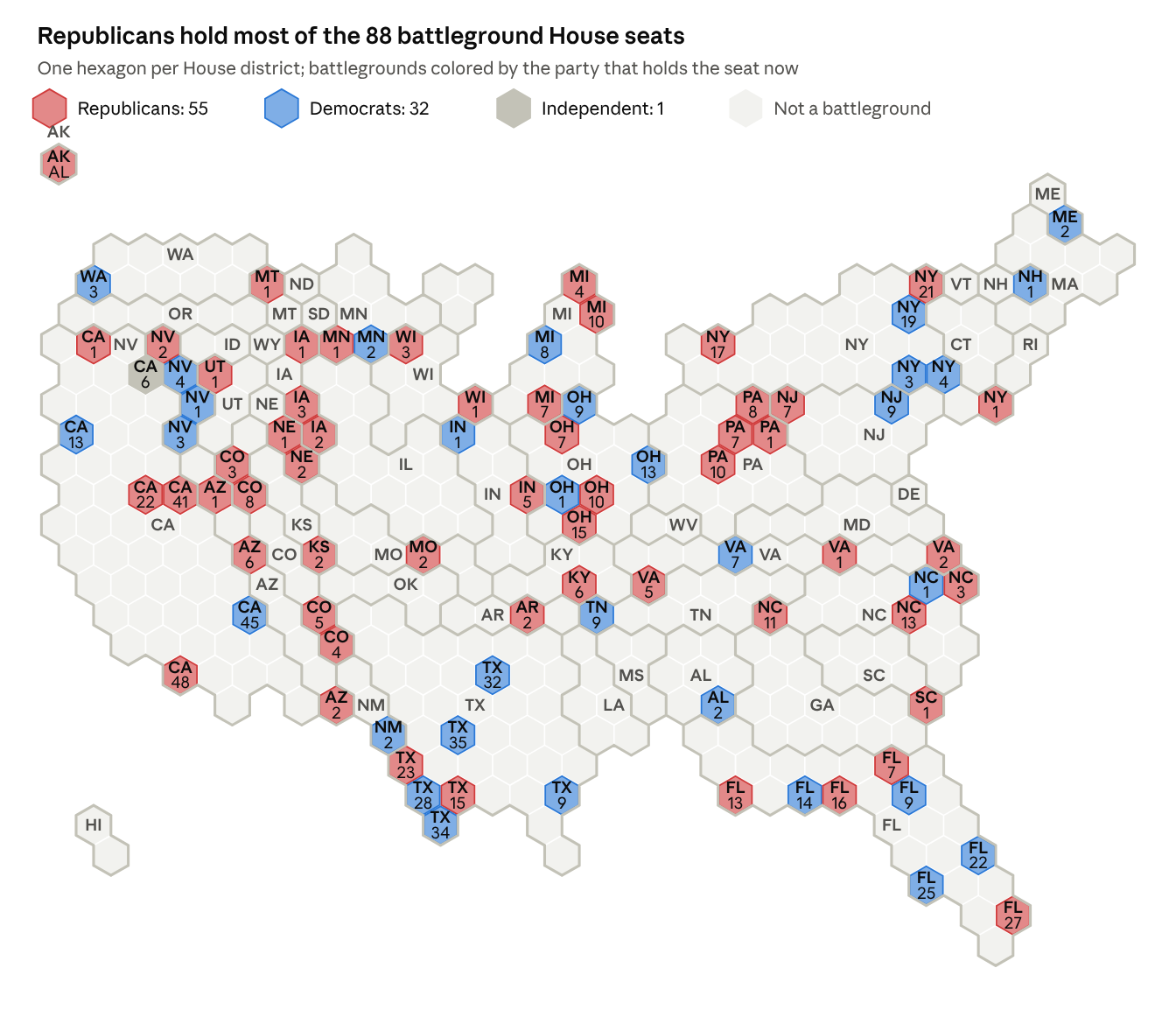
House: 218 seats for a majority. Republicans are defending most of the field: 12 of the 17 toss ups and 12 GOP-held seats Cook rates Lean D.
House seats most likely to change hands:
Lean D, now R-held: AZ-01, AZ-06, CA-48, CO-08, IA-01, IA-03, NC-11, NJ-07, PA-07, PA-10, VA-02, WI-03 (NE-02 is Likely D)
Lean or Likely R, now D-held: AL-02, ME-02, FL-09, TX-09
Redistricting flips (new maps): CA-01, CA-06, CA-41, UT-01 expected to go D; TX-32 and TN-09 expected to go R
Toss ups: CA-22, FL-14, FL-22, IA-02, KY-06, MI-04, MI-07, MI-10, MT-01, NC-01, NY-17, OH-07, OH-09, PA-08, TX-15, TX-35, VA-01
Senate: Republicans hold 53 seats. Democrats need a net gain of four for a 51-seat majority; Vice President Vance breaks 50–50 ties. Ratings are Cook’s as of Oct. 20.
Alaska (R, Toss Up): Mary Peltola v. Dan Sullivan*
Iowa (R, open, Toss Up): Josh Turek v. Ashley Hinson
Kansas (R, Toss Up): Adam Hamilton v. Roger Marshall*
Maine (R, Toss Up): Troy Jackson v. Susan Collins*
Michigan (D, open, Toss Up): Abdul El-Sayed v. Mike Rogers
Ohio special (R, Toss Up): Sherrod Brown v. Jon Husted*
Texas (R, open, Toss Up): James Talarico v. Ken Paxton
Minnesota (D, open, Lean D): Peggy Flanagan v. Michele Tafoya
New Hampshire (D, open, Lean D): Chris Pappas v. John E. Sununu
South Carolina (R, Lean R): Annie Andrews v. Darline Graham*
Georgia (D, Likely D): Jon Ossoff* v. Mike Collins
North Carolina (R, open, Likely D): Roy Cooper v. Michael Whatley
Nebraska (R, Likely R): Dan Osborn (I) v. Pete Ricketts*
Mississippi (R, Likely R): Scott Colom v. Cindy Hyde-Smith*
Florida special (R, Solid R): Angie Nixon v. Ashley Moody*
* incumbent. Matchups are listed Democrat (or independent) first.
Governors and statewide races
Twelve governor’s races are rated competitive, and seven of them are open seats. Ratings are Cook’s as of Oct. 27.
Georgia (R, open, Toss Up): Keisha Lance Bottoms v. Rick Jackson
Kansas (D, open, Toss Up): Cindy Holscher v. Ty Masterson
Nevada (R, Toss Up): Aaron Ford v. Joe Lombardo*
Wisconsin (D, open, Toss Up): David Crowley v. Tom Tiffany
Alaska (R, open, Lean D): Jonathan Kreiss-Tomkins v. Bernadette Wilson (ranked choice)
Arizona (D, Lean D): Katie Hobbs* v. Andy Biggs
Iowa (R, open, Lean D): Rob Sand v. Zach Lahn
Michigan (D, open, Lean D): Jocelyn Benson v. John James
Ohio (R, open, Lean D): Amy Acton v. Vivek Ramaswamy
Florida (R, open, Lean R): David Jolly v. Byron Donalds
Nebraska (R, Lean R): Lynne Walz v. Jim Pillen*
Texas (R, Lean R): Gina Hinojosa v. Greg Abbott*
* incumbent
Secretary of state: Arizona (Fontes v. Kolodin), Georgia (open), Michigan (open), Nevada (Aguilar v. Marchant rematch), Wisconsin (open)
Attorney general: Arizona (Mayes; 2022 was decided by 280 votes), Kansas (Kobach rematch), Michigan, Nevada and Texas (all open), Wisconsin (Kaul v. Toney rematch)
State legislatures that could flip
Minnesota’s tied House and one-seat Senate are the closest chambers in the country; 18 chambers could flip with a net gain of five seats or fewer. Seat counts are as of before the election.
Minnesota House: tied 67–67 (power-sharing); 68 for a majority; either party needs +1; all 134 seats up
Minnesota Senate: D 34–33; 34 for a majority; R needs +1; all 67 up
Michigan Senate: D 20–18; 20 for a majority; R needs +2; all 38 up
Pennsylvania House: D 103–100; 102 for a majority; R needs +2; all 203 up
Wisconsin Senate: R 18–15; 17 for a majority; D needs +2; 17 of 33 up
Arizona Senate: R 17–13; 16 for a majority; D needs +3; all 30 up
Pennsylvania Senate: R 27–23; 26 for a majority; D needs +3; 25 of 50 up
Maine House: D 75–73 (3 ind.); 76 for a majority; R needs +3; all 151 up
Nevada Senate: D 13–8; 11 for a majority; R needs +3; 11 of 21 up
Vermont Senate: D 17–13; 16 for a majority; R needs +3; all 30 up
Arizona House: R 33–27; 31 for a majority; D needs +4; all 60 up
Michigan House: R 58–52; 56 for a majority; D needs +4; all 110 up
Maine Senate: D 20–14 (1 ind.); 18 for a majority; R needs +4; all 35 up
Oregon Senate: D 18–12; 16 for a majority; R needs +4; 15 of 30 up
Texas Senate: R 18–12; 16 for a majority; D needs +4; 16 of 31 up
Wisconsin Assembly: R 54–45; 50 for a majority; D needs +5; all 99 up
New Hampshire Senate: R 16–8; 13 for a majority; D needs +5; all 24 up
Delaware Senate: D 15–6; 11 for a majority; R needs +5; 11 of 21 up
Alaska’s House and Senate are run by bipartisan coalitions, so watch who can organize the chamber rather than the party count. Eleven chambers have no regular election this year (both chambers in Louisiana, Mississippi, New Jersey and Virginia, plus the Kansas, New Mexico and South Carolina senates).
Ballot measures to watch
Taxes on the wealthy, abortion and voting rules carry the night’s biggest statewide measures; data centers dominate the local list.
Taxing the wealthy: California Prop 40 (5% one-time billionaire tax), Washington I-645 (repeal of the millionaires’ income tax), Colorado Amendment 87 (graduated income tax) against Prop 136 (4.4% cap meant to block it; if both pass, the one with more yes votes wins)
Abortion: Missouri Amendment 3 (repeals 2024 abortion rights), Virginia Question 1, Nevada Question 6 (second and final vote), Idaho Prop 1
Redistricting: Missouri Prop A (yes approves the GOP map splitting the Kansas City seat; no keeps the 2022 map), Maryland Question 3
Voting rules: voter ID in Ohio, Nevada, California (Prop 39) and North Carolina (mail ballots); Alaska Measure 2 (repeal ranked choice); Massachusetts Question 3 (top-two primaries) and Question 4 (same-day registration); Virginia Question 3 (restores voting rights on release)
Labor: Vermont Proposal 3 (constitutional right to collective bargaining)
Data centers: about 25 local bans, moratoriums and zoning votes
Florida amendments need 60%, Colorado amendments 55%, and Nebraska initiatives also need yes votes equal to 35% of all ballots cast. On Massachusetts Question 9, a yes vote keeps the 2024 gun law.
The new election sites are free to use, but were not free to make.
I’ve taken down the paywall, stopped normal billing, and made all Progress Report content — including new articles and the huge Election Hub site — free while I recover from open-heart surgery.
You’re invited support this work via donations to the newsletter’s GoFundMe, and every donation is very appreciated.