

Welcome to a Monday night edition of Progress Report.
I’m working on a big piece about city and county ballot initiatives, but I had to prioritize this one first because our intervention is needed ASAP. Let’s dig in.
Reminder: I’ve taken down the paywall, stopped normal billing, and made all Progress Report content — including new articles like the one below — free while I continue my recovery from open-heart surgery. This work is all pro bono ahead of the election.
You’re invited support this work via the newsletter’s GoFundMe, and every donation is very appreciated.

The most important political news of the weekend involved AOC and Bernie Sanders introducing The Strokes in NYC on Friday night. After that, there were two campaign items that made me raise my eyebrows and shift the work I was doing to meet the moment.
They boil down to this: Voters are increasingly opting for Democrats in generic Congressional ballot polls, but the coming blue wave could be smaller than expected due to to both a GOP cash advantage and a general center-left donor myopia.
Here’s the latest on the Congressional ballot, with some historical context that makes it even more eye-opening:
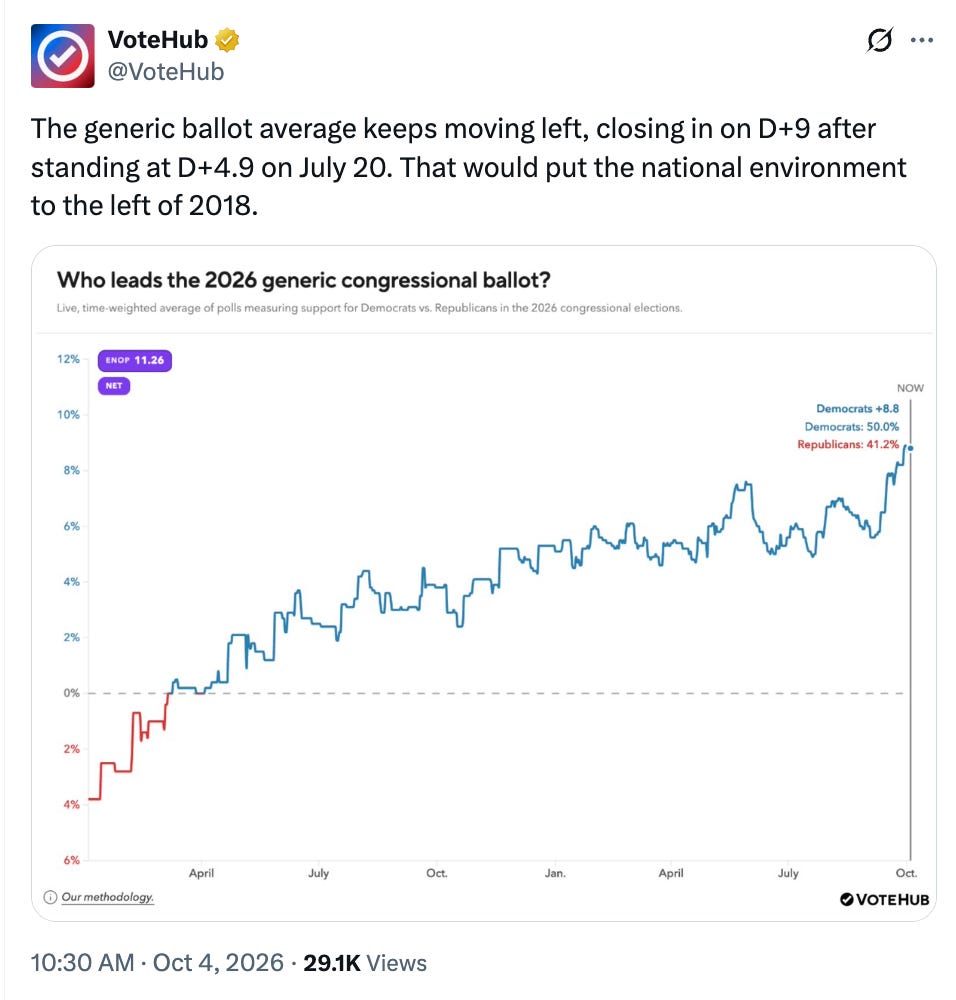
For comparison’s sake, Democratic Congressional candidates had a +8% popular vote margin in 2026, when the Iraq War and Hurricane Katrina were dragging George W. Bush’s approval to what were then record lows. Aggressive gerrymandering has made it less likely that Democrats will flip quite as many seats as they did in that wipeout two decades ago.
So Democrats are going to need help to maintain their advantages in red and purple territories, particularly in down ballot races. They’re being showered with money in key Senate races, but the same can’t be said down ballot. According to Politico, the party’s gubernatorial candidates are largely lagging behind in campaign cash, even in races in which they lead in the polls. And as former Wisconsin Democratic Party chair Ben Wikler explained, that gap could become especially costly further down ballot, when voters are more likely to reflexively return to their partisan defaults.
“Even if he only loses narrowly, the flood of Republican money could keep the state Legislature in GOP hands, denying Democrats a once-in-a-generation shot at unified control of the Wisconsin state government and a chance to undo the GOP’s House gerrymander and address its intentionally restrictive voting laws before the next presidential race,” Wikler said.
To some degree, this is hardly a surprise: letting state and local parties fester and then ignoring down-ballot races in 2010 and 2014 is how Democrats — and thus the country — got into this giant mess in the first place. It’s also what I initially started this newsletter, back in 2017, to address. It’s taken years of rebuilding to get anywhere near parity, and now the understandable allure of taking back the Senate is again threatening to leave local and state-level campaigns underfunded and outmatched.
Politics has been bombarded with more money than ever, but these down ballot races are still thinly funded enough that they can be significantly impacted with small donor dollars. So, with a month to go until election day, I’m launching a funding drive for legislative candidates in winnable races in swing states across the country.
Some notes:
Given both the right-wing gerrymanders in many states, the big Democratic lead in generic ballot polls, and a fair number of upsets in special elections, I’ve taken an expansive view of flippable and set the aperture to include districts that went to Republicans by 15 or fewer points in 2024.
Most of those districts were much closer on the presidential level, indicating a potential proneness to flipping in off-year elections with a deeply unpopular president.
Instead of a list with 60+ candidates, I’ve broken them down state-by-state, and am launching with the three of the four most competitive legislatures: Michigan, Wisconsin, and Pennsylvania.
Michigan: There are 14 candidates in total here: Three for the state Senate, where Democrats hold a one seat edge, and 11 in the House, where Democrats are looking to win back their majority.
Including on the list are the inspiring Katrina Manetta and Ana Aho Rink, who we’ve interviewed on live streams here at Progress Report.
Wisconsin: From being gerrymandered to the point of one-party rule in 2010 to a potential Democratic trifecta, Wisconsin is one of the great stories of democratic restoration. A redrawing of legislative districts has the state primed to flip, and we’re raising money for three state Senate candidates and four seeking election to the Assembly in Madison.
The list includes Ben Gruber, a rural blue collar candidate and one of the coolest stories we’ve featured on the Progress Report live stream.
Pennsylvania: We’ve got 11 candidates on this list, with two for state Senate and nine for the House. Democrats need exactly two state Senate seats to flip that chamber and could use as many House seats as possible to build up their ultra-narrow lead.
I’ll be back later this week with more candidates and a big break down of major local ballot initiatives.
Wait, Before You Leave!
Progress Report has raised over $7 million dollars for progressive candidates and causes, breaks national stories about corrupt politicians, and delivers incisive analysis, and goes deep into the grassroots.
None of the money we’ve raised for candidates and causes goes to producing this newsletter or all of the related projects we put out. In fact, it costs me money to do this. So, I need your help.
You can make a one-time donation to Progress Report’s GoFundMe campaign!