

Welcome to a Monday night edition of Progress Report.
Fascism and oligarchy are on the march, on the streets of Minneapolis, in the courtrooms of Washington, and the social media networks where you spend your idle time. It’s a terrifying moment, and I’m trying to take a dual approach to coverage: focusing on both big picture and street-level view.
Tomorrow I’ll have a piece on the rising threats to voting rights and functional democracy, but tonight, I’ve got a quick dispatch from the frontlines of another major fight — this one in my own backyard.
Note: The far-right’s fascist takeover of this country is being aided by the media’s total capitulation to Trump’s extortion. It’s never been more critical to have a bold independent media willing to speak up against the powerful. That’s what I’m trying to do here at Progress Report.
Just this week, you can help keep Progress Report afloat and build that network for half off — just $2.50 a month. Every subscription helps!
Thank you to our latest crowd-funding donors: Jim, William, John, Hildy, Ricardo, and Cheryl!


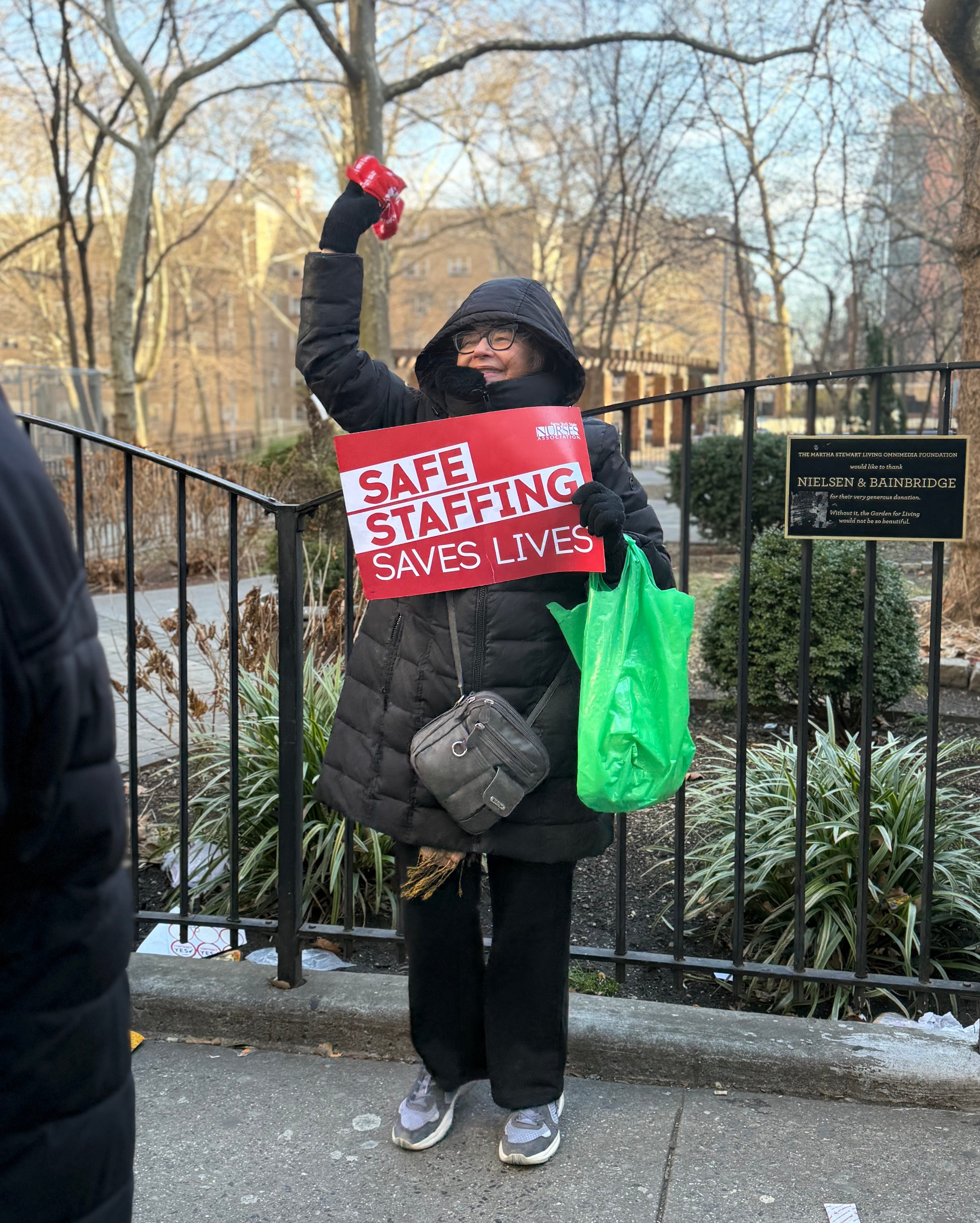
A record 15,000 nurses went on strike in New York City today after failing to come to a contract agreement with several major private hospital systems. There are picket lines stationed throughout several boroughs, and though I’m still recovering from yet another open-heart surgery, I dragged myself to the nearby Mount Sinai campus to show my support — it’s the least I could offer to those whom I owe my life.
The nurses, who are represented by the NY State Nurses Association, are striking at Mount Sinai, Montefiore, and New York-Presbyterian, the hospital where I had my first five open-heart surgeries. Long-term results on those operations varied — there’s a reason why I had a sixth surgery in late November, this time at the Cleveland Clinic — but I only made it through each increasingly complex and high-risk hospitalization thanks to the tirelessness, patience, and selflessness of the nurses who took care of me. Those last two descriptors are key, because I haven’t always been the easiest patient, to say the least.
I don’t want this newsletter to slide into another post-surgical trauma travelogue, but my experience is instructive in this case. Nurses are fearless and empathetic in a way that I don’t think we can really comprehend, largely because we often interact with them when we’re drugged up and desperate to be anywhere other than the hospital.
A quick anecdote: After my fifth heart surgery, in early 2024, I spent a week in a medically induced coma, so I never got to meet or thank the nurses that kept me alive as the treatment for one complication led to another. I don’t know the names of the nurses who had to wrestle me down when attempts to gently rouse me from sleep did not go according to plan, either.
One could argue that I never really knew the nurses in the step down unit, either, because post-surgical hallucinations convinced me that I was in a Hollywood diner, attending a magic show, on the docks with the mafia in the 1950s, and most of all, being unfairly constrained by nurses who were having children take my blood.
Needless to say, none of those thing were true, and my last few days were spent with enough clarity to make amends, but the generosity they showed me during both my mania and afterwards — not to mention all the complicated and not-for-the-squeamish care they provided during the worst of it — was humbling.
I remember sitting near the nurses’ station, finally able to leave my room, and wincing as they recalled my constant attempts to escape my bed while unable to drink liquids, much less stand up straight; each attempted escape set off alarms that required red alert levels of attention. I winced first out of shame and then laughter, because they all told me not to worry about it, that it was just part of their job.
These 15,000 nurses went on strike after months of fruitless negotiations with the hospitals, which the union says are trying to erode the safe staffing ratios agreed to after the last strike, in 2023. Now, I don’t have their health records in front of me — that would violate HIPAA — but my guess is that any executive who would suggest reducing the number of nurses on duty at any given time has never spent much time as a patient in a hospital. Because when you’re in that bed, connected by irritating tubes and wires to beeping screens and machines, everything feels like an emergency, and any delay when you hit that call button seems like an eternity.
Fewer nurses also means more exhausted nurses, which is a terrifying prospect when your life depends on a total stranger remembering the minute details of your condition, your treatment, and the motherlode of medications that you’re supposed to take at various points in the day (which may change several times, depending on vital signs and test results). There is no world in which there are too many nurses on duty, making rounds and assisting patients. They cannot possibly be a cost liability, because they provide a vast majority of the basic services that hospitals offer to their customers.
Another thing that the hospital executives want to do, according to the NYSAN, is cut back on the healthcare benefits that they provide to their healthcare providers. Does that mean that some staffers could potentially not afford to receive care in the same halls where they work, from the people they count as co-workers? Hospitals can’t technically refuse to care for patients, but they can kill them with overwhelming bills. For example, Mount Sinai no longer takes my insurance (Anthem Blue Cross!) which ruled out my being able to see a cardiologist there after my surgery in Cleveland.
Hospital executives argue that the substantial cuts to Medicaid are causing significant budget shortfalls, which is both undeniably true and a real problem in a city like New York and the neighborhoods where the three main campuses of these hospital systems operate. But those executives could undoubtedly find cost-savings elsewhere, starting with their own compensation packages (the head of NYP made $26 million in 2024), and perhaps dip into their cash reserves, which according to the union sits at more than $1.6 billion.
This was a last resort for the union, which spent weeks urging the hospitals back to the bargaining table after months of private negotiations. The strike could last 100 years and hospitals executives wouldn’t save a single life while the pickets were up, which should give you some idea of who should win here.
As a reporter who often covers labor, I often get emails about nurses strikes and organizing campaigns, especially in the wake of the pandemic. Earlier today, word broke that 500 nurses in Altoona had reached a union contract with the University of Pittsburgh Medical Center. At the top of their list of wins: “major investments in recruitment and retention to ensure safe staffing and quality patient care.”
Wait, Before You Leave!
Progress Report has raised over $7 million dollars for progressive candidates and causes, breaks national stories about corrupt politicians, and delivers incisive analysis, and goes deep into the grassroots.
None of the money we’ve raised for candidates and causes goes to producing this newsletter or all of the related projects we put out. In fact, it costs me money to do this. So, I need your help.
For just $5 a month, you can buy a premium subscription that includes:
Premium member-only newsletters with original reporting
Financing new projects and paying new reporters
Access to upcoming chats and live notes
You can also make a one-time donation to Progress Report’s GoFundMe campaign!
When we late wife was in a hospital as she battled lung cancer, I gained a whole new level of respect for both the doctors and nurses that cared for her. She was in the hospital for 21 straight days and had two surgeries: one to remove part of her lung and another to remove a tumor that had metastasized to her brain. THERE CAN NEVER BE A PHRASE "WE NEED FEWER NURSES!"
I have always had the greatest respect for nurses and that respect was recently reaffirmed after having two family members hospitalized the same week. The nurses were, literally, life-savers. Their knowledge was incredible and their patience was remarkable. They deserve anything and everything they are asking for.