

Welcome to a Saturday edition of Progress Report.
I’ve got a very deep dive on policy tonight, the first in what will hopefully be a substantial series looking at the necessary solutions to our most urgent problems. So let’s get into it!
Note: I’ll be honest, this newsletter’s paid subscribers have plummeted since I came back from open-heart surgery. It’s making it hard to do this work, because there are real expenses, including site coding, web hosting, electoral resources, media access, and more. This is a second full-time job, and if you can help make it sustainable, it will allow me to report and amplify stories you won’t find elsewhere.
You can help keep Progress Report afloat and build that network for just $5 a month — every subscription helps!
Thank you to our latest crowd-funding donors: James, Peter, Mark, William, Bruce, Roberta, and Valerie!


With Donald Trump’s failures piling up and poll numbers sinking to record lows, the battle for the Democratic Party’s ideological future has taken on new urgency.
It’s happening on parallel tracks: as upstart progressive populists and established moderates compete in ultra-expensive and frequently nasty midterm primaries, there is a more civil but no less high-stakes conversation happening between the party’s ideologically disparate policy factories. There’s broad agreement that the party needs fresh ideas and new directions; the question is whether those will entail mostly rhetorical and technocratic tweaks or involve tectonic shifts in purpose and policy.
When I opened The Good Life Agenda, the significant new proposal from Roosevelt Institute, a progressive think tank in New York, I expected to find a long list of policies in the realm of what you might hear from Elizabeth Warren and Bernie Sanders (and in some cases, already have). That was only further encouraged by the early declaration that “we need a policy toolbox that can overcome what decades of deregulation and trickle-down economics have done to our markets and our lives.”
And yes, the 60+ pages of the agenda do include a substantial number of policies — corporate regulation enforcement, a national infrastructure bank for housing, universal childcare, portable retirement benefits, breaking up vertically integrated medical monopolies, wealth taxes among them — but not in the hyper-specific, white paper, legislative language-ready form that can preoccupy wonks and ideologues alike. Instead, the report takes a more holistic view, seeking to reframe the mission of the Democratic Party’s domestic agenda around new political directions and economic realities.
“I think fundamentally we worry that the political ecosystem will miss the depth and level of change that people are looking for and the level of anti-institutionalism that people are feeling in this moment,” Elizabeth Wilkins, the president and CEO of Roosevelt Forward, told me this week. “We wanted to be able to demonstrate how do you respond to this ‘affordability moment’ in a way that will reshape government to be capable of redistributing power in the economy. That’s a little bit different than ‘here’s the five-point plan that some candidate should put out there.’”
The report is framed as a response to the populist anger that is coursing through the American public, including their broad distrust of both political parties and institutions. Instead of prescribing just how much to twist a knob to restore the country to a pre-Trump “normalcy,” it envisions a top-down shift in priorities and how they are delivered.
The Good Life is an aspirational title, with an overarching goal of delivering to every American the building blocks to pursue a rewarding existence, including free time and means to enjoy it. Broadly, the report seeks to address four overarching issues: trust, costs, income, and time. And The Good Life emphasizes five key tools: public options, taxes, industrial policy, monetary policy, and countervailing power.
Wilkins, who heads up both the Roosevelt Institute and Roosevelt Forward, previously worked as the chief of staff and director of policy and planning at Lina Khan’s FTC; before that, she was a senior advisor at the Biden White House. Working for the department most aggressive and innovative in reclaiming and asserting power in the previous administration gave Wilkins a unique perspective on what worked, where previous generations of policymakers fell short, and what must come next.
Below are excerpts of our conversation, attached to different elements of the agenda, exploring the depths of the societal and political change that Democrats must pursue in the years to come. This is the first part in what will be a series about the policy debates that will shape the Democratic Party, its agenda, and the future of American democracy.
A fundamental restructuring
During the Biden administration, experts and observers would often so extensively debate the specifics of a proposal that the broader purpose would almost seems beside the point. The Good Life eschews specific numbers for a focus on power and agency: who has it, who needs it, and how do we restructure society to achieve those fundamental outcomes.
One quote in particular, from a Roosevelt Institute fellow, stood out to me, because it underlined the fact that every decision should have a broader purpose, not simply to balance a spreadsheet or achieve arbitrary macroeconomic goals: “Congress should prioritize instituting a minimum tax on ultra-wealthy that reduces the outside's power to shape the rules of our economy in their favor in ways that undermine America's working middle class.”
I asked Wilkins about making policy with deeper structural outcomes and how Democrats need to think about ideas going forward. Here’s what she said:
I led the team [at the Biden FTC] that initiated our rule-making to ban non-compete clauses. And the discourse had changed enormously because there had been new economic research; people were really trying to question what are these things good for? But there was still a real instinct towards technocracy.
And It’s not that there isn’t earnestness in those efforts to help people. There really is a massive forest for the trees kind of orientation. If we remember that the ultimate goal is to really radically change people’s life possibilities, given where they are now, you have to do policy from the beginning with an eye towards how does it shift power.
It was, “Guys, if we don’t do a big, clear thing like banning them, we’re just succumbing to the same unequal bargaining power that employers and employees are always subject to.” Complexity goes to the power holder. If we think about it in a line-drawing technocratic sort of way, we will miss the fact that actually that plays into the hands of people who want to keep the status quo. We have to think much bigger.
We need to have a baseline of values and what are we doing this for, especially in economic policy where we’re going from an era of focusing on aggregate GDP, number of aggregate jobs, blah blah blah, which we know is totally missing the mark on how people are actually feeling and what people want for themselves.
How do you reframe the project around truly delivering for people? And not just in terms of some kind of technocratic exercise about “the poverty line is here and we want to move people above that” or whatever it is, but actually, what people are demanding is an end to the feeling of coercion and a support for their feeling of agency.
Public options
When you hear the term “public option,” you most likely think about the vague promise Democrats have made to allow people to buy into Medicare instead of carrying private health insurance. But that’s just one small example of a much more extensive approach to building societal infrastructure and providing services.
The Roosevelt agenda recommends all manner of low-cost, publicly available institutions and services, including:
Universal healthcare,
More federally qualified health centers
Universal childcare (free or a nominal charge of $10/day),
Public financing of affordable housing with a national construction financing fund
Public asset managers and portable benefits
A nationally funded public university and technical school system.
The overriding principle is about not relying solely on the private market, refusing to outsource all essentials to profiteers, and moving in the opposite direction of the submerged state, which makes people forget that government is involved in the first place.
This quote from The Good Life lays it out:
“The narrow, indirect tools policymakers have relied on since the ’70s have proven they’re not up to the job. Funneling subsidies to consumers through the tax code hasn’t maintained an adequate housing supply. Awarding incentives to private companies to deliver what should be public goods has empowered corporations but failed to make medical care affordable.”
Democrats have spent the past year or so raging against the GOP’s decision to allow ACA tax credits expire, a cruel abandonment of millions of Americans — and something that was ultimately inevitable when healthcare becomes a line item in a budget. The Good Life doesn’t make a choice between a public healthcare option or Medicare for All, but instead looks at what it would mean for government to deliver the services instead of just financing.
For so long, Democrats have centered their ideas on tax credits, and so I asked what inspired the pivot away in this agenda.
I think Democrats who are interested in social policy have been interested in tax credits for a long time for a particular reason, which was that it was a place where you could hide good social policy and kind of get it through as a sort of sausage-making kind of way. But the thing that we totally missed was it also hid from real human beings anything that the government was doing for them. Tax credits don’t build power for people. They aren’t visible. They don’t create agency.
And they also don’t create a constituency of people who are dedicated to keeping it because they understand what it is and they want it. Social Security, people love, they interact — well until the last year and a half — they interact with the Social Security Administration, it works pretty well, they get something important out of it.
Yes, that’s a money transfer but it’s also a power-building mechanism to create a constituency that has argued for and maintained the biggest piece of our social safety net for almost 100 years. Because it’s a visible, tangible way in which the government is working for you in the way that you want it to, in a way that tax credits or corporate subsidies or all these other submerged state ideas that are very that can be very corporate-forward just don’t do.
The submerged state refers to indirect policies — tax credits, building incentives, privatized contractors delivering benefits — and how they obscure the role of government in people’s lives. It’s the reason why there wasn’t all that much outrage over the ACA subsidies’ axing until people began to see the new costs on the ACA markets or from their existing insurers. It’s critical for people to understand what the public sector delivers to rebuild faith and trust in government.
We connected over one growing public benefit: universal 3K and pre-K in NYC (me) and Washington DC (Wilkins).
My kid was in daycare and it turned out that the daycare turned into free pre-K-3 and pre-K-4. When he went to pre-K-4 and I was asking, ‘Wait, I don’t have to pay for child care anymore?” it was the best day. I had never felt so good about the DC government in my life. The DMV does not make me happy. Free pre-K-4, it made me extraordinarily happy. It was a huge relief. And it really felt like somebody was on my side. The government saw me, it saw my problems. It was there to make my life easier. It was a hugely positive experience.
Ending the macroeconomic disconnect
The agenda does not read like a direct response to the Biden administration’s successes or failures, but does suggest a desire to go farther, push harder, and learn from the shortcomings of a presidency often caught between progressive instincts and corporate influence over the party, especially in Congress.
There is a focus on making policy that reflects the reality of people’s lived experiences, which today often differ from what the traditional economic indicators would suggest. That brought to mind the administration’s attempt to brand “Bidenomics” as a positive thing, given the remarkable job recovery numbers in the aftermath of Covid, as well as the Kamala Harris campaign’s efforts to run on an economy that did not match voter perceptions.
So I asked Wilkins, who had a front row seat, whether she had thought about that dynamic in hindsight and how it may have influenced this vision for the future:
I think we did some extraordinary things in the Biden administration. We were governing through an extraordinarily tumultuous and uncertain time for people. And that tumult and uncertainty was coming on top of people feeling like the sands had been shifting underneath them for a very long time. The instinct to say, “But look, GDP is growing or we’re adding jobs or in the aggregate the economy is doing well” really missed this point that there was a growing disconnect for a very long time between whatever we thought of as aggregate growth and a huge swath of people’s actual experience of the economy. And also, I suspect, a larger sense of the loss of agency and control, increase of anxiety and uncertainty.
I think we got a lot of things right in terms of policy in the Biden administration. We should have gone faster. I wish we had been more prepared because it turned out that the policy window and opportunity was huge.
We can fix those things. But I think [we have] to be relentlessly focused on not the fear of taking a risk and something going wrong, but the fear of the risk of under-delivery, the risk of not showing people that government is in a fighting stance for them and is going to use all of its tools to their benefit, visibly in a way that makes them feel like they have more agency in their lives, then I think we will repeat the same mistakes.
A new poll from Gallup underscores the slipping sense of optimism for the future: only 46% of respondents said that they think everyone in the country had the opportunity to achieve the “American Dream,” compared to 51% who did not think that was possible.
A life worth living
Economic analysis has been wide of the mark because it focuses on top-level indicators that are no longer applicable to most people, who have to scratch and claw and work their tails off to achieve anywhere near the security that was once seen as a birthright of Americans. The chart below attaches dismal numbers to this phenomenon; essentially, Americans now work far more for far less than they had in the past.
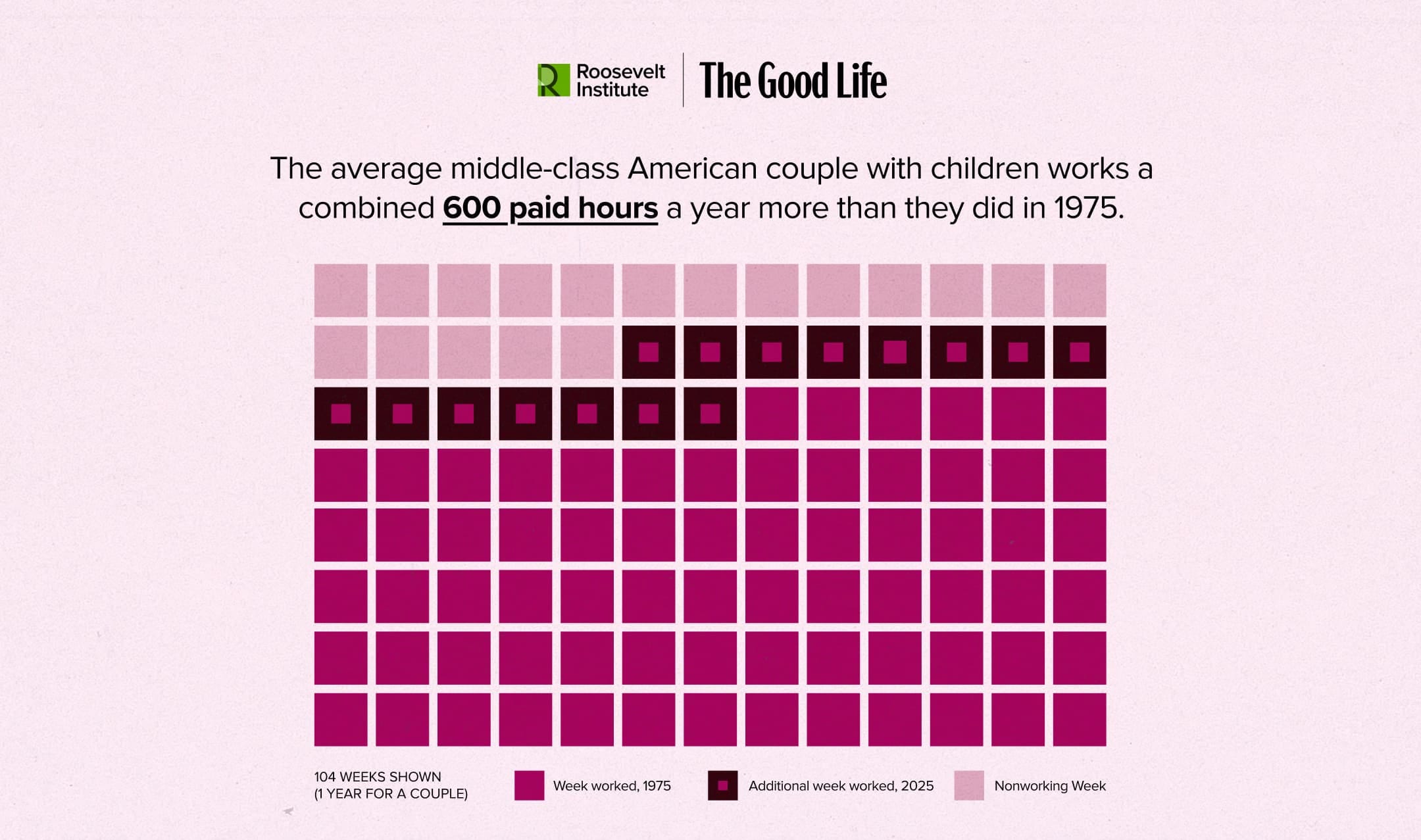
The Good Life agenda’s name derives not from any threshold of material wealth that qualifies as a good life, but for the far more human ideal of having enough time and resources to enjoy friends, family, and whatever financial or material gains they do achieve. If making rent and paying for groceries were the overarching goals, the anger that has seized this country wouldn’t be nearly as intense.
Here’s how the plan puts it: “Our agenda for affordable essentials establishes the foundation we need to have agency in our lives. We should be able to live near the people we love, not struggling to secure an apartment a hefty commute away, at rents that leave little left for saving. We should have more time to consider what makes our place feel most like home, rather than whether we can afford to heat it.”
A few years ago, I wrote an essay that essentially said that Americans hate being made the asshole, or being fooled and taken advantage of. Wilkins described it to me as “removing coercion” from people’s lives:
If you actually gave time back to people, how could you support the flourishing of other civic institutions which may or may not be the sites of power, but are the sites of people feeling connected and having a different kind of collective potential in their lives? If everything is politics and everything is interest politics, we need people power to be able to confront corporate power. But there is something just about what does it mean to love, to live a meaningful human life? And our economic policy should not forget that that’s ultimately the goal here: remove all that coercion and create all this enabling so that people can actually flourish and be happy, they have the tools to build that kind of life for themselves.
Things like the four-day work week and fair scheduling and stuff that puts rules around how you can exploit labor such that we actually take time back for workers and working people. And that we just say, “no, you cannot extract money from people and you also cannot extract their time.”
Then, our hope is that’s the kind of thing that then creates the space for us to come together again. If we’re just all little capitalist grains in the machine working however many hours, when are we ever going to be human and create those human connections?
Countervailing power
Coming together is both a means and an end. In addition to ending the atomization that has so poisoned politics, it provides an opportunity to rebuild public institutions and what the agenda refers to as countervailing power.
The coercion that Wilkins describes is a product of economic scarcity, which is itself the product of an imbalance of power between corporations and working and middle class Americans. In every overarching issue that the agenda seeks to address, the plan includes ways for the public to hold power to account and rebalance the scales. From unions and sectoral bargaining to tenants unions and beyond, the agenda argues for federal policies that foster mass membership organizations as a way to empower citizens.
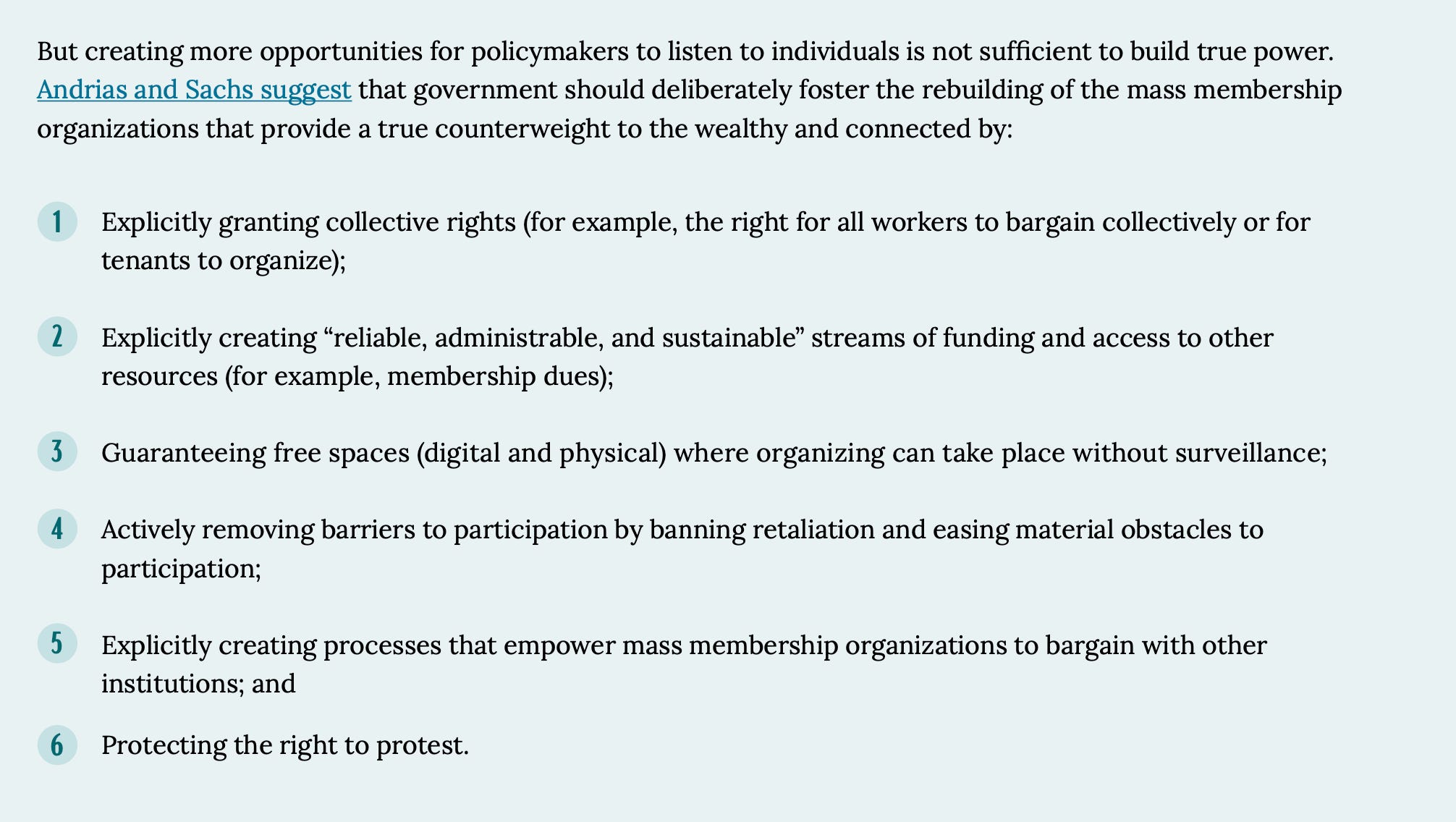
The mass surveillance and free spaces are especially important and represent a total shift from Trump administration policies, which have cracked down on organizing and created a chill on speech.
Wait, Before You Leave!
Progress Report has raised over $7 million dollars for progressive candidates and causes, breaks national stories about corrupt politicians, and delivers incisive analysis, and goes deep into the grassroots.
None of the money we’ve raised for candidates and causes goes to producing this newsletter or all of the related projects we put out. In fact, it costs me money to do this. So, I need your help.
For just $5 a month, you can buy a premium subscription that includes:
Premium member-only newsletters with original reporting
Financing new projects and paying new reporters
Access to upcoming chats and live notes
You can also make a one-time donation to Progress Report’s GoFundMe campaign!
This is the first I've heard of the Roosevelt Institute and the Good Life Agenda. Thank you for this synopsis. I intend to read the report in its entirety.
So much emphasis is given to macroeconomic programs, but we should not neglect microeconomic programs. Small scale projects inject funds where they can do the most good and in a timely fashion. They also strengthen political support. I thought it odd and somewhat ironic that one of the first casualties of the Tea Party revolt were earmarks. Yes, earmarks were prone to corruption, but they often served vital local needs. With proper supervision and a review process, they could play an important role in economic revitalization.
Always worth reading. Thank you.