

Welcome to a Wednesday edition of Progress Report.
A few things before we start:
The GOP’s new gerrymandered Texas maps are out.
Rep. Jerry Nadler, my Congressman, is getting a primary challenge from a 26-year-old, anti-Mamdani conservative Dem backed by anti-progressive billionaire Reid Hoffman. If Nadler drops out, should I run to prevent this kid from serving in Congress for the next 50 years?
Porn enthusiast Ted Cruz is a creepy old man.
OK, I’ve got a long piece for you today, so let’s get right to it.
Note: Paid subscriptions are dropping and it’s making it very hard to continue doing this work, because I have to do more freelancing as a result. If you appreciate the writing or learn something from it, please consider supporting Progress Report with a paid subscription. It’s just $5 a month.


The good news is that Donald Trump and the Republican Party are both pretty unpopular.
The even better news is that Democrats are even less popular, with polling numbers that have fallen farther south than ever before.
Yeah, I said better news, and I’ll explain why in a moment, after a brief overview of just how dismal things are right now.
According to a new Wall Street Journal poll, just 33% of voters view the Democratic Party favorably, while 63% have a positive impression of the party. That’s the worst performance in a WSJ poll since 1990. Republicans are underwater, too, but at 43-54%, hold a ten point lead. Donald Trump is the least unpopular with a 45-52% rating.
Republicans and Trump are also seen as more trustworthy on most major issues, despite taking a battering ram to the public interest. Trump has a negative score on the economy, yet 39% of voters said they trust Republicans to handle it, while just 27% said that they trust Democrats. And this is after the GOP passed the most unpopular economic legislation in generations.
Immigration is even more dire. Even as the public sours on ICE and the DOJ’s Gestapo-like enforcement tactics, the public still trusts the GOP by a wide margin, 45-28%.
You can check out the cross-tabs for more ugly numbers, which are fueled in large part by a massive realignment towards Republicans across almost every demographic:
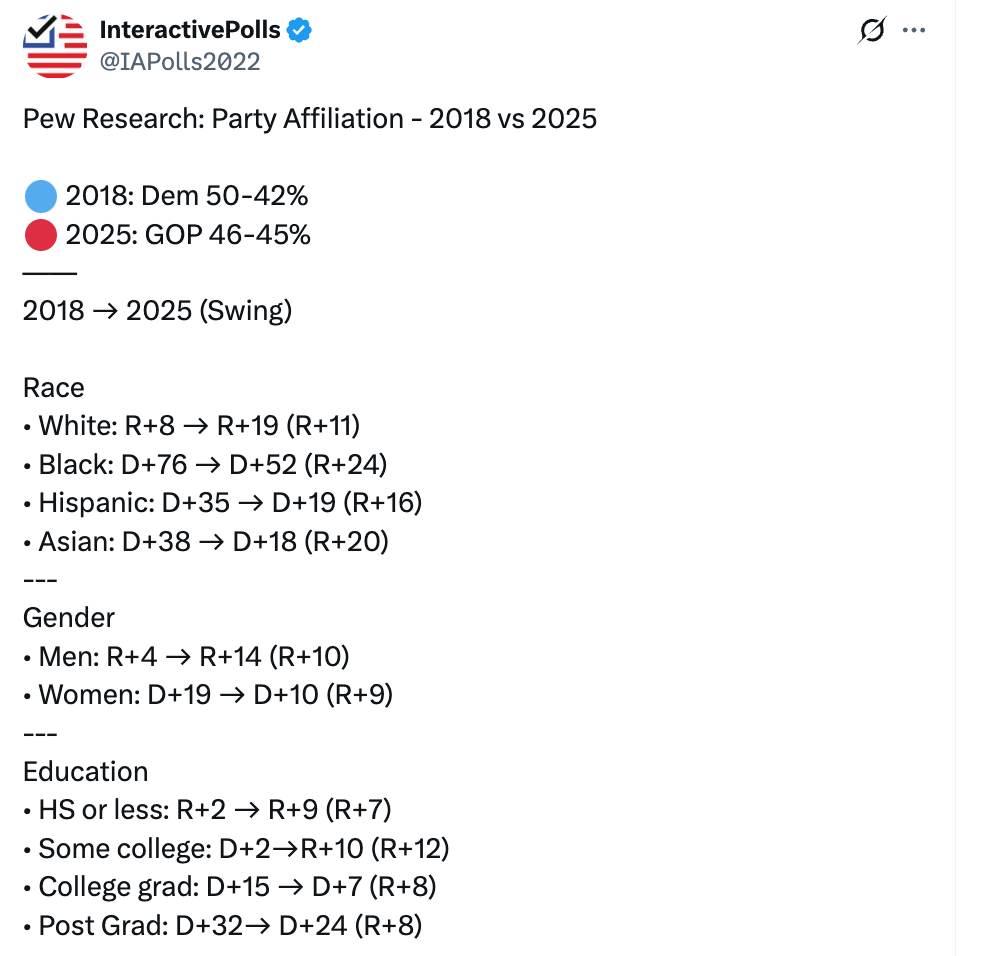
OK, I think the point has been well-communicated at this point: Democrats are in a major, major hole, and what was seen as a likely midterm wave is now more tenuous. At the moment, they have a three-point lead over Republicans on the generic ballot, but at this point in 2017, they held an eight-point lead. Add in pending GOP redistricting advantages, and the peril grows even deeper.
So why, then, did I say this is good news?
Because Democratic leaders have failed so thoroughly and obviously that they cannot plausibly blame anybody else. Likewise, they’ve sunk the party into such a deep hole that there is no quick fix that they can sell to base voters to keep them on board with the milquetoast status quo.
When something is rotten to the core, you have to burn it down to the ground before you can rebuild. Below, I’ve outlined some of the most important steps that will be required to reconstruct the Democratic Party from the ground up, and though there will be plenty of resistance to that approach from insiders and ultra-wealthy stakeholders, I believe that voters are primed to finally cast them aside. The stakes couldn’t be higher.
👹 Cast some more villains
If there was one positive takeaway from the Wall Street Journal poll, it was the overwhelming unpopularity of Elon Musk. Just 36% of voters had a positive impression of the world’s richest man, whereas 57% of respondents said they had an unfavorable view of the guy. The public was evenly split on Musk as recently as last October, when he was campaigning for Trump but hadn’t begun doing Nazi salutes and destroying the federal government.
Musk did a great job of making himself a target, but he wouldn’t have been cast out of government or so broadly loathed if Democrats and their coalition members hadn’t treated him like a piñata. Tens of thousands of people protested Tesla dealerships every weekend, Democrats attacked his outrageous wealth, and every cruel consequence of DOGE’s cuts were laid at his feet. Musk became a political liability for Donald Trump, who was forced to marginalize and push him out of government.
Republicans have long been successful at turning Democratic leaders and prominent liberals into bogeymen — or, usually, bogeywomen — and characters in the larger conspiracy that they have been spinning for their followers for the last 40 years. It’s much easier to focus ire on a person than an idea, and Democrats would be smart to start making prominent conservatives more radioactive. It fractures coalitions, creates easy-to-understand shorthands, and implies useful guilt by association.
🌊 Primary everybody
Okay, maybe not everybody, but there really is no downside to running as many competitive primary elections as possible.
There are dozens of Democrats in Congress with ossified political operations and soft support who win re-election by default, and most of them are in safe seats. They’re placeholders who turn their districts — which are frequently the biggest source of Democratic votes in swing states — into dead zones, depriving communities of visible leaders and depressing the turnout required to win statewide races. It doesn’t have to be this way. Just look at what happened in the New York City mayoral race.
Though Eric Adams’ exit from the Democratic Party technically made it an open primary, Andrew Cuomo campaigned as if he were the incumbent. He offered no real solutions — his platform was literally written in part by ChatGPT — and barely engaged with the public, leaving his related Super PAC to hire paid campaign workers for an otherwise nonexistent campaign apparatus.
In any other year, Cuomo probably would have cruised to a low turnout victory that did nothing to staunch the rightward drift of many minority communities in the city.
Instead, Assemblyman Zohran Mamdani challenged the status quo and shook the city out of its stupor. He ran an ideological and energetic campaign that activated 50,000 volunteers, inspired new voters, won back communities that voted for Trump, and proved the allure of populist policy. It reinvigorated politics in this city and opened the door to a new generation of leaders who are now organized and ready to seize power.
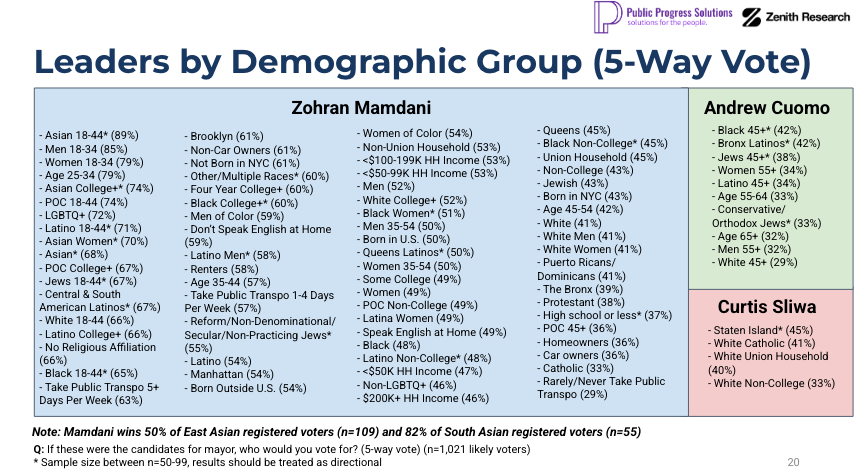
Mamdani’s movement overcame tens of millions of dollars in negative advertising and the collective power of some of the city’s biggest political bosses, creating the template for young progressives across the country. This is the time to empower them; Republicans have done a much better job of promoting young, charismatic new faces who can appeal to young voters, and the electorate is actively shifting as a result. Democrats won’t stop that with butchered TikTok memes.
It’s not just about age, either. Equally as important is replacing Democrats who are not in alignment with their districts and force the party into self-sabotage. Here in NYC, Levi’s heir Rep. Dan Goldman squeaked into office by winning a crowded primary with a tiny plurality of votes, thanks to millions of dollars of both self-funding and AIPAC-linked money. Over the past three years, he’s been deeply out of step with his lower Manhattan and northern Brooklyn district on a number of key issues, from Wall Street and crypto to Israel’s genocide.
Similarly, San Diego Rep. Scott Peters helped to sabotage the drug cost provisions in what eventually became the Inflation Reduction Act and never had to answer for it. He won his very blue district by nearly 30 points last year, so there’s no question that Democrats will hold on to the seat no matter who they nominate. Why continue to give him a free pass?
Even now, holding Peters accountable for actively working against working families on behalf of Big Pharma, and weakening legislation to the point that it was less effective and hurt Democrats at the ballot box, is worth pursuing, as it will deliver a message to both other incumbents and voters that reform is afoot and corporate collaboration is no longer tolerated.
👋 Jettison the losers
Not to put too fine a point on it, but the Democratic Party is sinking because the same losers are allowed to steer the ship into the rocks every two years. The same consultants run the campaigns, the same ancient politicians anoint the nominees and appear on TV, and the same unfulfilled promises are trotted out to voters who tuned them out years ago.
Why are these people entrusted with so much power? Why is James Carville, who hasn’t won an election in 30 years, still such a prominent voice? Why does Larry Summers, an elite pervert who celebrates capitulation to Trump, have any say over Democratic policy? Who the hell told Rahm Emanuel, a scandalously failed mayor and deeply corrupt Wall Street stooge, that he can come back from Japan and opine on things? Why are the advisers who kept Joe Biden isolated from reality still working as pollsters for top liberal Super PACs? These losers are taking home millions of dollars to fail time and time again.
In 2010, the Tea Party began the process of taking out the neoconservatives that had run the GOP during the Bush era, sending them packing to lobbying firms and the op-ed pages. Instead of speaking reverently or defending his legacy, they all but disavowed George W. Bush and sought to memory hole his presidency. It’s time that Democrats do the same thing.
⛅ Believe in things
It doesn’t seem rational for voters to trust Republicans on issues like the economy and immigration, but ask yourself this: do Democrats have any discernible positions on the economy or immigration?
Sure, they’re against rounding up immigrants and sending them to foreign prisons, but for the past year, they’ve mostly just followed the GOP line: cracking down on border security, voting for the Laken Reilly Act, and mostly staying quiet when people like Kilmar Abrego Garcia get abducted.
How about the economy? Did Kamala Harris have any kind of defining ideology, or did she mostly speak in broad strokes about middle class opportunity and allow billionaires like Mark Cuban to squash populist ideas on her behalf? Quick, what was her housing policy? Not the specifics, either; just give me the overarching principles. What did she propose on health care?
Don’t worry about looking it up; these are just rhetorical exercises. The point is that right now, the Democratic Party has no discernible point of view on the issues that matter most to people. Right-leaning legislators watered down or killed the more progressive parts of the Biden agenda, leaving mostly tax credits and modest reforms to pharmaceutical purchasing. Now instead of presenting an alternative vision, they’re spending more time bashing progressives for veering away from outdated orthodoxies.
Even the midterm election strategy revolves around opposing changes to the low income health insurance program that won’t kick in until 2027. It’s all status quo, zero economic populism, despite the obvious demand for it.
Democratic consultants and centrists are quick to credit social media for Zohran Mamdani’s success in the Democratic primary, but his videos, as impressive as they were, would not have broken through if he’d run a campaign based on vague promises and tepid half-measures. He had a sturdy narrative — elites are flourishing while working New Yorkers can barely pay the bills — and offered concrete solutions like freezing the rent and providing free buses.
The center-right of the party is trying to fill the ideological void with pro-business, technocratic manifestos like Abundance, but they’re hardly a fit in this era of inequality and rising populism. The left has a lot of big ideas, and if they can whittle them down to a few headline proposals and present them alongside a larger narrative about elite capture and social decline, there’s a chance to redefine the Democratic Party as more than a bunch of institutionalists who want to tinker around the edges.
👊 Go big or go home
So, which ideas should they settle on?
First, this is a long-term project, not a campaign plan to restore a temporary Democratic majority. So, for the political “realists” out there who don’t think it’s possible to convince Americans to shift in big ways, consider what Republicans have done over the past decade.
In 2016, when the North Carolina GOP passed a trans people using public bathrooms that align with their gender identity, there was so much national outrage that big corporations boycotted the state and caused enough damage that the law got repealed and Democrat Roy Cooper won the gubernatorial election.
Though it seemed a settled issue, conservative bigots were undeterred and tried several other approaches to marginalizing trans people, hammering away through the right wing media with false concern about school sports and parental freedom. Red states went back to bathroom bans and pushed it even farther, banning gender affirming care first for children and prisoners and now many adults, too. An issue that Democrats used to rally around is now a third rail, with national public opinion flipped almost entirely.
If that’s too niche, just recall that Donald Trump led an insurrection against the federal government, and instead of being hit with treason charges, he won back the presidency and then pardoned all of the lunatics who violently attacked the Capitol and tried to hang the vice president. Nobody even talks about it anymore!
At the same time, Americans are now much more supportive of immigration after five months of watching Donald Trump’s ICE goons brutalize their friends, neighbors, and co-workers. Public opinion is not stagnant, and instead of shoring up their rearguard and chasing polls, Democrats need to get aggressive and try to persuade people with ideas that will make a real difference in their lives.
If there’s one silver lining to Trump’s destruction, it’s that it gives progressives the room to push a national rebuild that is bigger and bolder than the technocratic systems that have produced so much inequality. The key is economic populism. Here’s some analysis from the polling firm Data for Progress, tying together the results of the 2024 election and the NYC primary to create a more holistic look:
Data for Progress’ 2024 post-election report detailed how inflation and the cost of living were the top issues for voters, who ended up taking out their anger on the Democrats in power and electing Donald Trump. More than 70% of likely voters nationally said inflation was getting worse for people like them, and more than 80% specifically said they had been paying more for groceries than in the previous year. As our 2024 report concluded, by clearly branding itself as the party of economic populism and actively fighting for working-class voters, the Democratic Party can regain support among those it lost in 2024.
Instead of promising to simply restore a deeply flawed health care system that Americans already hated, the GOP’s cuts to Medicaid, the ACA, and rural hospitals provide Democrats the space to call for bigger, fundamental changes that go well beyond repairing holes and filling gaps. We’re facing down the biggest retrenchment of the social safety net in American history, as something like 17 million people lose insurance and millions more will experience devastating price increases. Government involvement will look a whole lot more desirable, so now is the time to begin moving the Overton window toward the biggest expansion of the social safety net in American history: Medicare for All.
Young people are not afraid of something that will get labeled socialism, and people who lost Medicaid or ACA coverage won’t have any ideological qualms with going back to government coverage. As the job market continues to fragment and create a nation of gig workers, tying insurance to employment is increasingly absurd and untenable.
Housing scarcity is an even more dramatic problem at the moment, and it’s time to recognize that an approach that combined tax breaks and incentives for wealthy developers and vouchers for low-income renters has failed to make any iota of a difference. It’s time for a fundamental rethink on this issue, and after years of suburban resistance predicated on preserving home values, the average age of first-time homebuyers has skyrocketed to the point that people are ready to move to a new paradigm. Once again, this is a paramount concern for young people, and without them, there is no path back to power.
A lot of this will have to come at the state level, but ending the prohibition on government directly financing the construction of housing, enacting muscular social housing programs, and returning to mass production are three tangible policies that can scale up the housing supply far faster than relying on big developers who would rather keep housing stock low.
This is just a sampling; over the next months, I’ll be exploring new policy ideas with experts and putting together a compendium that can form the spine of a new progressive agenda.
🏗️ Build local and down ballot
There’s more than enough blame for the sorry state of the Democratic Party to go around, but one of the original sins was the total collapse of Howard Dean’s 50 State Strategy during the Obama era. Concentrating power and resources in an outside organization focused entirely on promoting the president’s agenda starved state and local parties of resources and attention, and Republicans took advantage, flipping state legislatures en masse and implementing gerrymanders up and down the ballot.
Project Redmap, as it was called, cemented GOP majorities that have turned swing states like Ohio into solid red ones. Republicans in those states have used their power to enact increasingly right-wing laws and choke out democracy, moving the Overton window, absorbing the shock, and setting the stage for Congress to pass similarly nihilistic and damaging legislation. The project has also been a major contributing factor to the redistricting mess in which Democrats currently find themselves.
There have been real efforts to reverse the dismal situation, and some progress has been made, but between the need to build up a bench of viable future candidates and counter the right’s further seizure of local offices, the work is just getting started. In many places, the local Democratic Party doesn’t even exist, and in others, it’s largely a husk run by the same people who have overseen its demise. Progressives who have been organizing locally to protest Trump’s policies over the past five months would be smart to start investigating which local offices and party positions they can seize — these are often uncontested races that wield outsized power.
Building local has two additional benefits: it creates an infrastructure that makes it possible to shift red territory to blue as well as giving progressives more sway over the direction of the party and its leaders. A party leader is only as strong as the support of the people who vote for them, which, for example, is why people like NY Dems chair Jay Jacobs continues to back center-right, pro-corporate candidates. These local battles can help shape a national election and ideological decisions for the entire party.
Wait, Before You Leave!
Progress Report has raised over $7 million dollars for progressive candidates and causes, breaks national stories about corrupt politicians, and delivers incisive analysis, and goes deep into the grassroots.
None of the money we’ve raised for candidates and causes goes to producing this newsletter or all of the related projects we put out. In fact, it costs me money to do this. So, I need your help.
For just $5 a month, you can buy a premium subscription that includes:
Premium member-only newsletters with original reporting
Financing new projects and paying new reporters
Access to upcoming chats and live notes
You can also make a one-time donation to Progress Report’s GoFundMe campaign — doing so will earn you a shout-out in the next weekend edition of the newsletter!
These numbers are SHOCKING, and something I wasn’t expecting. Here’s a question that hasn’t been addressed in your post: Is part of the problem that Americans don’t see the fall of democracy as a problem as long as they’re “taken care of” (i.e. they’re specifically favored by those in power)? I care about democracy a great deal, and my rights as a minority in this country as well. Those rights are under threat in multiple ways.
I do not know Nadler's district well as I live in California, but if Nadler drops out, there must a progressive alternative to Liam Elkind. You could be that alternative if you have deep community roots, can excite thousands of small donors, do zippy social media outreach, come across as likeable, and can handle tough questions comfortably. Who else in the district is a potential candidate who is a solid progressive and fits all the other criteria I noted above?
If Elkind gets unlimited funds from Reid Hoffman, it will take a very good candidate to beat him. Look what happened to Nina Turner in Ohio in 2022. She was prohibitive favorite but zillionaire money beat her. Just one example of oligarchy destroying progressive candidates.