

Welcome to a Saturday night edition of Progress Report.
My wife has been out of town since I sent the last edition of this newsletter, so it’s been just myself and our three year old son. It’s been a lot of fun, but I’ve had just about zero time to write a newsletter. I’m back tonight with Winners and Losers, and we’ll be live on Tuesday evening with an interview with another great swing seat candidate in a must-flip state. There’s a new ballot initiative feature on the way, too, so there’s lots of great coverage on tap.
Note: I’ll be honest, this newsletter’s paid subscribers have plummeted since I came back from open-heart surgery. It’s making it hard to do this work, because there are real expenses, including site coding, web hosting, electoral resources, media access, and more. This is a second full-time job, and if you can help make it sustainable, it will allow me to report and amplify stories you won’t find elsewhere.
You can help keep Progress Report afloat and build that network for just $5 a month — every subscription helps!
Thank you to our latest crowd-funding donors: David, Lisa, Theodore, Mary, Branch, Stephen, Larry, and Bruce!


Georgia Democrats (for the moment): Gov. Brian Kemp’s timing may just cost the GOP two seats on the Georgia Supreme Court.
Early voting in the state’s upcoming election was already underway when Kemp announced that he’d be summoning the legislature back to gerrymander maps for the next session, and from that moment forward, Democratic voters poured out to the polls en masse. More than one million voters cast early ballots, smashing the record set in 2022, with Democrats claiming a 15 point turnout advantage.
Usually, that’s merely a sign of voter enthusiasm, but because voters are also weighing in on two state Supreme Court elections, that huge advantage may be remarkably consequential. Republicans hold every seat on the Georgia high court, and if Democrats flip these two, they’ll have a chance to turn the Supreme Court blue in 2028. And if that happens, the GOP gerrymander may not last very long.
On the topic of Democrats running in this primary, I want to give special mention to state Rep. Nabilah Parkes, who is running for lieutenant governor.
Back in 2023, I was working on a story for More Perfect Union about the Medicaid unwinding, when state governments were kicking millions of low-income people off of state health programs. The story focused in part on a woman named Tiffany Givens, a pregnant woman who was erroneously kicked off Medicaid by the state of Georgia. You can watch that here:
Anyway, Tiffany couldn’t afford to see a doctor, so after our interview, I connected her with Nabilah in hopes that her office might be able to help with the Kafka-esque bureaucracy designed to keep people from re-enrolling. Tiffany wasn’t Nabilah’s constituent — she lived in the western part of the state, right on the border of Alabama, while Nabilah represented a district outside Atlanta — but this was really the only personal connection to anyone in Georgia’s government that I had at the time.
Long story short, Nabilah’s office was able to help Tiffany, who re-enrolled in Medicaid and gave birth to a healthy boy that spring. They kept in touch, too —Nabilah at one point helped her with groceries on Thanksgiving — and last week, I got a text from Nabilah explaining that Tiffany’s family had been evicted from their apartment by a slumlord who got sick of being asked to do things like fixing the sinkhole in their home and taking care of a fly infestation.
Tiffany has a GoFundMe to raise money for her family’s impending move and the security deposit needed to get a new apartment, and Nabilah asked that I put it in the newsletter, in case people would be willing to donate (I gave money myself, too). What was confusing was that I’ve also been getting texts from Nabilah’s campaign for lieutenant governor, so it took me a minute to realize that her message wasn’t a mass SMS. Instead, as the most important campaign of her life was hitting the stretch run, Nabilah was taking time to help a working class mom — who, remember, isn’t even a constituent — who was going through a personal emergency.
I’ll admit that I haven’t followed the Democratic primary for lieutenant governor in Georgia, but if you live in the Peach State and are looking for selfless leaders who actually give a shit about people, check out Nabilah Parkes’s campaign.
I’ll soon be adding legislative races in Georgia to my election tracker over at FlipStates.org, as there is an outside chance that Democrats could win back the statehouse for the first time since 2004.
Nebraska Democrats: Speaking of good primary turnout in states listed in the FlipStates.org tracker, things are looking up right now for Democrats in Omaha.
The primary, held on Tuesday, saw Democratic voters vastly outnumber Republicans at the polls in Douglas County, where the state’s most competitive legislative elections will be taking place. These are jungle primaries in a technically nonpartisan chamber, where the top two vote-getters advance to the general election regardless of personal party affiliation.
In District 4, the Democratic candidate, Cindy Maxwell-Ostdiek, outpolled the sitting Republican incumbent, 52-48. In two other districts, the two Democrats running combined to take a much larger percentage of the vote than the Republican on the ballot, strongly suggesting that in a one-on-one race, the Democrat could come out on top.
All told, Democrats won 10,000 more votes than the GOP-aligned candidates. They only need to flip one seat to break the GOP’s filibuster-proof supermajority, though they’ll want to win a few more because there have been defections on a number of major votes (including a roll back of the citizen-approved minimum wage increase).
Data center protests: Other than an abiding belief that Jeffrey Epstein was murdered to cover up for powerful perverts, there’s not much that unites Americans these days — just look at the vitriolic responses to this tweet of mine about the Supreme Court and redistricting. But a new consensus has quickly emerged: Americans of all political stripes do not want data centers built in their towns.
Check out the results of this new Gallup poll:
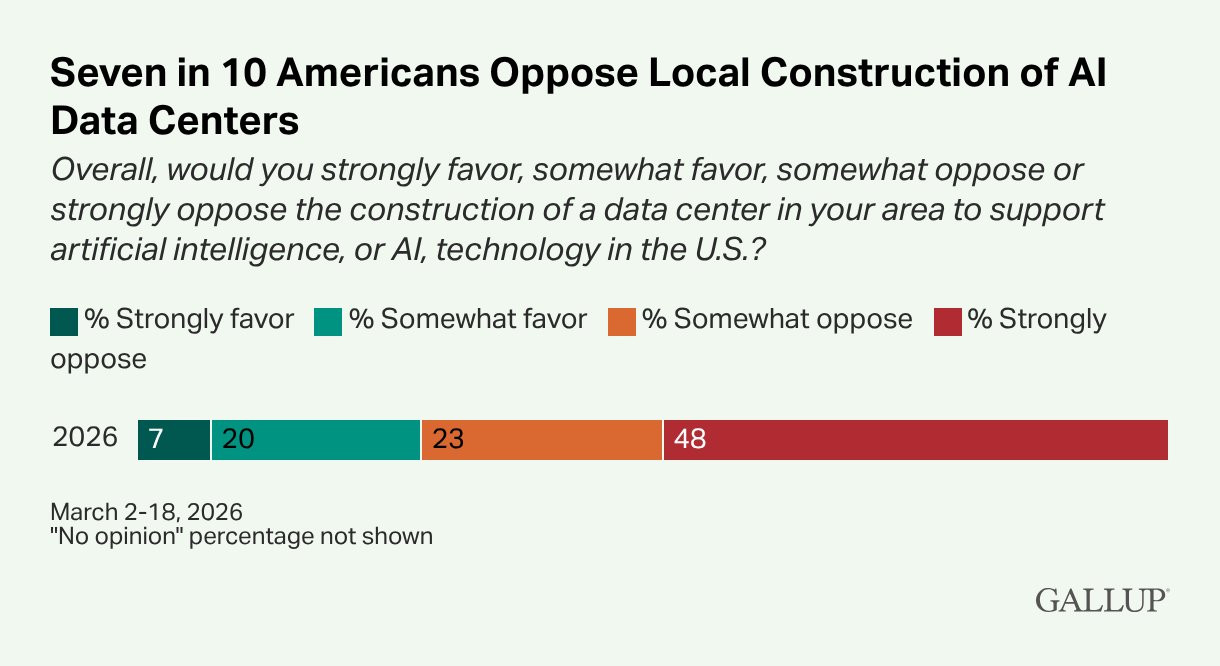
There are a variety of reasons why people say they oppose data centers, from their effect on the environment and drain on resources (water and electricity) to noise, traffic, and the sheer amount of money that state and municipal governments have been handing over to the developers that build these parasites. With many local governments eager to seize on temporary construction jobs and land sales, and national leaders terrified of the AI lobby’s largesse, the resistance to data centers has been almost entirely bottom-up, grassroots-led, and transcendent of political parties; rural Americans hate them just as much as anybody, if not more.
These activists began by targeting the construction of individual data centers and have since moved on to seeking broad moratoriums at the state and local level, a strategy that will be far more effective than simply playing public pressure whack-a-mole. And lawmakers are starting to wake up to the festering anger, as evidenced by the growing number of temporary data center construction bans winding through city halls and state capitols.

While Maine Gov. Janet Mills vetoed a data center moratorium passed by the legislature (there’s a reason she failed to catch on as a Senate candidate and lost to a populist oyster farmer), things are looking up elsewhere:
The city councils of both Seattle and Minneapolis are considering data center moratoriums, with the latter schedule to vote on the proposal on May 21;
Lawmakers and advocates in New York rallied in Albany this week in support of a three-year moratorium on new data center construction. It’s co-sponsored by Sen. Kristin Gonzalez, the chair of the Senate Internet and Technology Committee, who gave a solid overview of the larger politics in this fight:
“I don’t think every New Yorker necessarily is going to live in a community that is going to be sighted by a hyperscale data center,” she said. “This fight is bigger than just individual data centers. It’s literally a fight with big tech because they have been defining and setting the rules for how they operate and how they profit and we have been living with the consequences.”
In Ohio, grassroots activists are rushing to collect enough signatures to qualify a statewide ballot center moratorium on data center construction.

Abigail Spanberger (and workers in Virginia): A few weeks ago, when I was in DC, I got into a conversation with a few labor union political staffers and asked a question that had been vexing me for the past year: why didn’t unions or their allies speak up or push back with Abigail Spanberger, then the presumptive nominee for governor, said that she would not support the repeal of Virginia’s odious “right to work” law?
The timing was important: Spanberger hadn’t yet clinched the nomination when she disavowed the labor movement’s single-biggest priority. So how come there weren’t even any rumblings about the labor left backing a late primary candidate, if only to remind the former CIA agent not to take their support for granted?
The reply I got back was a pragmatic, if mildly depressing, assessment: Virginia is still a Southern state, unions only have so much political pull there, and there was an understanding that Spanberger would sign a bill that gave collective bargaining rights to more than half a million public sector workers.
Put aside the chicken or the egg nature of giving up on ending “right to work” because unions don’t have enough influence (how are they supposed to build power if they can’t easily add new members?) and you can see the logic of the compromise. As they put it, their advocacy had convinced Spanberger to get on board with authorizing workplace protections and contract negotiating rights to more than half a million workers, a half-loaf that would feed millions of Virginians.
It was a pretty good start — until it all fell apart.
Democrats in the legislature did their part, passing a bill that granted government employees collective bargaining rights, compelled binding arbitration to make sure they got a contract, created a labor board that would help oversee the process. It was the bill that Spanberger said she’d support, but by mid-April, she was suddenly demanding significant changes.
Most notably, she wanted to delay the implementation of the bill, remove arbitration, and and limit its initial reach; Spanberger proposed amendments that would allow state employees to bargain over wages and benefits, then 18 months later, grant the same basic rights to local government employees. Full implementation wouldn’t have happened until sometime in 2030, when a new governor could technically prevent it from taking effect.
Both the unions and the Democratic leaders who crafted the bill were shocked by the sudden shift in position. During a special session of the legislature dedicated to negotiating with Spanberger over her proposed changes to various bills,
“When the session was over, (Spanberger) came up with an entirely new bill,” Senate Majority Leader Scott Surrovell said. “It’s kind of hard to negotiate when the goal post gets put on a different field.”
So why did Spanberger do this? I’d like to know, but the statement she gave to the media was legitimately incomprehensible.
It’s pretty advance politicianese, nearly two minutes of circular gobbledygook that sounds supportive of the policy that she just killed. The best I can tell from reporting in Virginia is that she got pressure from local governments to veto the bill because they were worried that they’d have to pay employees a wage that might reflect their value.
Spanberger is steadfastly committed to presenting herself as a moderate, which in DC means scolding progressives and siding with bosses as the “responsible” thing to do. It’s a classic neoliberal, ‘90s-brained misconception that beating down workers and breaking your promises to your most loyal voters is politically savvy or would be admired as a tough-but-fair decision.
Consider what’s happened in Virginia: Spanberger won her election by nearly 15 points not because she was a particularly popular Congresswoman, but because voters in Northern Virginia — a place where a vast number of public sector workers live — were outraged at the Trump administration and the way it took a buzzsaw to the careers and livelihoods of government employees. Spanberger promised those people an alternative. Instead, they didn’t just get more of the same, they got lied to.
And here’s the thing: those 500,000 people who were going to get life-changing, income-boosting bargaining rights, they’ve now been denied those life-changing, income-boosting bargaining rights. I’m sure some were loyal Democrats, but there were police officers, firefighters, sanitation workers, and other blue collar professionals who will remember this November that Democrats break fundamental promises and are no better than Republicans when it comes to issues that impact them.
The labor movement has been unanimous in its outrage, a chorus of furious statements promising the sort of political consequences that Democrats have been trying to avoid from working people for years.
Here’s part of the statement from Lee Saunders, the president of AFSCME, the leading government employee union:
“For too long, anti-worker extremists have sidelined working people while starving the public services Virginia families rely on, earning the state a reputation as one of the most anti-worker in the country. Governor Spanberger campaigned on the promise to end this historic injustice.
“But she has broken that promise by vetoing legislation that would have finally granted most state and local workers the freedom to collectively bargain… Governor Spanberger made a choice today, and working people will remember it. AFSCME members will continue fighting to ensure every public service worker in Virginia has a real voice on the job. This fight is far from over.”
It wasn’t a banner week for Democratic governors, who do not seem to understand that politicians are no longer rewarded for partisan heterodoxies and punching down on working people. Watch how Republicans in the South are rushing to gerrymander while Democrats in blue states like Maryland and Illinois have been so reluctant to add safe blue seats.
One misconception about Donald Trump is that he does not win because he treats people like losers, but because he makes many people feel like winners. That fosters loyalty and enthusiasm. Spanberger just dealt a devastating blow to one of Democrats’ most important constituencies and blew a chance to consolidate a huge swath of voters. It’s political and moral malpractice.
Wait, Before You Leave!
Progress Report has raised over $7 million dollars for progressive candidates and causes, breaks national stories about corrupt politicians, and delivers incisive analysis, and goes deep into the grassroots.
None of the money we’ve raised for candidates and causes goes to producing this newsletter or all of the related projects we put out. In fact, it costs me money to do this. So, I need your help.
For just $5 a month, you can buy a premium subscription that includes:
Premium member-only newsletters with original reporting
Financing new projects and paying new reporters
Access to upcoming chats and live notes
You can also make a one-time donation to Progress Report’s GoFundMe campaign!
Thank you for this great column. I was not for her in the primary but knew she would win in the primary and general elections. A relative who donated to her is going to be deeply disappointed. Sadly she and other Virginia Democrats chose not to fight back against the one vote state Supreme Court shooting down the people of Virginia's vote. Please boycott Virginia's Dems by not donating to them because of this issue and their cowardliness in not lowering the age to retire for Judges to 70 or 65. There are plenty of other Dems across the country who will fight for democracy.The Georgia Dem running for Lt.Governor you told about helping that woman- I will send a donation.
What's so damning about spanberger's betrayal is that it shows she has no principles.
This is why you shouldn't elect spooks.