
Welcome to a Thursday night edition of Progress Report.
First, thank you to everyone who filled out the quick feedback form about this newsletter, what you want to read most, and what could be better. The responses are informative (and in many cases, very kind) and will help guide my coverage.
I was in Nevada on a work trip all week, so today’s newsletter will hit a lot of different notes. We’ll run down a cross-section of important stories from around the country, look at a big new report I released this week, and reflect on what I learned in conversations with politicos, labor leaders, and rank and file workers this week. I’ll be back to a regular cadence going forward.
Note: The far-right’s fascist takeover of this country is being aided by the media’s total capitulation to Trump’s extortion. It’s never been more critical to have a bold independent media willing to speak up against the powerful. That’s what I’m trying to do here at Progress Report.
For a limited time, you can help keep Progress Report afloat for just $3.50 a month — every subscription really, really matters!


Whoa: Democrats in Virginia say that they plan on redrawing the state’s Congressional map to counter growing Republican state gerrymandering. The party controls both chambers of the legislature, which will kick off a special session aimed at drawing a map that adds two to three new Democratic seats. Because it would be a constitutional amendment, the plan will require several steps: passing in the legislature, a Democratic legislative victory in November, passage again in January, and then approval from voters in a statewide referendum.
Democrats’ decision comes as a pleasant surprise, and my suspicion is that lawmakers there see it as a way to goose turnout in this fall’s elections. National leaders are still trying to get Illinois and Maryland to redraw their maps, but state lawmakers have been hesitant.
Upping the ante: Voters in California could have the opportunity to institute the nation’s first billionaire tax next year.
A coalition of labor unions and progressive advocates announced today that they were requesting permission from the state attorney general to begin collecting petition signatures on a measure that would institute a one-time 5% surcharge on the net worth of California’s richest residents; proceeds would go toward filling a huge impending gap in Medicaid funding caused by the GOP’s tax cut bill. Supporters suggest it could raise up to $100 billion.
The plan is to get the initiative on the ballot in November 2026, when Californians seem likely to vote in new Congressional districts, judging by the polls and early vote on Prop 50.
That guy: Leonard Leo, conservative judicial Svengali and dark money firehose, is funding the campaign pushing a new voter ID ballot initiative in Maine.
In better news: There are several advancing ballot initiatives in Michigan that would severely curtail the use of dark money in elections. One seeks to ban regulated public utility companies with government contracts from making political donations. Another seeks to force all political committees that spend at least $10,000 to influence a campaign to disclose their original donors to the secretary of state. It would create a distinction between people and companies, undoing the damage of the Citizens United decision at the Supreme Court.
Alaska: Democratic former Rep. Mary Peltola currently leads GOP Sen. Dan Sullivan by two points in a new poll by a firm called Alaska Survey Research. Peltola hasn’t announced her political future, but it’s widely expected that she’ll run for either governor or Senate.

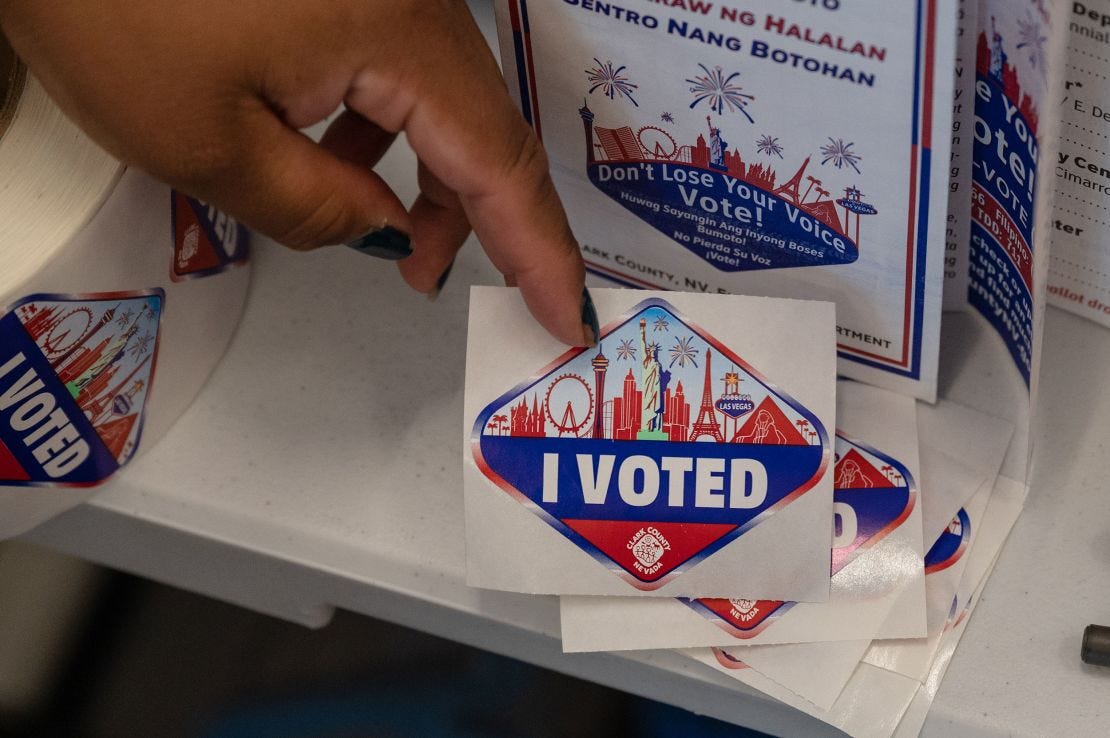
What Happens in Vegas Elections (Happens Nationwide)
Opportunities and challenges abound for the left in working class communities right now, as the “Trump slump” chills the economy and communities are terrorized by ICE thugs. The conversations with politicians, operatives, labor leaders and workers were all casual and off-the-record, so I’m not attributing anything, but Nevada’s place as a working class swing state and the fact that they all made similar points mean they’re worth considering. They also comport with recent polls and news stories, so here are my thoughts.
Defending democracy has to be paired with economic populism. Trump is staging federal invasions of peaceful cities and his henchmen down ballot are working overtime to cook elections, constitutional emergencies that deserve urgent attention and pushback. But, as one prominent leader told us, “If people can’t pay rent or figure out their childcare, they don’t give two shits about democracy — even though the attacks are an existential threat.”
If voters in places like Nevada are economically disaffected and Democrats don’t offer something better, we’ll wind up with elections like 2024, with working class Americans voting for the right-wing populists who make big promises and then pivot to dictatorship.
The answer isn’t choosing one or the other, but instead linking economic inequality to the corruption of billionaires and big corporations who crush working families and fund the dictatorial politics of Trump and his cohort. For example, the same companies and nasty tech billionaires making life unlivable for regular folks are bankrolling Trump’s destruction of the White House and determining which cities he invades. It all ties back to corruption, and there’s nothing that voters hate more than corruption.
Working class voters skew populist on economics and pretty moderate on social issues. This comports with both recent surveys that we’ve covered and everything I’ve personally learned and experienced. To me, the lesson isn’t to go throw queer people and other minorities under the bus, but to campaign and govern in a way that approval of your populism far outweighs any apprehension about changing social mores.
Regional issues are important for individual candidates to emphasize, but more broadly, it’s the cost of living that resonate mosts right now, especially groceries, housing, and car insurance. And according to a new poll that came out today, taking big swings on these issues, like cracking down on corporations behind price-gouging would be wildly popular.
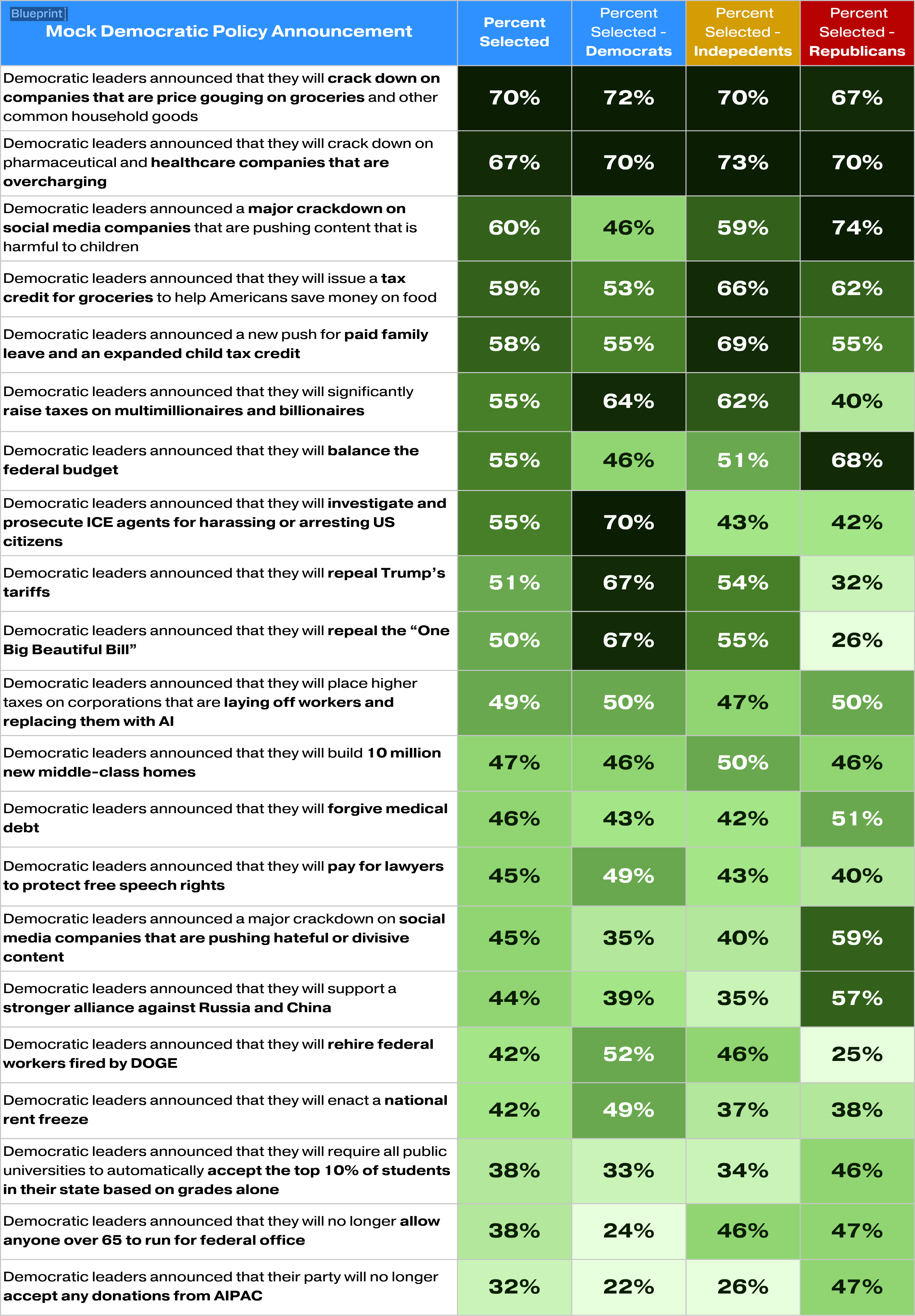
Democrats have to be convinced to go big. The above indicates that people want big policies. The following anecdote suggests that Democrats need some convincing to pursue them.
Service workers eyes’ were opened when Trump proposed to end the taxation on tips. Democrats mostly argued that it wouldn’t make a huge difference to many tipped workers, who didn’t make enough money to face income taxes on their tips anyway, but that fell on deaf ears. Kamala Harris gave a soft endorsement of making tips tax-free and also agreed to propose ending the sub-minimum wage, which would be far more helpful to servers and other tipped workers. But instead of making it a key part of her campaign, it was buried on her policy website, with little public exposure.
There is a growing, state-focused movement to repeal the sub-minimum wage, which on the national level allows restaurants to pay workers as little as $2.13 per hour. Democrats should ignore the National Restaurant Association and make this a priority in their next campaign, while also promising to make permanent Trump’s tax cut on tips, which is only scheduled to last for two years before expiring.
The Trump Slump is here and workers know it. Things are especially bad in Las Vegas and Reno, which are having their worst (non-pandemic) year in recent memory due to a nearly 15% collapse in tourist visits.
Unlike the pandemic slowdown, this is inarguably a byproduct of Trump’s maniacal choices; Canadians are boycotting the US over Trump’s mindless chatter about annexing the country, people from around the globe are terrified of being caught up in ICE raids even if they have valid visas, and income inequality has only been made worse by his tax cuts. Other cities have it worse, but they don’t rely nearly as much on tourism as Las Vegas, where visitors are the entire business.
Workers in Las Vegas who’d supported Trump are suffering real buyer’s remorse. A new poll shows that Trump’s approval rating is now underwater statewide in Nevada, which trends more conservative than Las Vegas itself. For Democrats, the key is giving them a viable alternative.

Nothing gets enough attention when absolutely everything is on fire, but the Trump administration and its corporate allies’ war on workers’ rights is one of the most under-covered and potentially politically potent ongoing sagas running right now.
Heat rises: The NLRB sued California on Friday over a new law that will allow a state agency to enforce labor law in the event that the NLRB fails to do so.
Assembly Bill 288 empowers California’s Public Employment Relations Board to step in to hear complaints against private employers if the NLRB continues to lack a quorum or just refuses to respond to election filings or unfair labor practice charges after six months. Hundreds of cases have piled up as the NLRB has gone without a majority since President Trump illegally fired Democratic appointee Gwynne Wilcox, whose lawsuit is still pending.
The Supreme Court broke precedent by temporarily allowing her firing to remain in effect until it decides on the merits of the case. Missouri Rep. Josh Hawley pointedly questioned one of Trump’s nominees to join the NLRB, putting his confirmation in danger. It’s a net positive to avoid having the chief counsel for Boeing as the final vote in a conservative NLRB quorum, and so long as the commission remains without enough members, it’ll be harder to argue against restricting states from filling in the gaps.
California is the second state to be sued by the NLRB over its efforts to supplement and strengthen its labor enforcement capacity, after the agency sued New York for passing a similar law. Illinois, which passed a constitutional amendment protecting the right to organize last year, should do it next.
While not a new law, New Jersey is also making moves to back workers against corporate conglomerates and abusive employers, with two lawsuits against Amazon. Both lawsuits tackle what have long been rampant problems for workers at the online behemoth’s plantation-like warehouses.
On Monday, the state sued the company’s Flex program for misclassifying drivers as independent contractors instead of full-time employees, and on Wednesday, it sued Amazon for discriminating against pregnant.
The Flex program contracts with third party delivery companies, who hire workers to work as delivery people for Amazon. That technically makes them subcontractors, but workers and unions have long argued that because Amazon determines their schedule and every other condition of their employment, they should be reclassified as direct Amazon employees.
The distinction would make them eligible for health insurance and other benefits while making the company liable for the conditions that they inflict on these workers. The Department of Labor under Biden tried to remedy the situation by affirming a new Joint Employer rule, but that was blocked by a federal judge. New Jersey’s DOL has proposed something similar.
The second case is a criminal complaint that alleges that Amazon has placed pregnant warehouse workers on unpaid leave, retaliated against those who try to take paid leave, and even fired people upon discovering that they’re pregnant. There’s no doubt in my mind that the attorney general has concrete evidence of the abuses against pregnant workers because I’ve been hearing about them first-hand for years. In some cases, women have wound up experiencing miscarriages after trying to hide their pregnancies or not being given lighter duty. I’ve tried to report on it, but there’s always been a reticence to go public. I’m glad it’s happening now.
Taking action: My latest piece at More Perfect Union looks at the decline of Starbucks through the eyes of both consumers and workers. Ultimately, many of its problems come down to greediness and understaffing. Starbucks Workers United, which represents over 13,000 workers at 550+ stores, will soon vote on a strike over the company’s refusal to continue collective bargaining.
Take a look at my piece below and let me know what you think.
Wait, Before You Leave!
Progress Report has raised over $7 million dollars for progressive candidates and causes, breaks national stories about corrupt politicians, and delivers incisive analysis, and goes deep into the grassroots.
None of the money we’ve raised for candidates and causes goes to producing this newsletter or all of the related projects we put out. In fact, it costs me money to do this. So, I need your help.
For just $5 a month, you can buy a premium subscription that includes:
Premium member-only newsletters with original reporting
Financing new projects and paying new reporters
Access to upcoming chats and live notes
You can also make a one-time donation to Progress Report’s GoFundMe campaign!