

Welcome to a Saturday edition of Progress Report.
Well, that was a terrible week. Granted, most weeks these past few years have been terrible, but even by that abysmal standard, this week was especially devastating. It was a whole verse of “We Didn’t Start The Fire” bad.
It feels a little strange to report positive voting rights news this week, but there were a few rays of light worth mentioning, as well as a potential political earthquake with ramifications all the way down the ballot.
Note: I’ll be honest, this newsletter’s paid subscribers have plummeted since I came back from open-heart surgery. It’s making it hard to do this work, because there are real expenses, including site coding, web hosting, electoral resources, media access, and more. This is a second full-time job, and if you can help make it sustainable, it will allow me to report and amplify stories you won’t find elsewhere.
You can help keep Progress Report afloat and build that network for just $5 a month — every subscription helps!


Maryland: Gov. Wes Moore signed the Maryland Voting Rights Act, which will apply to local and county governments. The law, which went into effect on Tuesday, prohibits election policies that “impairs the ability of a protected class to elect candidates of the members’ choice.” The protected classes proscribed in the law include race, color, and minority language speakers.
It’s unclear how the Callais v. Louisiana decision will impact the law, considering that the Supreme Court just made it almost impossible to draw district lines based on race. Still, any legal protection is a good thing, especially given the time that litigation can take its way to work through the courts.
Arizona: Put another L on the scoreboard for the Justice Department, as a federal judge tossed a DOJ lawsuit seeking sensitive voter data from the state of Arizona. This is the sixth state to successfully challenge the DOJ’s unprecedented and unconstitutional efforts to collect voter data.
Notably, the suit was tossed by U.S. District Judge Susan Brnovich, a Trump appointee and longtime member of the Federalist Society. Brnovich is also the widow of the late Arizona Secretary of State Mark Brnovich, who oversaw the quixotic and pointless “forensic recount” after the 2020 election. Mark Brnovich died in January.
I spoke with Arizona’s current Secretary of State Adrian Fontes about the lawsuit in October, when he noted that not only was the request illegal, it was also illogical and stupid.
“They’re saying that they’re using it to, quote-unquote, find a bunch of illegal voters,” Fontes said. “Now, this is a logical conundrum, because if the assertion has been for years that there’s been millions of illegal voters, where’s the evidence that they already have? And why are they just starting to build that case now?”
More recently, I spoke with Nevada Secretary of State Cisco Aguilar, who is also facing a lawsuit from the DOJ and described the whole process as a farce.
“Originally when we received the letter requesting the data and the information on Nevada’s registered voters, we responded asking why they wanted the information and how that information was gonna be protected,” he said. “But also, who is gonna be responsible for that information? And unfortunately they never responded to that letter. They responded with a lawsuit.”
The rest of the conversation with Aguilar will be featured in an upcoming MPU story on the Trump administration’s effort to seize control over the midterm elections.
Missouri: Secretary of State Denny Hoskins was able to run down the clock and implement the GOP’s gerrymandered map for this fall’s election, but his scheme to trick voters into keeping the map beyond this year has failed spectacularly.
Here’s the background: after the GOP redrew the Congressional map to eliminate a safe Democratic seat last fall, activists hustled to qualify a ballot initiative that would overturn the new gerrymander. That initiative will likely be on the ballot in November, and Hoskins, who loves to cheat and lie, tried to rewrite the ballot language to confuse voters.
Fortunately, a Missouri appeals court agreed with the activists at People Not Politicians and rewrote the language to make it clear that voters were being asked to repeal a gerrymander and reinstate the old, more reasonably drawn map.

Democrats are beginning to wake up.
I’ve covered the demise of the Voting Rights Act and the corruption of the conservatives on the Supreme Court for years now; longtime readers will remember my maniacal focus on Dick Durbin’s chosen fecklessness in a moment begging for bold accountability. The far-right built toward gutting the VRA for nearly 50 years, but it’s no exaggeration to say that old Democrats essentially invited the disaster of Callais v. Louisiana.
Now it’s up to a newer generation in DC and Democratic leaders in state capitols to change the party’s direction — and there are indications that it may be happening.
Whether it’s out of principle or a reaction to an existential threat, the consensus seems like it is suddenly shifting from foolish institutionalism and preemptive surrender to a long overdue willingness to fight back.
Here’s the setup: Just as soon as the Callais decision was announced and explicitly racist gerrymandering was blessed by the Court, Republicans across the South began talking about re-drawing their states’ districts — which in some cases were already gerrymandered — to create even more Republican seats. Florida pulled the trigger the same day, while Louisiana, Tennessee, and Alabama are moving toward white hood maps. Plus, Texas Republicans are already discussing rigging their maps even further next year, and depending on who wins Georgia’s gubernatorial contest, the Peach State may join in as well.
Instead of simply crying foul and promising doomed litigation and legislation, Democrats in blue states and swing states alike are openly talking up their interest in — and some cases commitment to — redrawing to produce more blue seats in 2028.
New York Gov. Kathy Hochul said Thursday that she’s intent on exploring redistricting that draws out GOP seats upstate; a once-reluctant legislator from Illinois indicated that he’s now convinced that the state should try to produce another blue seat; Colorado Democrats were already exploring ways to create up to three Democratic pickups in an increasingly liberal state, including a potential ballot initiative in November.
New Jersey Democrats are mulling over a way to squeeze out another seat, and even Democrats in California are now chatting about further ratcheting up their new gerrymander. Maryland Democrats tried but failed because their state senate majority leader refused to budge, but he’s now facing a primary challenge and may be forced to think differently in this new environment.
There will be structural challenges: existing independent or bipartisan commissions, required constitutional amendments, and parochial concerns, among other things. Plus, it’s one thing to talk about taking dramatic action and another thing to actually follow through.
What’s certain, however, is that Democrats will have to maximize their wins at the state legislative level: if they can flip a chamber in Pennsylvania, Michigan, and Wisconsin (and keep the governorship in the latter two), they’ll have the trifectas necessary to move forward with whichever process is required by their respective state constitutions.
In the best/worse case scenario, the collective Congressional map might look like this.
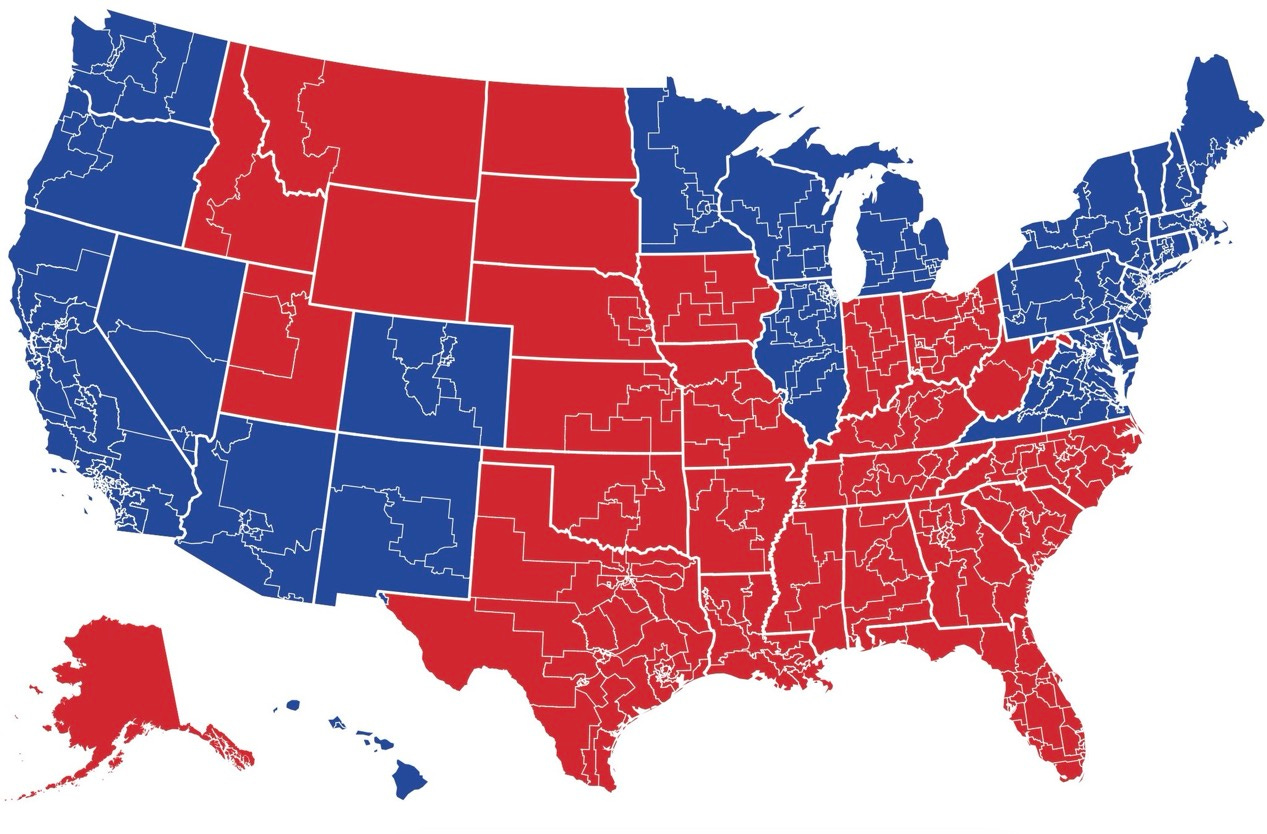
A nation of unflippable gerrymanders would produce a Congress of extremists, and frankly, a map like the one above does not feel sustainable.
And yet, this is the reality we face, I’m doubling down on my coverage of state legislative races. I’m tracking flippable seats in swing states where Democrats could either win a trifecta or break a GOP supermajority. I’ll soon be adding flippable seats in states where Democrats could win a supermajority, making redistricting all the more likely. And I’m about to kick off an interview series with many of these candidates, to give them exposure and media clips as well as help them raise money.
If you want to get a head start, here’s an ActBlue page with 45 swing state candidates; your money goes a very long way in these races. This is probably the last chance we have of saving this country’s democracy for at least the next few decades, because otherwise, this is what’s going to happen (via Democratic super-lawyer Marc Elias):
Unconstrained by any requirement to ensure minority voting rights, high-powered computers will generate maps optimized for partisan outcomes. With mid-cycle redistricting the new normal, lines will be adjusted every two years to ensure that population shifts do not undo the gerrymander.
Republican-controlled states will split cities into multiple pieces to prevent them from wielding any electoral power. Minority communities will be dispersed and disempowered simply on the grounds that they are more likely to vote for Democrats. Millions of voters will be silenced by GOP operatives wielding a computer and an algorithm.
To be clear, I hate the idea of gerrymandering and really championed the independent redistricting ballot initiatives in states that Republicans had rigged in 2011. Ideally, a new administration can ban biased redistricting, but until then, as perverse as it sounds, defending democracy might require inverting it.

Wait, Before You Leave!
Progress Report has raised over $7 million dollars for progressive candidates and causes, breaks national stories about corrupt politicians, and delivers incisive analysis, and goes deep into the grassroots.
None of the money we’ve raised for candidates and causes goes to producing this newsletter or all of the related projects we put out. In fact, it costs me money to do this. So, I need your help.
For just $5 a month, you can buy a premium subscription that includes:
Premium member-only newsletters with original reporting
Financing new projects and paying new reporters
Access to upcoming chats and live notes
You can also make a one-time donation to Progress Report’s GoFundMe campaign!
Democrats absolutely must engage in redistricting to produce more favorable electoral outcomes. To not do so is to surrender the country to a decades-long future of MAGA, white supremacists and oligarchs, and the decay, oppression and socio-economic failure those groups champion.