

Welcome to a Wednesday evening edition of Progress Report.
All eyes were on Donald Trump as he plopped down at the Supreme Court to watch his executive order revoking birthright citizenship get mostly demolished by even the justices he appointed. The court may soon have to consider yet another outrageous and blatantly unconstitutional executive order from the president — and tonight, that’s what we’re discussing, in the wake of a DNC lawsuit seeking to block it filed this evening.
Note: The far-right’s fascist takeover of this country is being aided by the media’s total capitulation to Trump’s extortion. It’s never been more critical to have a bold independent media willing to speak up against the powerful. That’s what I’m trying to do here at Progress Report.
You can help keep Progress Report afloat and build that network for just $5 a month — every subscription helps!


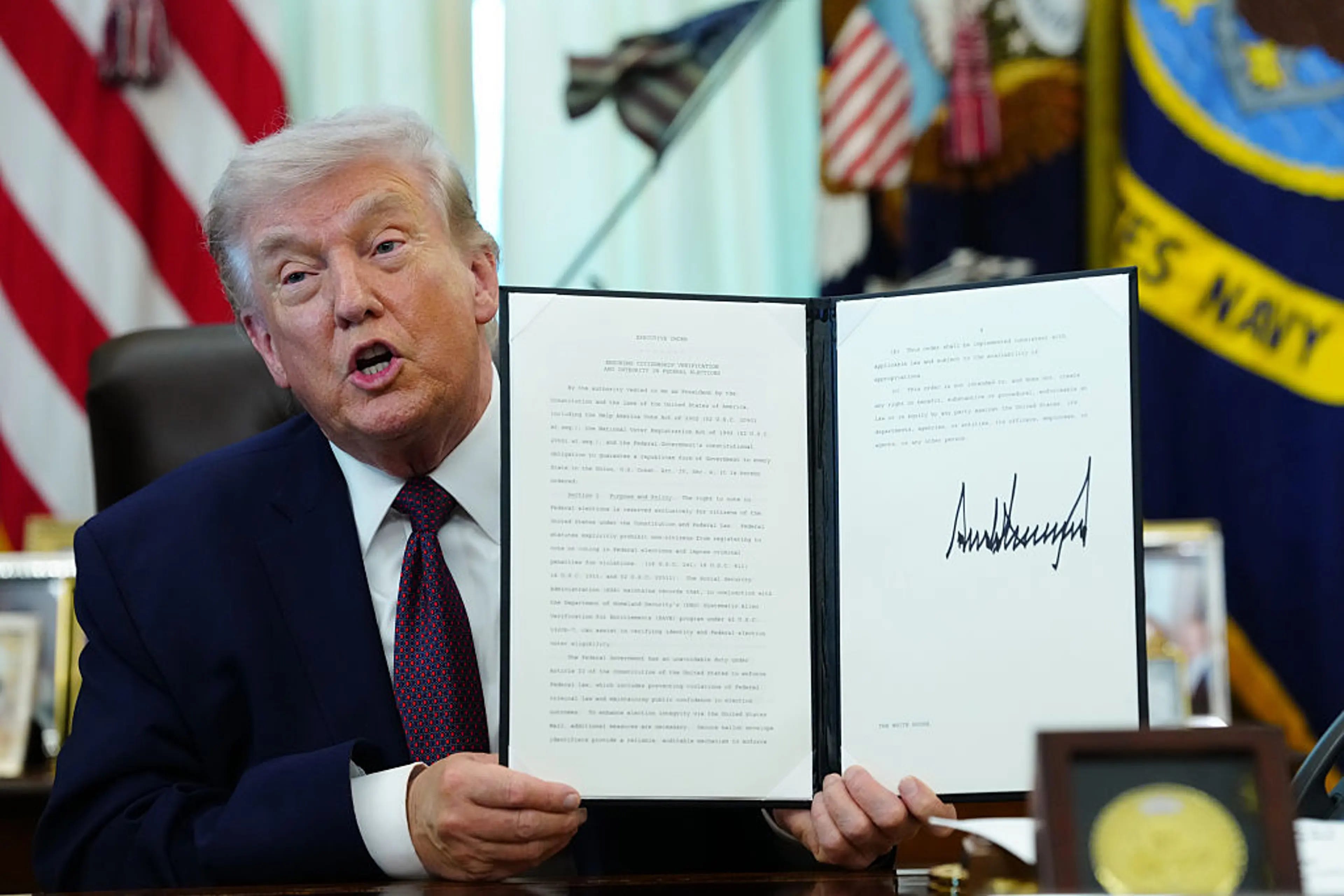
Foiled in his attempt to cajole the Senate into passing the SAVE America Act, President Trump on Tuesday afternoon announced a new executive order ostensibly intended to ensure that only US citizens vote in elections.
Much like Trump’s previous election-related executive orders, this one’s real purpose is to effectuate a federal takeover of election administration and make it much harder for certain communities to cast ballots. And much like those previous orders, this one is blatantly unconstitutional, on several levels.
But there is one key difference: this new executive order is utterly baffling and mildly incomprehensible, even to the experts. It takes aim at voting by mail, but the details are frequently muddled.
When I spoke with Jon Sherman, the litigation director at the nonprofit Fair Elections Center, he was actively trying to parse out what the order commands and working to make sense of the instructions in the text. Set aside the whole blatantly unconstitutional thing and there are two main functional problems: the order depends on faulty systems — “the entire executive order is based on a fantasy,” as Sherman put it — and leaves out crucial procedures for its execution.
Sherman suggested that voting rights groups will be quick to file for injunctions — the White House still has no constitutional role in the execution of elections, which led to the last order being blocked — but it should not be discounted as an important indication of what the administration is hoping to accomplish, or what states might try to do on their own. And given the rightward lean of the federal judiciary, there’s always the possibility that Trump’s latest gambit could stick around longer than expected.
And so, I asked Sherman to break down the executive order, how it would work, why it wouldn’t work, who it would hurt, and where it simply doesn’t make any sense.
What Does the Executive Order Say?
There are two main parts to the order, Sections 2 and 3.
“Section 2 directs the Secretary of Homeland Security, along with the commissioner of Social Security Agency, to essentially compile state-specific citizenship lists ‘using the SAVE system, SSA records, federal citizenship and naturalization records, and other federal databases,’” Sherman explained.
The administration has been working tirelessly to acquire state voter rolls — it’s sued more than two dozen states for the information, which White House officials want to vet for non-citizens. It’s had mixed success at best, so instead of demanding information from states, the executive order instructs DHS to create a federal list of eligible voters to send to states, with the expectation that state and local officials remove people as instructed.
Section 3, the other part of the order, instructs the US Postal Service to only send absentee or mail ballots to verified citizens, checked against a list that has yet to be created and does not have a defined source. That makes three lists of voters, cobbled together from incomplete (and mystery) sources, as a ramshackle confirmation process designed not to confirm.
“It’s a little obscure and unclear how these various lists interact,” Sherman said. “But they’re trying to essentially make access to mail-in voting contingent upon verification of US citizenship.”
Is The First Part Even Doable?
Here’s the problem: putting together an authoritative, updated list of citizens that does not disenfranchise large swaths of people is essentially impossible, given how our federalist system functions. The order seeks to combine several databases, but as Sherman explained, each of them is deeply flawed as a source for voter eligibility.
The Systematic Alien Verification for Entitlements (SAVE) system is used to verify the immigration status or citizenship of people applying for public benefits or drivers’ licenses. The data “can be quite outdated and unreliable,” Sherman said, and in 2023, the Fair Elections Center subpoenaed records that showed “massive data integrity issues” in the SAVE database.
“There were issues with maiden names; compound last names, which are common among Hispanic and other voters; transposed names, which happens often with Asian-American citizens,” Sherman said. “All of these data integrity issues mean that often people can’t be found in the system and can’t be verified as having naturalized subsequent to whatever they showed — their green card, for instance, or other proof of legal presence — at the DMV.”
Last year, Trump ordered the agency that oversees the SAVE system to include information from the Social Security Administration, but that’s far from complete, too.
“While SSA records provide an indication of citizenship, they do not provide definitive information on US citizenship,” Sherman said. “Individuals report their citizenship status to SSA when they apply for a Social Security number. The citizenship data it maintains merely represents a snapshot of the individual's citizenship status at the time of their interaction.”
This is important, because lots of immigrants apply for Social Security numbers long before they become citizens; you only need a work permit to get one. People may then go on to become naturalized citizens, but if they don’t update their information with the SSA — and why would they? — they’re not going to be identified as citizens in the database.
Back in 2006, it was estimated that 18 million people in the SSA database had incomplete or faulty information. And while the agency began teaming with DHS to automatically update some newly naturalized immigrants in 2024, Trump shut that down when he returned to the White House. Not a lot of foresight there.
Besides, the SSA didn’t even collect citizenship information before 1981, which would potentially disenfranchise generations of naturalized immigrants.
“It’s a fantasy to be able to put together an accurate, up-to-date list of United States citizens, and a fantasy to be able to think you can put together an accurate, up-to-date list of non-citizens,” Sherman. State governments have no greater ability. They have less ability to do that.
How About The Second Part?
Trump has long sought to enlist the postal service in his hypocritical war on voting by mail, and advocates already fear that new rules instituted by USPS last year could lead to slower ballot delivery time and discounted votes.
Here, there are two main issues: how it’d work and whether Trump has the authority to implement it.
The first one is no exaggeration: the language in the order calls for the USPS to use a “Mail-In and Absentee Participation List” in order to vet whether people should be sent mail ballots. You’d think that list would be the same as the one put together by the federal government, but you’d be wrong: the order commands states to submit a list of mail voters to the USPS, which would then create its own list and subsequently use it to determine who actually receives ballots by mail.
Or something like that. There’s really been a collective shrug over this second part; after we spoke, Sherman sent me some analysis from Aaron Blacksberg at Institute for Responsive Government, who took a stab at parsing out the vague and illogical order.
It’s entirely unclear to me from the face of this EO how these three (?) lists actually interact. My suspicion is that the rulemaking will result in something like, states can submit those lists of mail voters to USPS, USPS will check that list against the “State Citizenship List,” and the “Mail-In and Absentee Participation List” emerges from that process. Maybe with some way that voters can directly ask USPS to get on the list and USPS will then check that voter against the State Citizenship List. I’m spitballing there but that’s the only way I can make this make sense.
It’s a coin flip whether the administration actually thought through the logistics of this thing; one suspects it’s confusing on purpose. Either way, even though it’s technically parked in the executive branch, the White House has no direct jurisdiction over the USPS. Instead, the postal service is run by a Board of Governors, which at the moment only has four members — not enough for a quorum necessary to effectuate the policies.
No Carrots, Just Sticks
Maybe the White House recognizes that it can’t actually command states to do any of this, because the order attempts to get around the constitution by threatening to withhold federal funding from states that don’t comply.
Then again, maybe not, because the order also gives the attorney general discretion to prosecute state and local officials who issue federal ballots to individuals not eligible to vote in a federal election (as according to the USPS list of mysterious propriety).
Which again, the constitution’s Election Clause prohibits.
“Because the Congress didn’t bite with any of the 31 flavors of the SAVE Act that were proposed,” Sherman said, “they’re effectively trying to implement a citizenship verification regime by executive fiat.”
Several states are already working on challenging the order in court, and the DNC just filed a lawsuit; if any sanity prevails, it will be struck down sooner rather than later.
Then again, if there’s one silver lining, it’s that this could have been worse; it was only last month that the Washington Post was reporting that people close to Trump were pushing an executive order that would have sought to declare a national emergency, institute impossible voter ID requirements, and banned mail voting. That the administration went in this direction suggests that it is losing confidence in its ability to seize election systems.
Wait, Before You Leave!
Progress Report has raised over $7 million dollars for progressive candidates and causes, breaks national stories about corrupt politicians, and delivers incisive analysis, and goes deep into the grassroots.
None of the money we’ve raised for candidates and causes goes to producing this newsletter or all of the related projects we put out. In fact, it costs me money to do this. So, I need your help.
For just $5 a month, you can buy a premium subscription that includes:
Premium member-only newsletters with original reporting
Financing new projects and paying new reporters
Access to upcoming chats and live notes
You can also make a one-time donation to Progress Report’s GoFundMe campaign!