

Welcome to a Monday evening edition of Progress Report.
This is two issues in one, so let’s get right to it.
Note: The far-right’s fascist takeover of this country is being aided by the media’s total capitulation to Trump’s extortion. It’s never been more critical to have a bold independent media willing to speak up against the powerful. That’s what I’m trying to do here at Progress Report.
For a limited time, you can help keep Progress Report afloat for just $3.50 a month — every subscription really, really matters!


As the Supreme Court considers the future of the Voting Rights Act, the future of democracy is playing out in legislatures, court rooms, and front doors in states across the country.
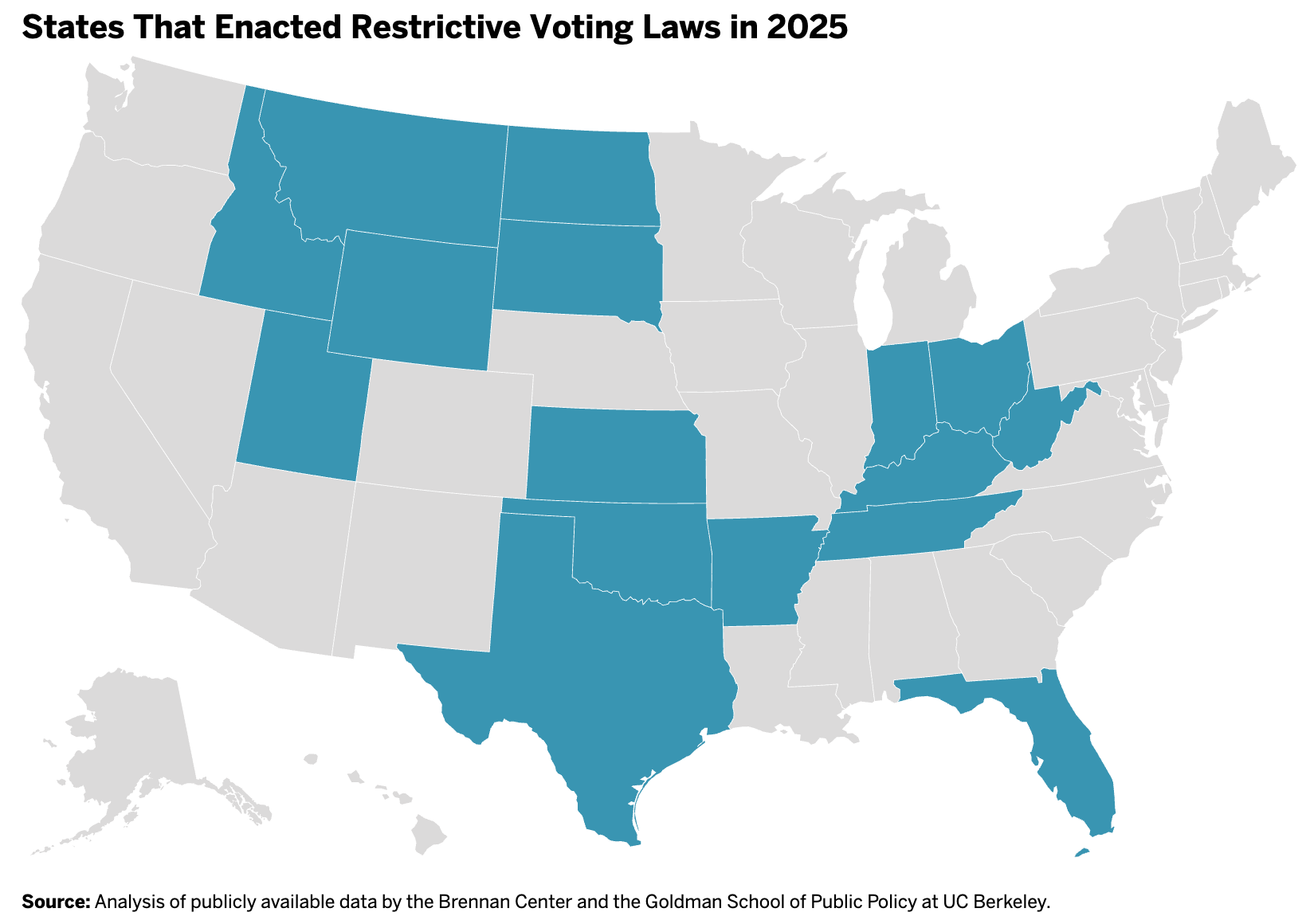
A total of 16 states have passed 29 regressive laws restricting voting rights this year, nearly equaling the record highs set in 2021, when 17 states passed 32 anti-voter laws. That earlier rush of voter suppression laws was prompted by Donald Trump’s spurious claims that the 2020 election was stolen from him, which failed to overturn the presidential race but provided political cover to GOP legislators who wanted to limit turnout.
Whereas this year’s crop of voter suppression laws and appoint have not been as expansive as the 2021 batch, they are explicitly informed by the right-wing anti-democracy infrastructure that formed around Trump’s attempts to thwart the transfer of power.
Erroneous conspiracies that blamed voter fraud for Trump’s loss have created the impetus for new ways of disqualifying voters. According to the Brennan Center for Justice, six states — Indiana, Kansas, Montana, Tennessee, Utah, and West Virginia — have passed laws that require or allow election officials to remove individuals from the voter rolls for reasons beyond normal federally-required maintenance.
Registering to vote is also becoming that much more difficult. Indiana passed a law that will likely require newly minted citizens to present a passport, birth certificate, or naturalization papers to register, while Wyoming passed a similar law that is likely to require immigrants to carry around paperwork that indicates their status in the country. Six states — Indiana, Kentucky, Montana, Tennessee, Utah, West Virginia — tightened their voter ID requirements by limiting which documents could be used upon showing up to vote.
Ohio Republicans are currently considering a bill that would disqualify absentee ballots received after Election Day. Currently, the state accepts ballots up to four days after Election Day, and the proposed reduction is drawing criticism from military veterans and active service members who fear they’ll be disenfranchised by the sluggishness of the global postal system. Last year, over 10,000 ballots from Ohioans came in within the four days after the close of polls on Election Day.
Kansas and North Dakota also passed laws that end the post Election Day grace period, as did Utah, which has been particularly aggressive in disenfranchising its voters. The state passed a large omnibus voter suppression law that features a provision that requires mail-in ballots to include the last four digits of a voter’s state ID or Social Security number. Worse, it ends universal vote-by-mail in 2029, becoming the first state to end its program.
Right-wing gerrymandering may also deepen: Indiana Gov. Mike Braun today called a special session of legislature to redraw the state’s Congressional map, though pressure from Trump and his charmless vice president has yet to translate into the requisite lawmaker support for the plan.
In New York, a new lawsuit from voters in Staten Island contends that the state’s current Congressional map disenfranchises people of color, which creates the outside chance of a redraw that would likely net Democrats another seat.
Facing resistance from voters and activists
Utah Republicans are also pursuing a series of constitutional changes that would devastate democracy in the state. As their effort to institute a new gerrymander pends in court (a decision is due November 8th), the party has focused on an effort to repeal Proposition 4, the constitutional amendment that banned gerrymandering.
It’s not going particularly well, though: the state’s Republican Lt. Governor recently told lawmakers that she would block an effort to repeal the amendment via indirect initiative, which involves collecting petition signatures but circumvents voter approval.
Lawmakers have since pivoted to attempting a direct ballot initiative, which would entail asking voters to approve the repeal of an amendment they passed overwhelmingly in 2018. Ironically, Republicans now have to overcome the steep barriers they’ve erected around ballot initiatives: they’ll have to collect more than 140,000 signatures from more than half of the state’s 29 state senate districts.
If they manage to do that, whichever new map a judge chooses would go on hold until after voters weigh in on re-rigging the maps in November 2026. As for what the voters think now, you can anticipate a close election: Prop 4 passed with just 51% in 2018, and new polling has it up 44-20%, with 36% of Utahns uncertain of whether they’d support the amendment this time around.
Republicans in Ohio are also in the middle of trying to further rig their Congressional map. Lawmakers are slow-walking what is supposed to be a bipartisan process so that they can ensure complete GOP control of mapmaking, and with it an additional two to three Congressional seats. Those antics, and the potential political oblivion that Democrats face in the Buckeye State, have pro-democracy activists there once again considering a ballot initiative campaign to overturn whatever distorted map that comes out of the process.
Citizens vetoes are difficult to secure in Ohio, requiring nearly 250,000 petition signatures in just 90 days and then an expensive campaign ahead of a November election. But there are reasons to believe it could be successful: Ohioans have twice voted to ban gerrymandering, only to see Republicans use loopholes and a conservative state Supreme Court free them of those limitations.
Republicans also relied on very misleading language on a constitutional amendment last year to narrowly defeat another anti-gerrymandering initiative; Secretary of State Frank LaRose’s office simply called a ban on gerrymandering a requirement to gerrymander, an absurd distortion that once again passed muster with the state’s top court.
Missouri Republicans are seeking to use grossly misleading ballot language on their own voter rights amendment, which would make passing new initiatives almost impossible. A coalition of voter rights groups have filed a lawsuit objecting to the language, which focuses on preventing non-citizens from voting (already illegal, of course) and ignores the real purpose of the amendment.

No S’more Graham?
On paper, Graham Platner looked like the ideal candidate for Democrats. On skin, maybe not so much.
It didn’t really bother me all that much when the Maine oysterman and Senate candidate’s impolitic old Reddit comments began to emerge in the media earlier this month. Sure, he said some stupid shit, but the explanation that Platner offered — he was a jaded combat veteran grappling with PTSD when he made those posts, but has since found his way — made total sense to me. Moreoever,
Besides, if Democrats are to transition from the hollow career politicians who cratered the party to younger and more authentic candidates, then they’re going to have to accept the fact that just about anybody aged 45 or younger has either posted something cringey or been tagged in at least a few embarrassing photos. The party desperately needs real people running for office, and going forward, that’s usually going to mean some dumb posts or texts. Obviously, there’s a limit to what’s acceptable, but Platner’s Reddit history, considering the context of the site, didn’t seem disqualifying. In fact, a deep dive into his years of comments suggest he has long been a staunchly progressive populist anti-fascist who believes in a multicultural society.
The standards have changed: Trump’s victory in 2016 taught us that voters are willing to overlook off-color remarks and unsavory personal opinions, and his sweep last year, after attempting to violently overthrow the government, multiple felony convictions, and affirmed liability for sexual assault, affirmed that a stunning number of Americans simply don’t care so long as someone is ideologically aligned, or at least offering a compelling appeal to their material interests.
Even former North Carolina Lt. Gov. Mark Robinson, who wrote hardcore porn fantasies about family members and called himself a “Black Nazi,” took more than 40% of the vote in the state’s gubernatorial election last year. Why hold Democrats to a much higher standard and unilaterally disarm when it doesn’t really seem to matter?
But loosening standards doesn’t mean disregarding them entirely, and the revelation that Platner had a tattoo closely resembling a Nazi symbol, and the way he’s responded to that revelation, has really given me pause.
Given the context, I actually am inclined to believe his initial explanation: if a bunch of drunk Marines on shore leave in Croatia decide to get tattoos together in some shady backwater parlor, the odds are pretty decent that the badass-looking skull they choose will turn out to have something to do with Nazis. What I don’t buy is Platner’s claim that he only recently discovered the meaning of the skull and crossbones emblazoned on his chest.
Jewish Insider, a conservative news outlet, reported that old acquaintances have suggested that Platner was well aware of the significance of the symbol more than a decade ago. I’ll take it with a grain of salt, considering the outlet and the use of anonymous sources, but as much as I want to give the guy a pass, would I really believe it if a Republican or conservative Democrat made the same excuse?
Let’s be objective: Platner is a history buff who apparently liked taking his shirt off at big parties. Is it really possible that he went nearly two decades without either stumbling across the image of the SS Totenkopf or having someone tap him on the shoulder and politely inform him that he had the insignia of the Nazi concentration camp guards above his right nipple?
Criticizing Israel’s government and genocide has opened the left to deeply cynical and unfair accusations of antisemitism, but it’s going to be that much harder to combat them if activists stick with a guy who had a giant Nazi tattoo for nearly 20 years. This isn’t to say that Platner is actually a Nazi or that he’s lying about his political convictions, but the bar for a political candidate has to be higher than broad ideological agreement, especially when it comes to this particular subject.
If Platner can prove that he really didn’t know the significance of his tattoo up until this month, I’m happy to retract my skepticism, but if we’re going to call out conservatives for believing Trump’s lies because they love tax cuts and ICE raids, we should think twice about buying such a far-fetched story.
More than optics or self-righteousness, this is about trust. If someone is going to sell themselves as populist champion and ask for small dollar donations from working class people amidst a rough economy, they need to be honest about their flaws and mistakes; at the very least, if they’re caught, they can’t offer flimsy excuses. Continued exodus from Platner’s staff indicates that there is a sense of betrayal from the people closest to him, too.
As I wrote about Gov. Janet Mills, Platner has every right to continue to pursue this race, and who knows, maybe enough voters will decide that they either believe him or don’t care about the scandals. If that’s the case, I’ll be glad to have a left-leaning populist nominee and root for him against Sen. Susan Collins in the general election. But in such a critical Senate election, with the very future of democracy on the line, Democrats — and the American people writ large — would probably best served by somebody else stepping up to run a people-first campaign.
If nothing else, Platner’s meteoric rise shows that there is a deep hunger for populist outsiders in Democratic politics right now, and no movement should be based around one candidate. There’s still time for a new Platner-type insurgent to emerge. They should probably just get a full body scan before expecting any endorsements.
Wait, Before You Leave!
Progress Report has raised over $7 million dollars for progressive candidates and causes, breaks national stories about corrupt politicians, and delivers incisive analysis, and goes deep into the grassroots.
None of the money we’ve raised for candidates and causes goes to producing this newsletter or all of the related projects we put out. In fact, it costs me money to do this. So, I need your help.
For just $5 a month, you can buy a premium subscription that includes:
Premium member-only newsletters with original reporting
Financing new projects and paying new reporters
Access to upcoming chats and live notes
You can also make a one-time donation to Progress Report’s GoFundMe campaign!
Great article. This is a crucial race for control of the U.S. Senate. My educated guess from studying Maine politics is that Platner could not win the general election, even though as a small donor I would like to support a populist. The smart thing for him to do is to drop out and prove by actions that he has changed from his early years and his tattoos. Mills has done some un-populist things BUT has spoken out strongly against Trump, especially on Trans so unless another populist enters the race I would stick with Mills. Platner killed his chances- you don't start at the Senate level with a questionable past.
Aren't Platners Reddit comments from 2020-2021 coming out just proof that his opposition, Janet Mills, is a paid corporate stooge? That's some expensive digging into someone's past and insane media framing