

Welcome to a Tuesday night edition of Progress Report.
Tonight we have a new entry in our new series featuring activists and organizers on the frontlines of the fight against fascism. Let’s get right to it.
Note: The far-right’s fascist takeover of this country is being aided by the media’s total capitulation to Trump’s extortion. It’s never been more critical to have a bold independent media willing to speak up against the powerful. That’s what I’m trying to do here at Progress Report.
You can help keep Progress Report afloat and build that network for just $5 a month — every subscription helps!
Thank you to our latest crowd-funding donors: James, Susan, Bruce, and Cindy!


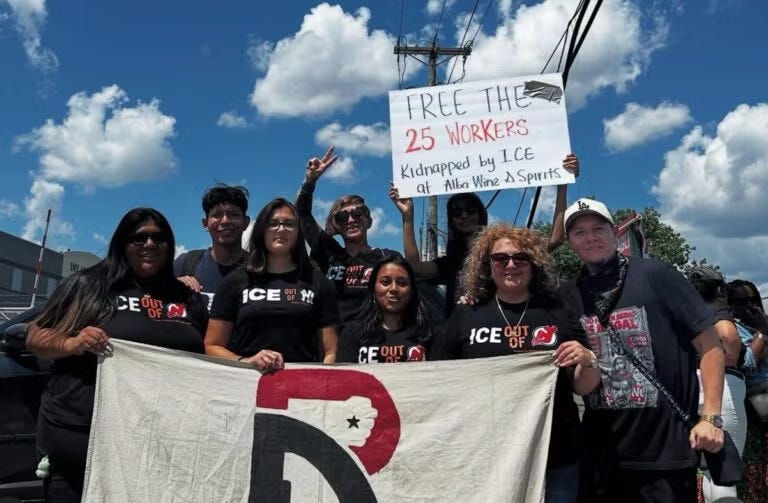
As the federal government wages an all-out occupation of Minneapolis, it’s also launching smaller scale daily invasions of other cities and towns across the country. Official resistance has varied: in some places, Democratic mayors and governors have refused to cooperate with ICE, and in some cases, signed laws intended to limit the agency’s Gestapo-like operations; others, not so much.
There has been an uptick in reported ICE incursions in New Jersey, a state riddled with immigrant detention centers that have been the center of conflict between lawmakers and law enforcement officials. Yet while New Jersey’s spiritual leader, Bruce Springsteen, slammed ICE during a charged speech during a recent concert, the state’s outgoing leader, Gov. Phil Murphy, on Tuesday vetoed two bills intended protect immigrants from the feds.
Passed last week, one bill would have limited expanded on an attorney general directive that limits when state, county, and local police officers could assist federal immigration agents; the other was a data security bill that limited how personal data stored at hospitals, schools, and libraries could be shared with ICE and other agencies.
The move outraged immigrant rights’ activists, one of whom I spoke with late today. Paulo Almiron is a community organizer and media coordinator at Resistencia en Acción NJ, which works to assist immigrants and their families in Mercer County, which includes Trenton and Princeton. He gave me a rundown of what’s happening there as the state is increasingly flooded with ICE thugs and how his organization is helping the most vulnerable.
Progress Report: Where are you seeing the most ICE activity?
Paulo Almiron: The most common ones are at businesses, and that includes workplaces; some of the biggest rates that we saw in 2025 were at warehouses. Then other raids have been conducted as people were heading to work in work vans or their personal vehicles. People going to court are often detained as well. Either immigration court or criminal court, they leave and then they immediately get detained.
It’s gotten to the point that people don’t trust public institutions anymore. And people, our neighbors, tell us they’re scared of going outside for even the simplest things like getting groceries or dropping their kids at school.
How do you help mitigate that?
As of now, we have a program to help with accompaniment to appointments. However, we are in the process of building a team that will take care of other tasks, like accompanying people to get groceries or going to drop the kids at school. Going to work is another thing that people are afraid to do because of the raids, especially if it involves outdoors work; it’s easier to get racially profiled that way.
So you get a call from someone who says “hey, I’m in Princeton and I think there’s ICE agents here outside the Home Depot.” You send people, what do they do when they get there?
First we sent somebody to confirm — that person has the role of examining the area and finding any possible ICE agents, who are mostly going to be uniformed. We haven’t seen as many cases of ICE agents in civilian clothing, but they have occurred in the past.
We check for any suspicious cars, any suspicious activity. If it is confirmed that ICE is in the area, then we dispatch everybody who’s in reserve and available at that moment. And then we demand that they show a warrant or leave. We document the situation and then we get in contact with any affected families to support them in terms of commissary funds or phone costs and referrals to trustworthy lawyers.
It must be terrifying for families. Walk me through what happens next.
The process at first can be confusing for a lot of families. In the first 24 hours that somebody is kidnapped by ICE, they’re first put in a processing center and then they are sent to a detention center to stay there for a longer term. So we have to find out where they are and then that’s when we connect them to um to lawyers that we know are trustworthy and low cost. When these lawyers take cases, we follow up with them to see what other needs they have. In some special circumstances, we have fundraised for families that lost their income earner, which is most of the time the father.
Whole families are devastated. We have seen it in our own cases. We have seen them in third-party cases in other counties. The kids are inconsolable. There was this one case of this grandfather who was taken in Philadelphia. It was on the day of his birthday. And his grandchildren saw him as their father figure, and they were expecting to give him cake, candles, you know, only to find out that he was taken away.
And lawyers are ripping these people off?
In terms of lawyers, with the rise in detentions and deportations, we have seen people getting quoted with ridiculous legal fees, way above what a lawyer would normally charge. Even for simple stuff like translations or notary signatures. We’re also afraid that anybody can just claim that they’re an experienced lawyer. There’s been people who told us that lawyers promise them a lot of things, like, “oh, I’ll get you out of detention” or “I’ll get you a bail,” only to not deliver and keep the money.
Are there any good lawyers?
In some cases, some of the lawyers that we know will take pro bono cases or they will take them at lower costs because we know that these families are working class.
Within the coalition, we coordinate on how we can push for legislation or how we can coordinate our rapid response efforts in order to enhance our coverage and have effective actions throughout the state.
Mikie Sherill was just inaugurated as governor of New Jersey today. What would you like to see in terms of legislation?
What we want right now is those bills to be reintroduced and we expect nothing less than them being passed. I know that Mikie Sherrill is hesitant, just like Murphy was, but we need to try. It’s the best way that we can through policy grant protections to us and our neighbors.
How can people help?
One of our main funds is the Rapid Response Emergency Fund. Any donations that go to that fund pays to train our volunteers and then to also support affected families with phone bills for calls with their loved ones.
Wait, Before You Leave!
Progress Report has raised over $7 million dollars for progressive candidates and causes, breaks national stories about corrupt politicians, and delivers incisive analysis, and goes deep into the grassroots.
None of the money we’ve raised for candidates and causes goes to producing this newsletter or all of the related projects we put out. In fact, it costs me money to do this. So, I need your help.
For just $5 a month, you can buy a premium subscription that includes:
Premium member-only newsletters with original reporting
Financing new projects and paying new reporters
Access to upcoming chats and live notes
You can also make a one-time donation to Progress Report’s GoFundMe campaign!