

Welcome to a Friday edition of Progress Report.
Thank you to everyone who tuned in to the live stream tonight with Jason Poulos, the progressive running an upstart primary challenge against conservative DINO Rep. Jake Auchincloss in MA-04. It was a great conversation, focused on Democratic politics, corporate money, and AI policy, and I’ll have the whole video and write-up for everyone else later this weekend.
Tonight we’ll run through headlines and data points on some of the week’s biggest — and most ignored — stories.
Also: My friend Tiffany, who featured in this video report I produced a few years ago about the Medicaid unwinding, was illegally evicted from her home by her slumlord. Her young family (she’s got a two-year-old son) has two days to find $1500 for a deposit on a new apartment. If you can spare any change, please consider helping them with a donation — your assistance means the world.
One more thing: Tomorrow (Saturday, May 30th) is my birthday! And to celebrate, in a promotion that has nothing to do with my age, I’m offering 40% off paid subscriptions to Progress Report for the next day. That’s just $3 a month to help keep this journalism going!


Democracy: On Thursday, a federal judge refused to block President Trump’s latest attack on voting rights, writing that damages could only be speculative before the administration actually enacted the executive order. But U.S. District Judge Carl Nichols may not have to wait much longer to do the right thing: on Friday, the government said that it would move forward with implementing the order, which calls for the US Postal Service to severely limit who receives mail-in ballots.
In short, Trump wants the Department of Homeland Security to create lists of citizens in every state, which would dictate who the USPS could send a mail-in or absentee ballot. There are two problems: first, the federal government has no right to do this, and second, the database that the administration wants to utilize is deeply flawed and will undoubtedly lead to mass disenfranchisement.
Judge Nichols essentially acknowledged that point, but used what I’ll call the Lloyd Christmas Argument — “so you’re saying there’s a chance…” — to justify allowing the order to move forward.
“While it is conceivable these Lists may have some flaws, at least initially, it is impossible to be sure when the agencies have not yet determined what databases they will use or if they can perfect them ahead of use,” Nichols wrote. “And even if the Lists as initially compiled contain some flaws, that would mark only the first step in an attenuated chain of speculation.”
You can learn more about this potential catastrophe in my latest story for More Perfect Union, a deep dive the right’s relentless attack on voting rights and the Trump administration’s plans to federalize elections
As the video notes, these aforementioned lists would be built on something known as the Systematic Alien Verification for Entitlements (SAVE) system, which is used to check on the immigration status of noncitizen immigrants who are applying for public benefits like Medicaid and SNAP. It is deeply flawed, incomplete, and frequently gets things wrong, as it is not a database in and of itself but instead a tool for querying other databases.
Intended as a backup tool for states checking Medicaid eligibility, it is in no way designed for use as a primary resource that determines whether somebody can exercise their most precious political right.
Which is why Trump is so eager to use it for that very purpose. According to a poll that we had conducted last month, 53% of Americans say that restricting mail-in voting would make it harder for them to cast ballots. Further, 37% of Americans said they opposed the policy while 33% say they were in favor.
Judge Nichols does allow for the possibility that the harms will reach the threshold that the order should indeed be blocked — the actual illegality of the thing should really render this moot — but every inch you give this administration, the closer it gets to cheating, stealing, or otherwise scamming Americans out of their rights.

Data Centers: The populist uprising against massive, energy-sucking, water-polluting data centers is forcing even the most pro-AI, corporate-friendly politicians to scramble to rethink their support.
In New Jersey, Gov. Mikie Sherrill proposed serious guardrails for new data center construction, seeking to limit their impact on communities and energy bills while forcing developers to deliver on promised impacts:
“The four-pillar plan proposes that data center developers must ‘pay their own way,’ and bring energy to the grid with them,” according to the New Jersey Globe. In addition, the projects must “be transparent and report energy and water use; engage with communities on concerns involving noise and light pollution; and build facilities with union labor and strong wages.”
Municipal governments have been taking action into their own hands, implementing moratoriums and outright bans on their construction. Last week, it was a ban in Millville, NJ, and just last night, the rural town of Andover voted to stop a data center project.
Even more remarkably is the shift happening in the Midwest, where one-time supporters have begun to backtrack. In Pennsylvania, Gov. Josh Shapiro is seeking to thread the needle between the rising populism and his own default pro-corporate stance.
Just last year, Shapiro announced that Amazon would be spending $20 billion to develop AI campuses in the state, then joined Trump and Sen. Dave McCormick to announce a $90 billion investment in AI, energy, and data centers. This week, he made a high-profile announcement about forcing them to pay their own way.
According to WHYY, Shapiro’s plan stipulates that “developers seeking state support would be required to build, bring online or buy incremental electric capacity at their own expense, and by 2035, ensure up to 32% of its energy comes from resources that include nuclear, hydropower, solar, wind and batteries.”
Shapiro is trying to avoid the boondoggle happening in Ohio, where incentives for data centers overshot estimates last year by more than a billion dollars. The $1.5 billion in corporate welfare spent on these massive projects was so egregious that this week, Gov. Mike DeWine — a guy who has never met a tax incentive he doesn’t like — actually suspended the Ohio sales tax break for new data centers until the state can conduct a “study” into the economic and other impacts of their construction.
That said, DeWine may have another motivation: a grassroots coalition is trying to qualify and then pass a ballot initiative that would ban new data centers in Ohio, and hitting the pause button now could lower the urgency for a populist movement driven by outrage.
Corporate money: On the subject of energy and ballot initiatives, there’s good news out of Michigan, where activists have filed a huge number of signatures in support of banning public utility companies and government contractors from making political contributions.
Voters Not Politicians handed in more than 562,000 signed petitions, over 200K more than necessary to qualify their good government initiative. The grassroots campaign has raised over $2 million, and it will need every cent of it to take on energy companies, health insurers, and other contractors that spend huge money on elections every single cycle.
Texas: A few interesting polls in the Lone Star State, which may prove to be the tipping point in the race for control of the Senate this year.
First, the Hispanic shift toward Donald Trump may not be as durable as Republicans thought, as a new poll found that 20% of Texas Latinos who voted for Trump in 2024 regretted their decision. Trump won 55% of Latino voters in Texas, and the assumption that the GOP had permanently shifted the demographic to the right fueled the gerrymandered map that Republicans hope will give them five new Congressional seats.
Now, they may regret their strategy:
Of the 500 voters surveyed, 300 live across five of the state’s top battleground congressional districts, each of which are Hispanic-majority seats: the 15th and 23rd Districts, which Democrats hope to flip from GOP control, and the Democratic-controlled 28th, 34th and 35th Districts, which Republicans are targeting after redrawing their boundaries to make it easier for a GOP candidate to win.
In those districts, a slight majority of respondents — 54% — said they planned to vote for the Democratic candidate for Congress; 27% said they’d support the Republican, while the rest were undecided, according to the poll.
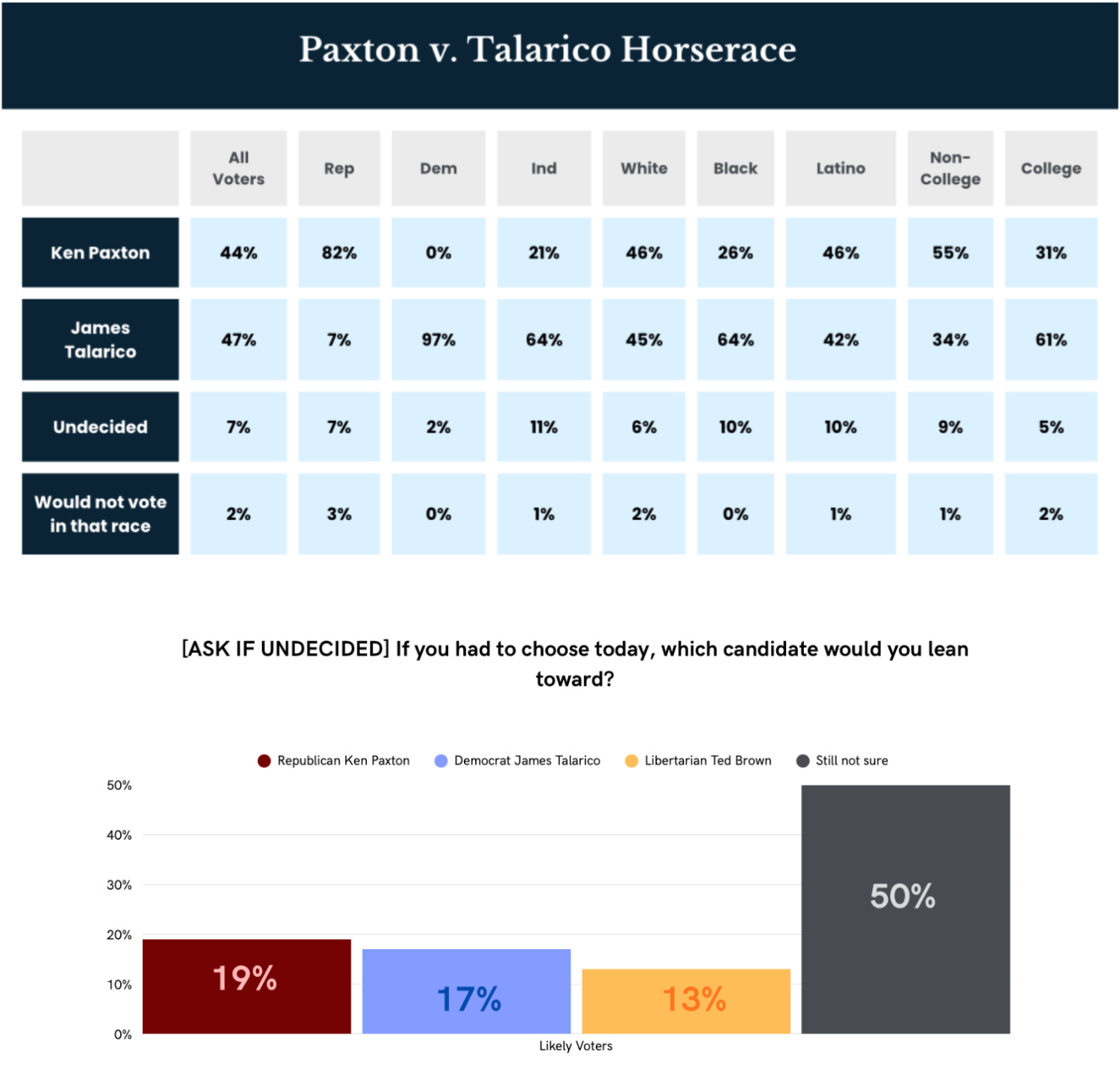
What’s particularly interesting is that Latino voters are one of the only demographics that give sleazebag Attorney General Ken Paxton the edge against state Rep. James Talarico in a new poll of their Senate race. The Texas Public Opinion Research-conducted poll has Talarico, who Republicans have weakly tried to smear as a trans vegan (not that there would be anything wrong with either thing!), outpacing Paxton 47-44%.
Wait, Before You Leave!
Progress Report has raised over $7 million dollars for progressive candidates and causes, breaks national stories about corrupt politicians, and delivers incisive analysis, and goes deep into the grassroots.
None of the money we’ve raised for candidates and causes goes to producing this newsletter or all of the related projects we put out. In fact, it costs me money to do this. So, I need your help.
For just $5 a month, you can buy a premium subscription that includes:
Premium member-only newsletters with original reporting
Financing new projects and paying new reporters
Access to upcoming chats and live notes
You can also make a one-time donation to Progress Report’s GoFundMe campaign!
What is the judge talking about? We have to wait until the election is stolen and then sue trump? This is insane - what trump is doing is blatant election tampering. there is just no end to the madness and the number of people participating in it. People acting like these are normal times and we have a normal president and normal congress and normal supreme court
"Talarico, who Republicans have weakly tried to smear as a trans vegan"
...
I appreciate that the DNC's social account actually took a swing and told steven miller to shut his ugly face hole. However, a better response (and the one I hope the dems take going forward) would have been "Yeah? And so what if he is? He's still gonna lower the grocery and gas bills that you ignorant shits have so thoroughly fucked."
In other words, what if Zohran but real fucking rude.