

Welcome to a Monday night edition of Progress Report.
If you missed it, the New York Knicks are the NBA champions. I wrote about experiencing the city’s spiritual rapture last night.
One dream at a time, so tonight it’s back to the business of trying to save American democracy. I’ll also have an important new policy story later this week.
Note: I’ll be honest, this newsletter’s paid subscribers have plummeted since I came back from open-heart surgery. It’s making it hard to do this work, because there are real expenses, including site coding, web hosting, electoral resources, media access, and more. This is a second full-time job, and if you can help make it sustainable, it will allow me to report and amplify stories you won’t find elsewhere.
You can help keep Progress Report afloat and build that network for just $5 a month — every subscription helps!


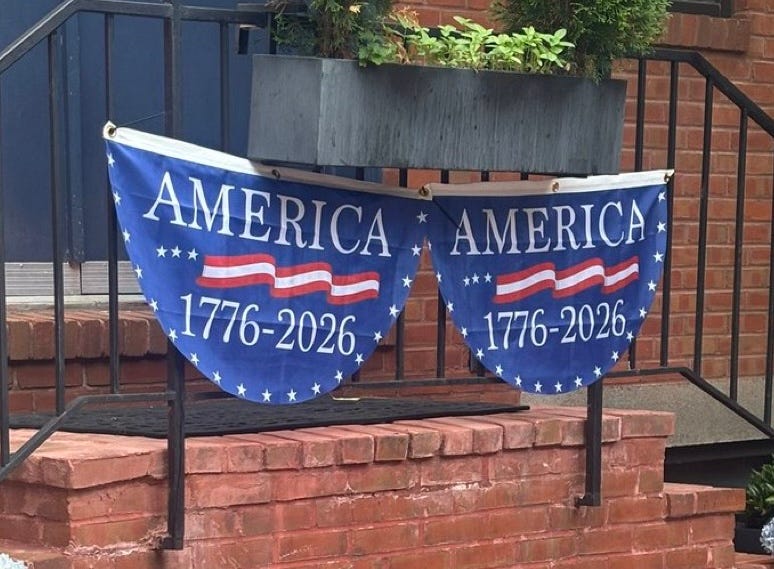
It’s been seen on banners and posters, star-spangled streamers and decals, an accidental gravestone: America 1776-2026.
As people prepare to celebrate the 250th anniversary of American democracy, they are inadvertently commemorating its death, which would be funny if it weren’t bleakly appropriate. Or, at risk of becoming so.
These past few weeks were illustrative of that fact, while also offering some hope that irreversible disaster can be averted.
This past few weeks were particularly chaotic with regard to Trump’s most recent voting-related executive order, the federal commandeering of elections that he signed at the end of March.
As a refresher, Trump ordered each state to submit a list of voters to the US Postal Service and instructed the Department of Homeland Security to construct a state-by-state list of “eligible” voters based on shoddy and very incomplete federal databases like the SAVE system. That database is used to verify whether immigrants are eligible for Medicaid and other benefits and is by nature out of date, missing years’ worth of newly enshrined citizens.
The order was purposely vague, but the idea was that DHS would check the lists submitted by states to USPS against its own lists, and the postal service would only send mail ballots to people who made it through that flawed system.
The order would be catastrophic and unequivocally illegal, disenfranchising untold numbers of eligible voters and making it very difficult for many more to cast their ballots. If it’s helpful, I wrote, reported, and produced this piece explaining the how and why:
We released that video in mid-May, and already, the situation has shifted several times over. Let’s review.
Earlier this month, the USPS submitted a proposed rule that would cut off mail voting for everyone in states that did not provide voter lists to the federal government. This is the latest attempt to extort states into surrendering their confidential voter data; the Justice Department has sued over half a dozen (mostly Democratic states) over their failure to hand over voting rolls, an effort that has only yielded embarrassing smackdowns from federal judges. On the other hand, it was revealed last week that ICE has been directly haranguing local governments for voter lists, and obtained them in Webb County in Texas and Forsyth County in North Carolina.
Undeterred by those losses, the Department of Homeland Security submitted a memo that detailed how it would work with USPS to “integrate” their lists and monitor for “election fraud.” It also said it would give states access to a portal with “citizenship-related data” from various other departments, presumably to inspire voter purges.
But last week, DHS walked that back a bit, saying that it had only begun “preliminary conversations” with USPS about integrating their systems and would only follow through should the postal service get approval for its plan to limit mail ballots.
This was less a surrender than a tactical feint. A federal judge ruled late last month that because the administration had not yet implemented Trump’s executive order, and thus had not actually caused any harm, he could not issue an injunction. DHS’s explicitly announcing that it was set to collaborate with another federal agency to implement the order could have amounted to crossing a dumb, arbitrary line that should have never been drawn in the first place, triggering an injunction.
Imagine somebody announcing their intention to punch you in the face, cocking their fist back, and a cop saying they couldn’t do anything until actual damage was done. (Okay, maybe not the best example in this country, depending on what you and your assailant look like, but you get the point.)
Fortunately, late last week, an appeals court agreed to expedite the plaintiffs’ appeal of that decision, with final briefs due in early July. Another federal judge is also weighing a challenge, this one from Democratic states. Time is of the essence.

Not that the administration will let that discourage it from federalizing elections and suppressing the vote. In the latest entry into the DOJ’s campaign of intimidation and law-fare against progressive organizations, the FBI last week raided the offices of Ohio Organizing Collaborative, a pro-democracy group in the Buckeye State.
The raid, paired with intense questioning of employees and volunteers at the progressive organization, was said to be related to an investigation into so-called voter registration fraud, a thin pretext that organizers weren’t buying.
"The OOC is not going to stop its work," a board member, Prentiss Haney, told the Columbus Dispatch. "If anything, it's going to continue to build upon this work and make sure that our faith leaders and our community leaders and working class folks know that we're going to stand with them and not let them be intimidated by forces who want to use political forces to stop them from engaging in fair elections."
What’s become clear from all of this is that state governments can either be willing collaborators or key bulwarks against these attacks on democracy, so long-term, the best approach to preserving the republic may well be fortifying majorities and winning new ones at the state legislative level.
It was for this reason, among several others, that I decided to dedicate countless hours to creating FlipSeats.org, a public database of key swing seats in swing states where Democrats could either win new majorities or break GOP supermajorities. Over the past few months, as primaries have taken place and races have sorted themselves, I’ve worked to complete the lists of nominated (or de facto nominated) candidates in key races in Michigan, Wisconsin, Pennsylvania, Arizona, Minnesota, North Carolina, Kansas, and Nebraska.
Over the weekend, I decided to expand the list to three more states that the DLCC says it is targeting for supermajorities: Colorado, Nevada, and Washington. All three have been added to the site, with races and candidates all filled out and ready for perusal.
They don’t get as much attention, but Democrats only have to flip one seat in each chamber — so, one in the House and one in the Senate — in both Nevada and Colorado to win supermajorities. Washington is a bit of a longer shot, but the more seats that Democrats can flip there, the more likely it is that they’ll be able to move forward with a redistricting plan for 2028. The same goes for Nevada, where supermajorities would allow Democrats to override a veto from GOP Gov. Joe Lombardo should he win re-election.
Check it out, find a candidate to support, and help fortify democracy: FlipSeats.org.
Wait, Before You Leave!
Progress Report has raised over $7 million dollars for progressive candidates and causes, breaks national stories about corrupt politicians, and delivers incisive analysis, and goes deep into the grassroots.
None of the money we’ve raised for candidates and causes goes to producing this newsletter or all of the related projects we put out. In fact, it costs me money to do this. So, I need your help.
For just $5 a month, you can buy a premium subscription that includes:
Premium member-only newsletters with original reporting
Financing new projects and paying new reporters
Access to upcoming chats and live notes
You can also make a one-time donation to Progress Report’s GoFundMe campaign!
I would like to donate to the Ohio Organizing Collaborative (it's 501(3)(C). But I cannot find an address nor do they respond to email for the request
It's hard to believe this is happening but it is. Happy 250th birthday America!