

Welcome to a Thursday night edition of Progress Report.
I feel zero sympathy for Pam Bondi, but her firing once again leads me to ask why anybody has ever agreed to work for or been loyal to Donald Trump. From contractors in Atlantic City to his own vice president, it invariably ends with disgrace, humiliation, and unceremonious disposal. There has never been a person in his life who he hasn’t thrown to the wolves, but at least over the past decade, they’ve all deserved it.
Bondi heads back to Florida after spending a year covering up for pedophiles, thwarting investigations into killer ICE agents, and running failed prosecutions of Trump’s political enemies. Whoever replaces her will be just as bad, because the rot comes from the top, but it’s always worth enjoying some schadenfreude when it happens.
Good news roundup coming this weekend!
Note: The far-right’s fascist takeover of this country is being aided by the media’s total capitulation to Trump’s extortion. It’s never been more critical to have a bold independent media willing to speak up against the powerful. That’s what I’m trying to do here at Progress Report.
You can help keep Progress Report afloat and build that network for just $5 a month — every subscription helps!


There’s a reason why artificial intelligence companies are planning to pour more than $100 million into this year’s midterm elections: people really don’t like AI.
This according to a new poll from Quinnipiac, which found declining sentiment toward the technology:
80% are somewhat or very concerned with AI generally;
76% of respondents say they frequently do not trust the answers produced by AI platforms like ChatGPT and Claude;
55% believe that AI will do more harm than good in their day-to-day lives;
70% say that the technology is likely to reduce the number of jobs available
30% are worried that AI is going to take their jobs
Reporting has suggested that corporations are using AI adoption as an excuse to cut jobs, the numbers are proving the concerns are legitimate. A new study found that of the 60,000 jobs cut in March, a full quarter of them were related to artificial intelligence. The tech industry is positively bleeding jobs right now, with an even higher percentage related to AI uptake.
The Quinnipiac poll is not a one-off, either; polling across the board shows bleak public opinion on artificial intelligence.
In an NBC News poll earlier this month, just 26% of respondents said that they had positive feelings about AI, with 46% professing negative sentiment. Even grimmer, 57% of respondents said that they believe the risks outweigh the benefits of AI, which are in the eye of the beholder.
In that sense, surveying people on the broad field of AI is a bit reductive and ignores the vast scope of what the technology can accomplish. Quinnipiac found that that 51% of respondents said they use the technology for research, even if they don’t trust the results, and nearly 30% use it to write. Plus, 20% of respondents use it for medical advice — something I’d have to cop to as well, having consulted it to decipher doctors reports and operative notes during my heart surgery saga.
How do we explain the seeming contradiction? It’s simple: most people are personally using ChatGPT et al as a more coherent Google search engine and quiet cheat code for mundane work tasks, so they see them really more like small technological improvements than any breakthrough or threat. On the other hand, the news is saturated with dystopian stories about surveillance, deepfakes, and the government insisting that it should be allowed to use AI to kill people.

It’s not simply a specter, either; data centers are popping up in communities all across rural and suburban America, often kept secret by NDAs and layers of LLCs. The incessant noise and resource extraction have long since superseded any supposed economic benefit that developers promise. In the Quinnipiac poll, 65% of respondents said they opposed the construction of data centers in their communities, with just 24% in favor.
The opposition is more than theoretical and reflects more than dread: people across the political spectrum are rising up to oppose these new energy-sucking monoliths, often in raucous town hall meetings that go viral and inspire further resistance. This grassroots backlash and activism has led to $64 billion in data center projects being blocked or delayed.
The Political Implications
Many of the issues that dominate our politics are astroturfed into relevance; think the right’s obsession with trans people and suddenly renewed fear of Sharia Law. Artificial intelligence represent the other side of the coin: a major concern among voters across the partisan divide, one that has people clamoring for intervention — Quinnipiac found 74% of voters believe that government has not done enough to regulate the technology — but to this point, largely unclaimed by politicians of either party.
On the left, Sen. Bernie Sanders and Rep. Alexandria Ocasio-Cortez have called for moratoriums on data centers, while on the right, Florida Gov. Ron DeSantis, a man who has never met a big business tax incentive he doesn’t like, has also worked to limit their development in his state. But for the most part, neither party has really distinguished themselves as having the pulse of the people on AI, as the NBC poll indicates.
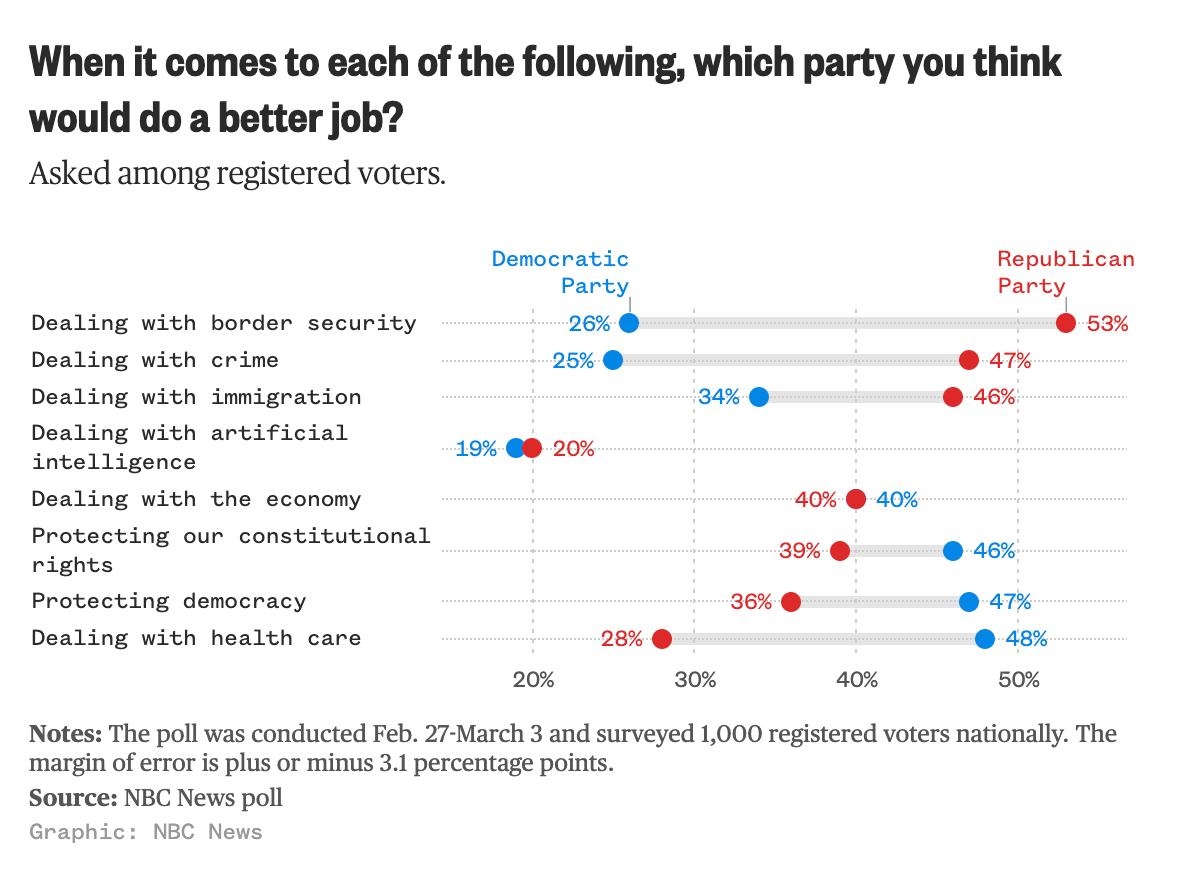
It’s really a jump ball at this point; 20% of respondents said that Republicans would do a better job on dealing with artificial intelligence, compared to 19% who gave the nod to Democrats. That’s well within the margin of error, and Democrats are much better positioned to make the argument that they’re willing to stand up to the world’s most powerful and unpopular tech companies. Doing so would help to recapture rural voters, libertarians, and a litany of other lot voters.
They can thank Donald Trump for setting the biggest contrast; the president in December issued a (likely illegal) executive order that purports to preempt any state-level regulation of artificial intelligence. His Secretary of Defense, Pete Hegseth, has repeatedly waged public battles with Anthropic over the right to use their AI product, Claude, to murder people without limits. And the White House counts some of the biggest AI boosters as very vocal cheerleaders and advisers, tying the administration inextricably to the technology.
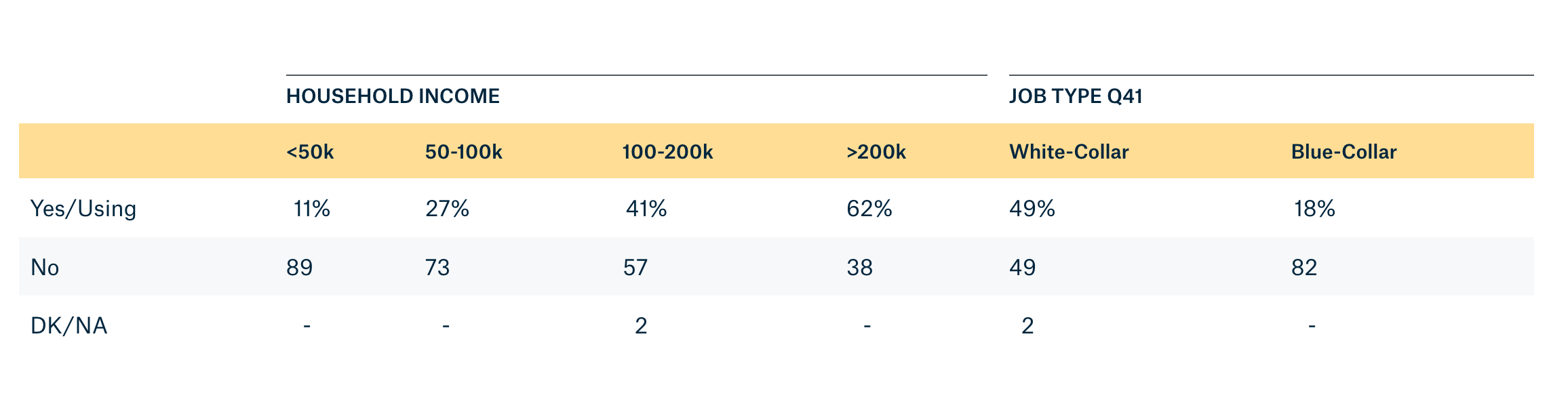
Trump’s backing of AI is another strike against him among blue collar and working class voters, who are the least likely to use artificial intelligence and most skeptical of the technology.
Democrats, on the other hand, have been far from perfect on the issue — Hakeem Jeffries was following the money when he created the House caucus’s commission on AI — but have shown far more fortitude and defiance. Opposing data centers and regulating AI are now core parts of many progressive candidates’ campaign pledges, and the industry itself is in many ways helping drive the perception that the left opposes unfettered AI with its massive, intrusive election spending.
It’s happening on the state level, too. Whereas the promise of construction booms led to 38 states creating tax incentives for data centers in recent years, the tide is beginning to turn the other way. A flood of repeals have been introduced by Democratic lawmakers in various legislatures, including Virginia, Michigan, Arizona, Maryland, and Georgia. Other states, like New York, Oklahoma, and Vermont, have seen full-on moratoriums on data center construction introduced, and on Thursday, word emerged that Maine is moving forward with a pause on the energy-sucking behemoths until November 2027.
It would be wildly premature to suggest that the party is poised to win this issue, because Democrats have a remarkable talent for fumbling the bag, stepping back from the brink of showing courage, and proactively winning policy arguments that go beyond rejecting what a Republican is doing. Fortunately, AI touches on so many of the issues where Democrats have recently struggled, including but not limited to energy, security, and the economy.
This is a rare opportunity to own an issue that is set to dominate people’s lives, and inspire populist backlash, for the next generation, and right now, there’s little popular belief that this party stands for anything; in NBC’s poll, the only subjects less popular than AI are Iran… and Democrats.
Wait, Before You Leave!
Progress Report has raised over $7 million dollars for progressive candidates and causes, breaks national stories about corrupt politicians, and delivers incisive analysis, and goes deep into the grassroots.
None of the money we’ve raised for candidates and causes goes to producing this newsletter or all of the related projects we put out. In fact, it costs me money to do this. So, I need your help.
For just $5 a month, you can buy a premium subscription that includes:
Premium member-only newsletters with original reporting
Financing new projects and paying new reporters
Access to upcoming chats and live notes
You can also make a one-time donation to Progress Report’s GoFundMe campaign!
I totally agree...Dems could score big with a strong stance on AI. With regards to the unpopularity of Democrats: I think that has much to do with the fecklessness of the leadership - Schumer and Jeffries. Their unwillingness to oppose the criminality of the the Trump regime with little other than mildly remonstrative comments, and their reluctance to put forth bold solutions to the massive problems facing the American people is not exactly a formula for engendering admiration or allegiance. There are a good number of Democrats who DO vigorously oppose the policies and behavior of the regime and who DO have powerful ideas for creating a more equal and just society. Unfortunately, they are not the face of the party...Schumer and Jeffries are. The poll you referenced concerning which party does better on the metrics listed is demonstrative of two things: Democratic are horrible at messaging and; the American public is woefully uninformed. On the border security and immigration issues, both Obama and Biden deported (assuming that is the standard of approval) as many (Biden) or more (Obama) undocumented people as Trump, but without terrorizing our communities and murdering people in the streets. With regards to crime, other than the murder rate (which is higher in red states than blue states), crime rates are generally a municipal issue and there is no significant statistical relationship between the political affiliation of the municipal leadership and the crime rate. Finally, the public has been gaslighted for the last century that Republican administrations are better for the economy than Democratic ones. In the modern era, the US economy has performed significantly better under Democratic presidents than it has under Republican presidents. It is mythology that Republicans are as competent managing the economy as Democrats are, just as it is mythology that Republicans are better at dealing with border security, immigration and crime. Could Democrats do better? Could they implement real solutions to the problems of healthcare affordability, economic inequality, immigration, crime, environmental issues...AI? Of course, but even with the weakness and inaction of the current leadership, they pretty much outperform Republicans on almost every metric already - they just suck at communicating that to the public.
AI is hee o stay but we can put limits on how it is used. Require that all energy used by a data center be green energy and that data centers be located on rivers that flood. We also need to require the blue states to adopt the all the voter protection of voting rights and access that are in the John Lewis Voting Rights Act and the voting access reforms in the Pelosi Voting Rights Act. Democrats in the blue states and red states that allow citizens to put issues on the ballot need to combine the local elections with the even year midterm elections . This will boost voter turnout, save taxpayers millions, and result in more women and more minorities being elected to local offices. Thisreform would also help break the GOP dominance of local government and help prevent extremists from getting control of school boards.