

Welcome to a Sunday edition of Progress Report.
This being my sixth open-heart surgery, I thought I knew from experience what the recovery would entail: creakiness and chest pain, six-to-eight weeks of slow but steady progress, a gradual return to the energy and enthusiasm that drove my personal and professional lives.
Turns out that I was a bit naive.
What I didn’t understand until now is that I’m not just healing from another major operation, but really trying to recover from two years of being sick, of trudging through physical and mental deterioration, grappling with a failed surgery and the uncertainty of whether I’d make it through to the other side. I have to overcome the cumulative effect of two major heart surgeries, another serious procedure, and the extreme stress and transformations caused by the ongoing issues that were finally repaired in Cleveland.
All of that makes the success of my surgery last month even more remarkable, something I try to remember as I drag myself around the apartment and putter around the building’s lobby. I’m fortunate to have health insurance and some time off from work, too; in this country, it puts me among the most privileged and fortunate.
Still, relative privilege only goes so far in this country, and the grind of a consuming day job, and the loss of subscribers here, are always on my mind. The past half-century has forged an unforgiving system that demands constant sacrifice for mere subsistence. A reprieve is a privilege; the United States is the only nation that does not guarantee any paid time off, and when people rise up and use the electoral system to pass even the most modest protections, as they did in Missouri in the fall of 2024, politicians strike them down.
It’s easy to observe the problem and prescribe some mass organizing and populist uprising as the solution, but the reality is that those who need the help most — whether it’s paid time off, health insurance, or some other criminally denied essential — have the least time to dedicate their time to politics, especially our present-day version with its cynical promises and disappointments. According to a new poll from NBC News, we’ve already reached a critical mass of people who believe that participating in politics, and ostensibly even impacting the outcomes of elections and debates, is futile:
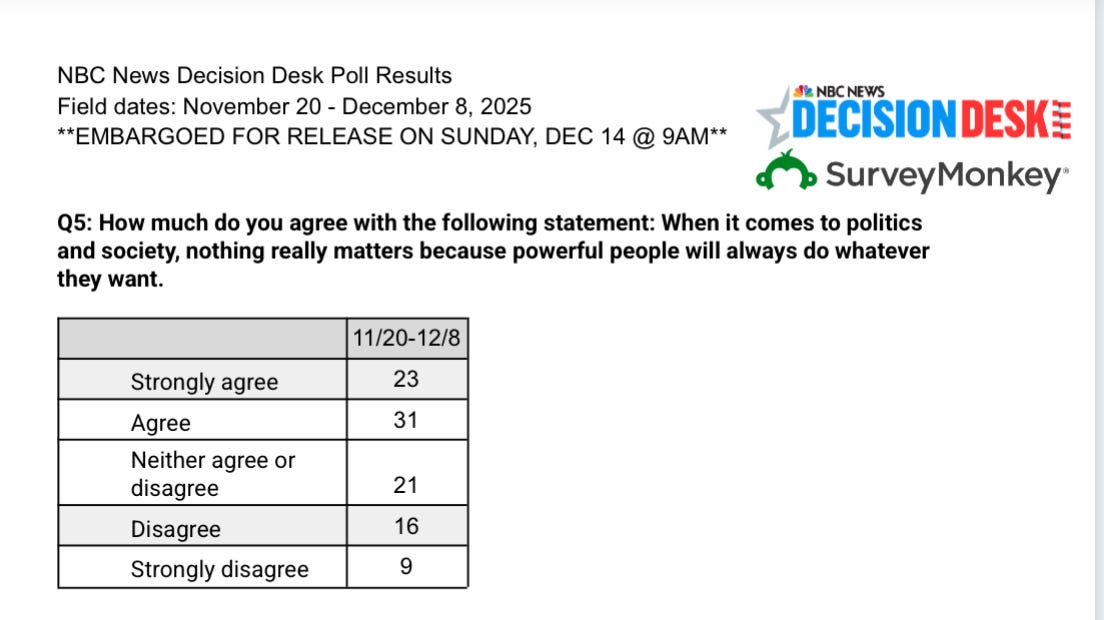
This is the crux of modern-day class politics, which go far beyond the traditional debates over labor, markets, and access to services. As we barrel toward the midterm elections, it’s imperative that we support candidates who understand the desperate need for a total restructuring of our wage-slave economy and social order, and can justify and reward the faith placed in them by voters in what is likely to be a wave election. Tonight, we’ll look at one issue undergirding that battle right now.
Note: The far-right’s fascist takeover of this country is being aided by the media’s total capitulation to Trump’s extortion. It’s never been more critical to have a bold independent media willing to speak up against the powerful. That’s what I’m trying to do here at Progress Report.
I’m offering half-off paid subscriptions as I get back on my feet, so now can help keep Progress Report afloat and build that network for just
$5$2.50 a month — every subscription helps!


Democratic Party elites are making foolish, short-sighted choices on artificial intelligence.
The last week has been discouraging from both policy and political perspectives. A quick review:
First, House Democrats introduced a new panel of lawmakers that will advise the caucus on issues pertaining to AI, stacking it with members who either represent Silicon Valley or have accepted gobs of money from Big Tech companies and dutifully voted for their interests. Corporate shills like Reps. Josh Gottheimer and Zoe Lofgren should have no influence over Democratic policy decisions.
Then, New York Gov. Kathy Hochul gutted the RAISE Act, a strong AI safety law passed by the legislature, and replaced it with an industry-friendly framework preferred by tech lobbyists and PAC-wielding billionaires.
And when President Donald Trump signed a dubious executive order purporting to preempt state regulation of artificial intelligence, any objections from Democratic governors were drowned out by the protests of Republicans like Florida Gov. Ron DeSantis, who has been outspoken on this issue. Polling indicates that people vehemently oppose such preemptions.
So, with so much chaos constantly unfolding, why do these things register as serious problems, much less concerning portents for the next year?
As I wrote last month, AI is poised to become one of the defining issues of the next political era, both as Orwellian technology and umbrella for a host of other contentious matters — mass layoffs and job loss, corporate subsidies, tech oligarchy, privacy, energy prices, and the division of increasingly limited natural resources, among others.
More than just a set of issues, AI’s growing dominance in the workplace and people’s personal lives, along with its near-constant presence in the news cycle, is installing the term “artificial intelligence” as a new generational framework for everything, both a vague and looming specter as well as an active threat to everyday life as we have known it.
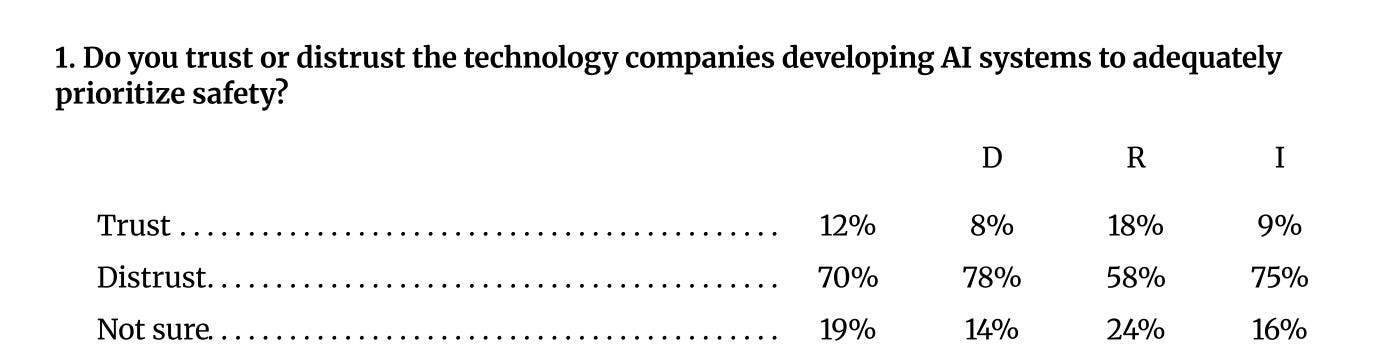
Americans were primed to fear the technology by a century’s worth of apocryphal sci-fi tales about sentient robots who overtake humanity, and while it hasn’t reached that point quite yet, it has been disruptive enough, in ways that only benefit the world’s wealthiest and most contemptible men (and a small selection of engineers who are being showered in an opulence fueled by borrowed money).
Career prospects are shriveling, corporations are using the technology to gouge consumers, it’s becoming increasingly difficult to discern reality from LLM-generated fiction, corporate experiments in journalism are accelerating the decline in trustworthiness, and shadowy tech companies are seizing land and resources from bamboozled local politicians wooed by patriotism and a pittance of compensation. While still rare, AI chatbots have played heavy roles in a growing number of suicides and mental breakdowns.
Though gun control seems unobtainable at the moment, there is far more appetite for regulating algorithms, deadly or otherwise. The popular uprising against AI — fueled by the sort of elusive organizing I mentioned earlier — has shifted into a new gear, creating a significant wedge between popular opinion and elite policymaking that transcends partisanship. Communities are increasingly mobilizing against vast new data centers, defying well-compensated shills like former Sen. Kyrsten Sinema, and uniting across partisan and cultural lines against exploitation.
This is not anecdotal; polls show Americans are increasingly wary of the technology and all that it represents, cynical in particular about the motivations of those companies that are so eagerly pursuing its implementation. Skepticism now exponentially outweighs optimism, and aside from scientific tasks that few people understand, there’s little enthusiasm for AI’s implementation, and deep fear about its consequences.
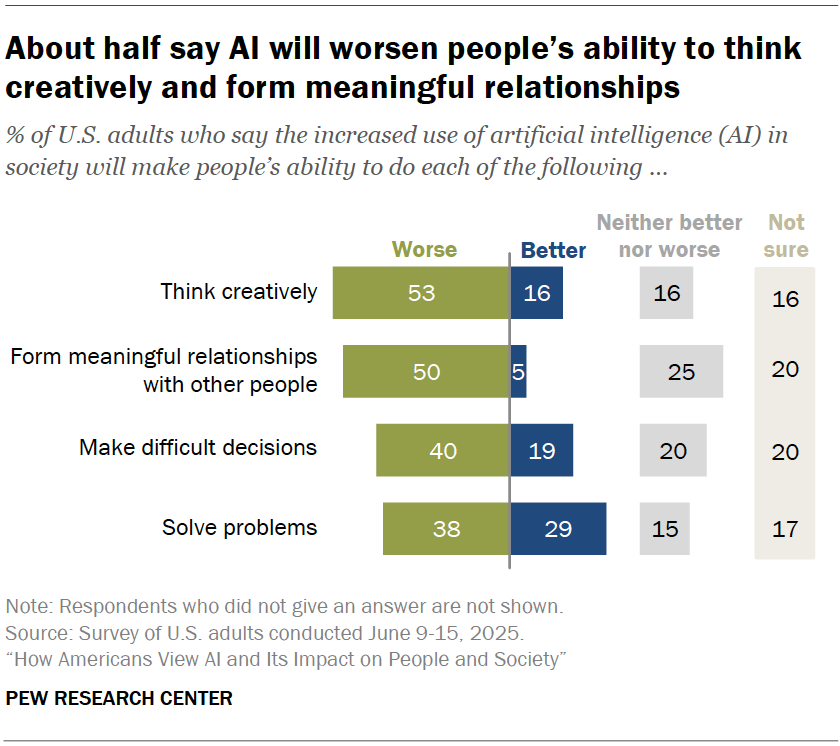
I harp on this not because I am personally opposed to all AI — it can be helpful with research, given the degradation of Google, and it provided important translation and guidance as I navigated my health issues these past two years — but because it is exceedingly rare for one thing (be it technology, law, philosophy, or suite of policies) to hold so much power in the public imagination.
As I’ve written, the free trade deals of the ‘90s and early 2000s are seen, especially by working people, as fundamentally responsible for economic stagnation and decline, a perception that has doomed Democrats across the South and parts of the Midwest. Similarly, the federal government’s decision to bail out banks while allowing underwater homeowners to drown during the mortgage crisis created a generational narrative about the priorities of politicians and the power and impunity granted to financial elites.
Democrats own both calamities, and the neoliberal influences that drove those decisions are now pushing the party’s leaders toward a failure of similar scope and consequence. This can be mitigated, and there are Democrats who are outspoken in their efforts to rein in this technology instead of giving its creators carte blanche to restructure society as they see fit. Donald Trump and Ted Cruz are currently the faces of enabling algorithmic overlords. Democrats should know instinctively to run in the other direction.

Legendary director Rob Reiner and his wife Michele were stabbed to death in their Brentwood home this weekend — allegedly by their son, Nick. Tragic, heartbreaking. An incalculable loss, one that plunges us further into a darkness that Reiner spent his life combatting.
Texas Republicans drew their gerrymandered Congressional map under the assumption that the rightward shift by Hispanic voters last year was permanent. Polls and special elections indicate that they may have been overconfident, endangering what was intended to be a five-seat House pickup.
State Supreme Courts have largely been bulwarks of democracy, at least when it comes to ballot initiatives. But in Arkansas, the state high court just handed the legislature the power to gut voter-approved laws, rendering the initiative process almost toothless.
Here’s a nice look at how public employees, union activists, and everyday Utahns forced Republicans to repeal their ban on public employee collective bargaining.
Wait, Before You Leave!
Progress Report has raised over $7 million dollars for progressive candidates and causes, breaks national stories about corrupt politicians, and delivers incisive analysis, and goes deep into the grassroots.
None of the money we’ve raised for candidates and causes goes to producing this newsletter or all of the related projects we put out. In fact, it costs me money to do this. So, I need your help.
For just $5 a month, you can buy a premium subscription that includes:
Premium member-only newsletters with original reporting
Financing new projects and paying new reporters
Access to upcoming chats and live notes
You can also make a one-time donation to Progress Report’s GoFundMe campaign!
I’m 100% subscribed to your Substack. I would never quit you. I think you’re amazing. Your surgery is going to make you better and stronger. You have my total support and I don’t know what I would do without you.