

Welcome to a Saturday edition of Progress Report.
There’s a lot of action percolating here at Progress Report headquarters: I’m collecting potential participants for an interview series with state and local candidates in this year’s elections; pulling together another series, this one focused on shaping a future progressive platform; and I’m finishing up the MAHA story that I’ve been working on for months.
As for today, there is a whole lot of news to discuss and analyze: Redistricting battles, the fight to restore direct democracy, a whole bunch of Democratic primary challengers, polling, positive policy developments, and much more. Let’s get to it.
Note: Paid subscriptions are dropping and it’s making it very hard to continue doing this work, because I have to do more freelancing as a result. If you appreciate the writing or learn something from it, please consider supporting Progress Report with a paid subscription. It’s just $5 a month.


🗳️ Voting rights: The Supreme Court just tried to Friday news dump the potential demise of what remains of the Voting Rights Act.
The court late Friday afternoon formally requested new briefs in Louisiana v. Callais, a multi-year fight over a federal court order instructing the state of Louisiana to draw a second Black-majority Congressional district. Louisiana used the subsequent map in 2024, and the high court further delayed the case in late June. Now the court is asking lawyers to argue over whether the second Black-majority district, ordered under the auspices of Section II of the Voting Rights Act, violated the 14th and 15th amendments.
Passed in the wake of the Civil War, the two amendments have long safeguarded the rights of racial minorities. Over the past few decades, the conservative movement has been on a mission to pervert their meaning, arguing that programs intended to even the playing field are discriminatory against white people. The Supreme Court used the argument to eliminate affirmative action from college campuses; now the court may be ready to cite the constitutional amendment passed to ensure Black people’s citizenship to finally kill what remains of the law that ensured their right to vote.
Taking back the ballot initiative
It was good while it lasted: between 2016 and 2022, progressives racked up big policy wins in red states with wildly popular ballot initiatives. Medicaid expansion, minimum wage increases, paid leave, abortion rights — it was all popping off, much to the chagrin of Republican majority legislators.
Progressive initiatives have continued to succeed over the past few years, but Republican legislators have gone from simply angry to actively sabotaging. Initiatives have been repealed, gutted, and tossed out by courts, while the process itself has been made increasingly difficult to even access.
This spring was particularly brutal: Republicans in Missouri and Nebraska each gutted increases to the minimum wage, while Michigan did so on a bipartisan basis; Florida, Arkansas, and Utah made it almost impossible to qualify an initiative at all.
Now activists in those states are fighting back, launching new initiatives that they hope can harness popular anger and overcome the hurdles put up by Republicans.
In Arkansas, persistence has paid off for a group called Protect AR Rights, which finally convinced the state attorney general to certify its ballot amendment after two failed attempts. AG Tim Griffin rejected both attempts by citing the state’s new law, which requires that the amendment maxes out at the eighth grade reading level. This time, Griffin tweaked some of the wording of the title and amendment itself, which would restore direct democracy in the state, but gave the green light to organizers to begin collecting signatures.
A bipartisan coalition of activists in Missouri took a big step in its effort to stop lawmakers from screwing with successful ballot initiatives after they pass. Triggered by the GOP’s slowdown of the minimum wage increase and repeal of a paid time off requirement passed by voters last year, a group called Respect Missouri Voters submitted 38 versions of an initiative intended to prevent such injustices from happening again. The initiatives would make it almost impossible for lawmakers to repeal voter-approved laws or make the direct democracy process more difficult.
Though not directly connected, activists in other states are also organizing around good government initiatives meant to return democracy to the people. In Michigan, a coalition called Michiganders for Money Out of Politics is pushing an amendment that would ban regulated public utilities (think energy providers and gas companies) and state contractors from donating directly to political candidates and a slew of other political organizations. Their executives would also be banned from making political contributions.
In addition, the proposal would require groups that make any sort of political ad in the lead up to the election to disclose their donors, blowing up dark money groups that try to fool voters. Michigan would be the first battleground state to require such disclosure.
Similarly, activists in Montana just submitted the text of a ballot measure that would ostensibly prevent corporations from spending money in elections by redefining them as “artificial persons.” The proposal is designed to counter the Citizens United decision, which ruled that corporations are people and thus entitled to unlimited political spending.
Primary races and fresh faces
🌴 Hawaii: Conservative Democratic Rep. Ed Case officially has a primary challenger, as state Sen. Jarrett Keohokalole announced this week that he’s seeking the party’s nomination in Hawaii’s first Congressional district.
At 41 years old, Keohokalole is more than three decades younger than Case, and offers both a generational and ideological contrast to the 72-year-old incumbent. Case, now in his sixth term, has always been further to the right than most Hawaii Democrats; this year alone, he’s rankled locals by siding with Republicans on the SAVE Act (the terrible citizen-only voting bill) and voting to censure Rep. Al Green for his brief protest against Medicaid cuts during Trump’s address to Congress.
“This is a very frustrating time in our country, and it's having really immediate and difficult impacts on our community here in Hawaiʻi,” he said when making his announcement. “To have 30,000 kamaʻāina about to lose their health care, to have public education funding be cut, to make more room for the wealthy in the form of tax breaks. I don't think it makes any sense. And I think there's more we can do about it.”
Keohokalole has served in the state legislature since 2014 and currently chairs the state Senate’s Commerce Committee.
🌭 Illinois: Rep. Danny Davis will retire from Congress at the unusually young age of 83, calling it a career after just 15 terms in office.
Davis had initially proceeded as if he planned on pushing past 30 years in Congress but instead bowed to the newfound pressure on elderly Democratic incumbents. In announcing his retirement now, he’s hoping to give an edge to his chosen successor, state Rep. La Shawn Ford, in what should be a very crowded primary field.
At least nine Democrats have declared their candidacies for the safe blue seat representing Chicago, including the city’s treasurer, Melissa Conyears Ervin. Several others are said to be considering the race.
🚆 Connecticut: Former Hartford Mayor Luke Bronin announced that he’s jumping in to challenge long-serving Rep. John Larson, whose age and recent health scare have created questions about his future in Congress. Larson, 77, froze up while speaking on the floor of Congress in March, an incident that his staff blamed on a “complex partial seizure” connected to a heart valve replacement.
Bronin has been eyeing higher office for years now and recently mulled a run for governor, only to switch gears when it became clear that Gov. Ned Lamont would be running for a third time. In an interview with local journalists, Bronin, 46, highlighted the affordability crisis and need for generational change.
"Our country is in crisis, our party is in crisis, and we have to start doing things differently," Bronin said. "What's happened in our country and what's happened to our party over the last year is a huge wake up call, and as a Democratic Party we better start showing that we see that and that we're making the changes we need to make."
Larson is facing several primary challengers, though Bronin, who served two terms as Mayor of Hartford and led the city out of bankruptcy, is likely the most formidable.
🐯 Missouri: Rep. Emanuel Cleaver taking fire from all sides lately. Just as Republicans are threatening to unfairly redraw his Kansas City district, a growing number of Democrats are plotting to ensure that he won’t be on the ballot no matter what the 5th Congressional district looks like next year.
There are now two Democrats who have officially declared primary challenges to Cleaver, both of whom are several generations younger than the 80-year-old lawmaker. This week, a former radio host named Hartzell Gray, 33, announced what he called a “pro-people” campaign focused on economic populism. He has scored the endorsement of the Progressive Democrats of America.
“This moment doesn't require us to get back to a status quo, this moment requires an unapologetic progressive,” Gray told the local NPR affiliate. “This is a campaign rooted in our people. We have done so much history together, and we have so much more to do, and none of that can include platitudes.”
Jordan Herrera, an Air Force vet and lawyer, announced his candidacy in March. Openly queer, he’s campaigning on protecting LGBTQ+ people and tackling affordability issues. Herrera worked for the Missouri Attorney General’s office until last month, when he was fired out of what he called retaliation for attending an anti-mass deportation protest.
For more about Democratic primary challengers:

🙄 Read the room: Disgraced former Gov. Andrew Cuomo spent much of the Democratic mayoral primary campaign trying to smear Assemblyman Zohran Mamdani as an anti-semitic threat to New York’s Jewish communities. The effort didn’t work, obviously, and now we know why: New York Democratic voters understood and shared Mamdani’s actual position, support for Palestinians simply trying to survive a genocide.
In a new poll from Data for Progress, 62% of Mamdani voters indicated that his support for Palestinian rights was a very important factor in their decision at the ballot box. Another 26% of his supporters said they appreciated his standing up for Palestinians but that it did not sway their vote either way. Interestingly, when framed as his willingness to stand up to the Israeli government, 46% of Mamdani’s voters said that the stance influenced their vote, while 42% said it was an important issue but didn’t impact their vote.
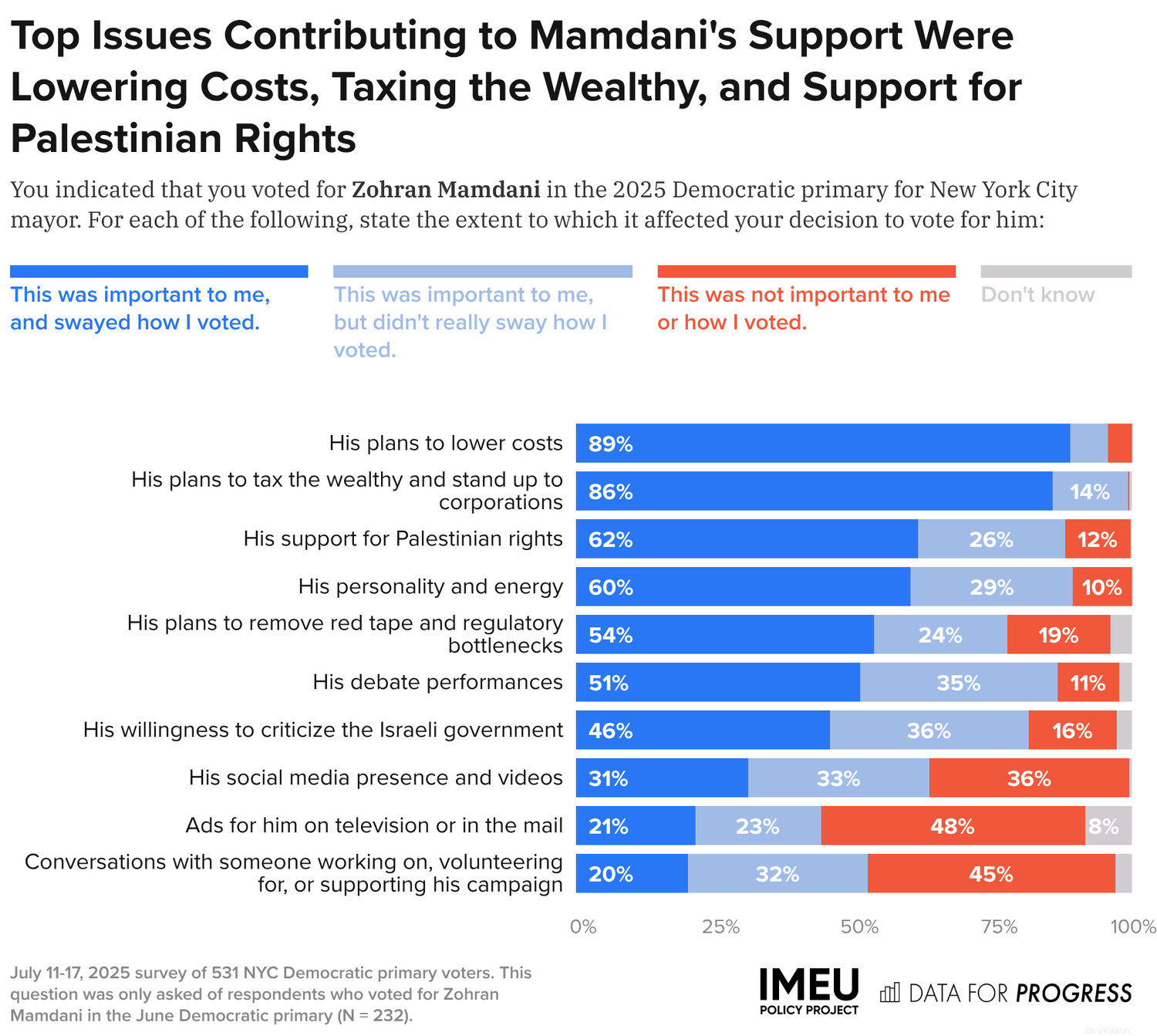
What’s clear is that New York Democrats — who constitute a vast majority of the city’s voters — have seen through Cuomo’s dishonest smears. That news may not have filtered down to him, as the disgraced former governor has continued to call Mamdani a dangerous anti-semite during his various TV interviews. He’s three decades late in his attempt to fan tensions between Jews and people of color in New York. As the top issue in the chart above indicates, it’s populism that wins now.
😠 Redistricting: The Supreme Court ruled that partisan gerrymandering is beyond the scope of the federal judiciary back in 2019, setting up the pending nightmare we currently face today.
Under pressure from Donald Trump, Texas Republicans released their proposed gerrymandered Congressional map this week, complete with five districts that would likely flip from blue to red. Additionally, New Hampshire Republicans this week said that they’re also looking at redrawing their Congressional map, in order turn one of its two districts red. Ohio is obligated to draw a new map, which will likely be even redder than the current configuration.
If nothing else, it’s been heartening to see Democrats do more than complain and clutch propriety as Republicans rig the game. Driven no doubt by his own ambition (and in this case, I’m fine with that), California Gov. Gavin Newsom has been leading the response from blue states. Yesterday, he revealed his plan to run an end-around: the Democratic supermajority in the legislature would pass a new map and put it to voters to approve in November.
“This is not going to be done in a back room. This is not going to be done by members of some private group or body,” Newsom said. “It’s going to be given to the voters for their consideration in a very transparent way so they know exactly what they’re doing and they can go back in 2030 to original form with our independent redistricting intact.”

New Mexico: Lawmakers are likely going to be summoned back to Santa Fe for a special legislative session in the next month or so, mostly to deal with a Trump-induced budget shortfall. In the meantime, momentum is building for a bill that would ban federal immigrant detention centers from being built in the state. The proposal became far more viable this week, when a spokesperson for Gov. Michelle Lujan said that she’d be open to signing some version of it.
Los Angeles: On a related note, LA County is moving to ban law enforcement from hiding their faces and identities while on duty, a response to the brutal raids and invasion of federal troops that have terrorized the region.
Colorado: There was a mutual disarmament in Denver this week, as labor unions and business groups pulled dueling ballot initiatives that sought to remake workers’ rights in the Centennial State.
Unions moved first, taking down a proposal that would have enacted “just cause” job protections that require employers to have a valid reason for firing somebody. When that initiative disappeared from the Secretary of State’s website, sponsors of Initiative 39, which proposes making Colorado a full “right to work” state, took theirs down, too. The state AFL-CIO is considering a number of possible initiatives and legislative campaigns, which will benefit from having Gov. Jared Polis no longer in office.
Oregon: Gov. Tina Kotek signed a package of bills aimed at spurring new housing construction, including multi-family buildings and modular homes. One of the bills bans local governments from preventing the construction of duplexes and triplexes on land zoned for single family units, and another streamlines the approval process in part by creating a standardized land use and design standards.
Wait, Before You Leave!
Progress Report has raised over $7 million dollars for progressive candidates and causes, breaks national stories about corrupt politicians, and delivers incisive analysis, and goes deep into the grassroots.
None of the money we’ve raised for candidates and causes goes to producing this newsletter or all of the related projects we put out. In fact, it costs me money to do this. So, I need your help.
For just $5 a month, you can buy a premium subscription that includes:
Premium member-only newsletters with original reporting
Financing new projects and paying new reporters
Access to upcoming chats and live notes
You can also make a one-time donation to Progress Report’s GoFundMe campaign — doing so will earn you a shout-out in the next weekend edition of the newsletter!