

Welcome to a Tuesday night edition of Progress Report.
First, the New York Knicks are in the NBA Finals.
Second, Texas Republicans just voted to make one of the nation’s biggest scumbags their Senate nominee, a disturbing development with a big silver lining: Democrats have a legitimate chance of winning a US Senate seat in Texas for the first time in several generations.
Third, tonight we’ll dive into a grassroots campaign that’s setting the pace for what the left can accomplish with real planning and long-term strategic vision.
Note: I’ll be honest, this newsletter’s paid subscribers have plummeted since I came back from open-heart surgery. It’s making it hard to do this work, because there are real expenses, including site coding, web hosting, resources, media access, and more. This is a second full-time job, and if you can help make it sustainable, it will allow me to report and amplify stories you won’t find elsewhere.
With my birthday coming up later this week, I have a goal of adding 40 new paid subscribers and for a limited time, I’m offering 40% off the paid subscriptions that keep us afloat — that’s just $3!


There’s a fascinating experiment in democracy and policy underway in Tacoma, Washington.
Three years ago, a grassroots coalition in Washington’s second-biggest city harnessed growing frustration over exploding housing costs and used a ballot initiative to pass expansive tenant protections that it hoped would keep rent down and evictions to a minimum. They won by overcame vehement opposition from lawmakers and the most expensive campaign in city history, staring down the all-powerful real estate lobby and winning by 300 votes.
The upset was just the beginning; victory proved pyrrhic when the city council decided to essentially ignore the Tenants Bill of Rights duly enacted by voters. That part of the story is sadly not unique in an age of pro-business autocracy, but what happened next is what makes this situation highly unusual.
Instead of ruing a legal loophole that has reduced their law into a suggestion, the organizers behind Tacoma for All got to work on a new initiative that would address the structural weakness, bolster other parts of the law, and force their representatives to work on behalf of working people. The surge in rent costs and evictions over the past three years makes them an even more formidable movement, a new strength that will be key in November as the coalition braces for an onslaught of corporate money designed to smear and discredit their populist agenda.
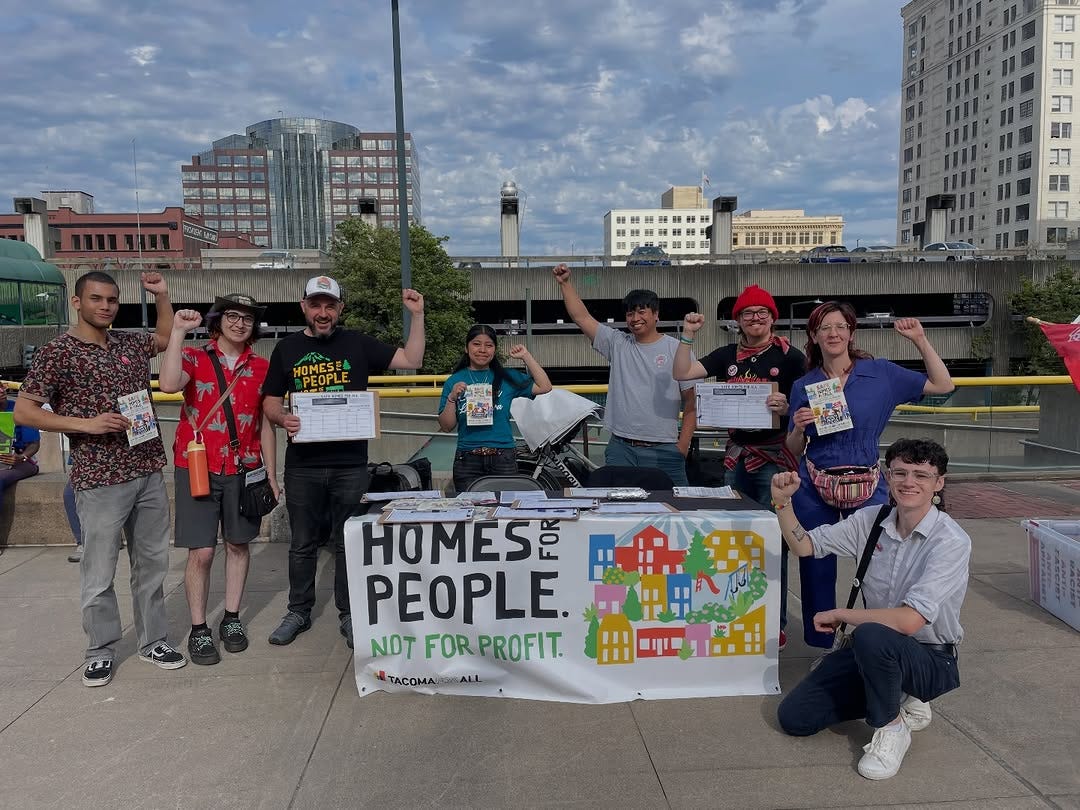
With ballot initiatives popping up all over the country, on housing and data centers and taxing billionaires and public education among other crucial issues, I spoke with Tyron Moore, one of Tacoma For All’s leading organizers, about the campaign, the struggle to overcome decades of ingrained corporate power, and the ins and outs of winning this next election, and how his movement is building people power to fundamentally change the city and its politics.
This Q&A has been lightly edited for clarity and length.
Progress Report: This is an ongoing saga. Walk me through how the 2023 campaign came together.
Ty Moore: This was something immediately out of COVID where there was a profound crisis of evictions. All the eviction protections were being progressively dismantled. Rent had gone up 40% in five years in Tacoma. A bad housing crisis was made worse.
Tacoma for All emerged out of Tacoma DSA’s Housing Justice Committee. Our platform was much more expansive than what we eventually ran as an initiative — it included mass affordable housing, social housing, tenant protections. We built a significant coalition around that.
The city council effectively ignored us, so by the end of 2022, we decided run a portion of that platform as an initiative. We ended up formally calling it the Landlord Fairness Code. We were a ragtag coalition. No institutional backing, no paid staff at the beginning. A lot of folks coming out of DSA and other left circles, and early union support from the grocery workers.
And you faced a lot of opposition as you gained momentum?
The city council called us up in the midst of signature gathering, when it was clear we had the momentum to get on the ballot, and asked for negotiations. They said, “If we pass something at the city level that gets close to what you want, would you consider not turning in signatures?” And we said, yeah, okay, we’re open to that.
We had a series of five real negotiations; multiple city council members, staff, the city attorney, the city manager. In the end, what they offered was far from acceptable. They did come significantly our way on other things like limiting late fees, limiting move-in fees, notices for rent increases, but not enough. So we moved forward.
Then the landlord lobby and real estate interests really came in — they’d been holding back publicly, though clearly organizing and raising money in the background. It ended up being the most expensive election campaign in Tacoma history.
What did the Landlord Fairness Code win in the end?
We won some of the strongest eviction protections in the state. A six-month cold-weather eviction moratorium. A school year eviction moratorium for households with children and educators.
We won relocation assistance, so any rent hikes over 5%, landlords had to pay at least two months’ rent in relocation assistance. If it went up to 10%, it was three months’ rent. Landlords cried foul that this was backdoor rent control.
We won six-month notice for all rent hikes. Limiting late fees to $10 a month on back rent. Limiting move-in fees to no more than one month’s rent and fees, whether that’s a security deposit or other fees.
Then the city just didn’t enforce it.
There was no city enforcement. We built in a strong private right of action, but we did not build in city enforcement, and that was a political decision. We knew it was a problem, but we didn’t want to bite off more than we could chew.
From day one, the city said, “We will not enforce the Landlord Fairness Code.” There’s two sets of tenant protections — there’s something called the Rental Housing Code that the city itself passed, and technically they do enforce that, but there’s only been one fine against one landlord in the last three years since they were supposed to be strengthening enforcement. And then for the Landlord Fairness Code, there’s been zero enforcement.
How is enforcement supposed to work?
There’s a hotline tenants can call. The first priority is to attempt to reach a settlement. They call the landlord up and say, “Hey buddy, looks like you’re violating the law here, what’s your side of the story?” If they decide the landlord probably is violating the law, they’ll pressure them to come into compliance with the threat of a fine. And they say in most cases, those do eventually come into compliance.
But tenants don’t even know this resource exists. And it often takes a very long time. Tenants in the worst slumlord places are subject to retaliation. They get no compensation; so maybe in the end an illegal rent hike gets reversed, but the landlord just hikes the rent anyway on a delayed timeline with proper notification.
We’ve talked to many, many tenants who’ve heard that the city doesn’t do shit, it doesn’t really change anything. And they know as soon as they call, it puts their landlord on notice that they’re a problem. In the worst complexes in the city — the ones our bill was designed to help — calling the city is a real deterrent to tenants.
With no fines, there’s no deterrent to landlords. The worst thing that happens is the landlord gets a lecture and has to come into compliance with this one individual tenant. They’re going to bet that most tenants will never file a complaint.
So what does the new initiative do?
First, when a tenant calls the hotline, their job would not be to attempt to find a settlement. Their job is to investigate. If there’s been a violation, it’s to actually cite the landlord, put it on record that there’s been a violation. And then the city shall issue a fine of no less than $500 and up to five times the harm caused to the tenant. And that fine shall go directly to the tenant.
So it changes the incentive structure. It offers a potential for the tenant to have some justice, especially if there’s been harm caused. And hopefully it will act as a more meaningful deterrent to landlords who systematically violate the law.
How do you ensure they actually enforce the new law, given what happened with the old one?
The honest answer is we have no guarantee at all. They will face political pressure, there’ll be a public mandate, we will name and shame and expose examples. That’s the only mechanism.
If this was just a one-off thing, we might even question whether it’s worth it. But this is about building a movement, building political power. The more the city gets on the wrong side of public opinion, the stronger the momentum toward electing city council members who will actually stand up for tenants. That’s part of the longer-term strategy as well.
The city council also tried to roll back what passed in 2023, right?
They made an attempt to severely roll it back. One council member — a landlord herself and the closest to the landlord lobby — had been threatening to do it for a long time. By law they can’t touch initiatives until two years after its implementation date. She began preparing her rollback well in advance of that, and then scheduled a vote.
We mounted a very concerted effort. The policy she dropped publicly in early October was very different from what actually passed on December 8th. We had hundreds of people coming again and again to public comment, thousands of letters being sent.
In the end, the rollback was actually relatively minor. The biggest thing they achieved was exempting non-profits from the law. Most of the core victories were preserved.
Why does the city council keep fighting things that passed with popular support?
Tacoma’s an interesting place. In the popular understanding of Washington state politics, you might call Tacoma more purple than Seattle by a long shot. But things have been changing. The sweep of national politics is absolutely impacting Tacoma. We rode that wave in 2023. There’s a lot of young people moving here.
But the city council is pretty out of step and does reflect a more conservative, business-friendly orientation. And sometimes we think of politicians as overly calculating, but they just believe what they believe. They’re pro-landlord and pro-market. They believe tenant regulations undermine affordable housing by making it more expensive to build here. So I think they were just ideologically opposed.
The initiative also includes the right to form a tenants union. Is there a big tenants union movement unfolding in Tacoma?
That’s a whole other side of the story. Last year we launched a 501(c)(3) whose main mission is organizing tenant unions. The first strike-ready tenant union went public in December. We now have four more that have gone public, representing six buildings. There’s a supermajority of an entire portfolio of a California-based landlord who owns a bunch of properties in Tacoma — they’re now unionized and fighting to get that landlord to the negotiating table.
The initiative would give that real legal footing. It says landlords must come to the table and bargain in good faith when there’s a majority union. And it gives other protections — just like OSHA standards must be posted prominently in every workplace, if our initiative passes, every laundry room, every entryway, every public space in any building will need prominent posters saying, “You have the right to form a tenant union.”
We are trying to combine an organizing strategy that’s been showing some great successes in the first months, alongside a political strategy to strengthen organizing rights. Most tenants are like: “What the hell’s a tenant union?” Never heard of it. But hopefully through the initiative, we can generate a lot of debate about it and point people to the resources to organize one.
It’s an interesting idea to create a legal structure around tenant’s unions, because generally there’s nothing compelling landlords to bargain.
There’s no equivalent of the NLRB or the equivalent state bodies for tenants. We based ourselves on the model of a 2022 law in San Francisco. Similar laws have passed in a couple of different Bay Area cities. It kind of creates a miniature NLRB where the city gets to issue fines and hold landlords accountable if they do not bargain in good faith.
You try to distinguish between small and large landlords in the legislation, put more onus on the corporate landlords. Has that helped politically?
We tried to give some carve-outs, at least in terms of how the policy is paid for — putting more of the licensing fee burden on big landlords. We don’t exempt small landlords from the same laws. Their tenants have the same exact rights as tenants of big landlords. But in terms of the licensing fee structure to pay for it, we try to put that more on big landlords.
To be real, we’ve gotten a few token small landlords to publicly speak out for this initiative and the previous one. Our attempt to split the petty bourgeois from the big capitalists is pretty limited.
What’s the strategy to win the vote this fall?
Our central strategy is appealing to people’s basic sense of decency. Shouldn’t everyone have to follow the law? Isn’t it wrong that just because you’re a big corporate landlord, you can jerk the law with impunity? That’s not fair. And then to lift up the stories of tenants — these slumlords — to talk about what their experience has been.
If people go to the voting booth thinking, “Should landlords have to follow the law? Do I stand with the tenants whose rights have been clearly violated, who are being forced to endure undignified conditions?” — if that’s the narrative, I think we win easily.
Obviously the opposition is going to try to make the narrative: this is punitive, it’s going to drive small landlords out, it’s too much regulation, we’re going to undermine affordable housing. If those are the questions voters are thinking about most when they go to the ballot, I think we will struggle to win. So it’s a battle of the narrative.
We have our work cut out for us on lifting up tenant stories, and we haven’t done that as well as I’d have liked yet. We have some good videos in the pipeline for social media, and I think we’re going to be able to do that in the fall.
Wait, Before You Leave!
Progress Report has raised over $7 million dollars for progressive candidates and causes, breaks national stories about corrupt politicians, and delivers incisive analysis, and goes deep into the grassroots.
None of the money we’ve raised for candidates and causes goes to producing this newsletter or all of the related projects we put out. In fact, it costs me money to do this. So, I need your help.
For just $5 a month, you can buy a premium subscription that includes:
Premium member-only newsletters with original reporting
Financing new projects and paying new reporters
Access to upcoming chats and live notes
You can also make a one-time donation to Progress Report’s GoFundMe campaign!
City councils will always be old and out of touch as long as their pay is so low that only retired people or well off business owners can afford it
I was an inadvertent landlord when I couldn’t unload my condo for a decent price back in the aughts. I did all I could to keep my tenant happy. A good tenant is also a paying tenant. I also didn’t raise the rent beyond what the market could take. I guess I don’t get the “profit at all costs” mentality. I hope this works out for everyone in Tacoma.