

Welcome to a Friday edition of Progress Report.
I’m working on a piece about the Trump administration’s invasion of American cities and how we can help residents resist the ICE thugs and soldiers terrorizing their streets. I’ll have that out this weekend, but in the meantime, I’m re-upping my report on a revelatory new study about how Democrats can win back working class voters, especially in the all-important Rust Belt states.
Note: The far-right’s fascist takeover of this country is being aided by the media’s total capitulation to Trump’s extortion. It’s never been more critical to have a bold independent media willing to speak up against the powerful. That’s what I’m trying to build here at Progress Report, despite the political and legal dangers that presents.
Unfortunately, paid subscriptions are dropping and it’s making it very hard to continue doing this work, because I have to do more freelancing as a result. If you appreciate the writing or learn something from it, please consider supporting Progress Report with a paid subscription.


History is shaped by populist movements and working class majorities, though you wouldn’t know it by the way Democrats have governed and campaigned over the past few decades. The catastrophic misguidedness of the party’s embrace of the elite became indisputable last November, when the final remnants of the New Deal coalition dissolved amid working class voters’ decisive turn to a Republican Party offering a cynical and seductive right-wing populism.
This was less a realignment than existential disaster, given the rapid dissipation of the professional middle class and the geographic peculiarities of the electoral map. As a result, the future of the United States as anything other than an oligarchical autocracy depends on the rise of progressive populism and its restoration at the heart of the Democratic Party.
New research by the Center for Working Class Politics (CWCP) reveals the potency of true progressive populism, and perhaps more importantly, offers a guide to the policies and rhetoric that can both best connect with voters and change their material conditions. The CWCP surveyed thousands of voters in the Rust Belt states that used to be the Democratic firewall — Michigan, Wisconsin, Pennsylvania, and Ohio — to better understand what they think of the current Democratic Party, which kinds of ideas and language most appeal to them, and how their values shape their beliefs.
I reviewed the study’s results with CWCP director Jared Abbott this week, and below you’ll find analysis of its most interesting findings and Abbott’s thoughts on what they mean.
Sleeping on Woke
For four years now, conservatives have lambasted Democrats as the party of “woke,” turning what was once an urban term for socially conscious into a stand-in slur for every kind of perceived deviance from white, Christian, conservative identity. It is the catch-all enemy in every right-wing culture war, a high crime punishable by ad hoc federal defunding by the Trump administration. But it is not, according to this wide-ranging survey, actually the main reason why Democrats are so loathed by voters at this moment.
To be clear, the Democratic brand is in the gutter, but peoples’ politics are animated by far more consequential issues than pronouns. CWCP’s report finds that just 11% of independents and 19% of Republicans cited Democrats’ supposed “wokeness” as the main reason why they dislike the party. Instead, it’s a sense that the party has become corrupt and out of touch with everyday people that has animated much of the animus against Democrats in the four Midwestern states.

Progress Report: I was surprised to see “wokeness” as a relatively minor objection to Democrats, and really interested by the broad viewpoint that they are “corrupt” and untrustworthy — especially in an era when Donald Trump and Republicans are so brazen about quid pro quo, self-enrichment, and helping out billionaires. Democrats have people like Bob Menendez, but not nearly to the same degree.
Jared Abbott: People do care about the “woke” stuff, but it’s not the top of mind issue for most people. Corruption is something that I think a lot of Democrats just think of as a Republican thing, but it really resonates with independents and even some Democrats as a way to talk about the ways in which elites — both political and economic — are pulling the wool over our eyes.
The former president of Mexico, AMLO, his whole economic populist agenda was about fighting corruption and he had this very expansive notion of what that meant, including bad neoliberal economic policies. I think that’s language that Democrats could be using a lot more because they need to address the fact that they’re being viewed as corrupt; not necessarily because they’re doing backroom deals and taking bribes, but because they seem of a piece and in cahoots with the economic elites in this country that have been leaving working people in the dust for 40 years.
Progress Report: Did people give an indication of what they mean by corruption? It seems more about systemic power than individual enrichment.
Abbott: Corruption is viewed more broadly as people are rigging the system for their own benefit and they’re screwing over everybody else, not in the narrow sense of taking bribes like Bob Menendez or something.
Progress Report: How much of it, do you think, has to do with the fact that so many prominent Democratic elected officials, like Nancy Pelosi, are really wealthy? Is it a function of the education polarization?
Jared Abbott: There’s a couple of people that in their answers to open-ended questions said that the Democrats are the party of the rich and corrupt. Independents and definitely Republicans view Democrats as the party of the wealthy and elites, and even though it’s obviously true that Republicans are the party of the ultra, ultra-elite and the ultra, ultra-rich, it’s also true that the average income of the Democratic voter and Democratic donor has gone up a lot.
It’s also hard to disentangle people thinking of Democrats as cultural elitists because they act like their college education puts them in a higher status. I think they’re probably connected to each other.
Communities that have experienced heavy levels of deindustrialization or economic decline, both rural white areas and more urban Black and Latino areas, they’re feeling like they’re not getting what they need to get ahead economically. Their impression is that many Democrats are these very high-flying professionals that are doing really well while everybody else is suffering and Democrat politicians are just not focused on fixing that problem.
The Style of Progressive Economics Really Matters
One of the classic liberal laments is that working class people who support Republicans are voting against their own interests, a statement that is both technically true and lacking in important nuance. Application and rhetoric make an enormous difference in how people receive and relate to policy, because self-interest goes far beyond cold financial calculation. People often vote for their values, not their net worth, especially when they have little reason to believe that the latter will actually improve.
In this study, CWCP provided a mix of “strong” populist rhetoric, which offered a sharp critique of corporate power and its negative impact on workers, and “weak” populist rhetoric, which involved less blame assigned for social inequities. The former was more analogous to Bernie Sanders’ broad moral outrage at systemic corporate abuses, while the latter used rhetoric taken directly from Kamala Harris’s presidential campaign, which posited that most businesses played by the rules and that the economy was skewed by the misdeeds of a few bad actors.

All told, strong populist rhetoric was 11 points more persuasive to the survey’s Rust Belt respondents, and that’s without taking into account the actual policy prescriptions that were offered in the study. Drilling down into the cross tabs, strong populist messages were especially persuasive to the kinds of voters who have drifted away from Democrats in recent elections. Respondents who have working class jobs preferred strong populist messages by 22 points, while those with annual incomes beneath $50,000 favored the blunt and confrontational economic rhetoric by 18 points.
The CWCP survey also asked respondents to consider 25 different policies, which were split between mainstream Democratic proposals, more progressive ideas, and some more classic supply side mainstays. The study also categorized the policies as either pre-distributive or redistributive, the former focused on shifting power dynamics in the workplace and economy to create a fairer playing field.
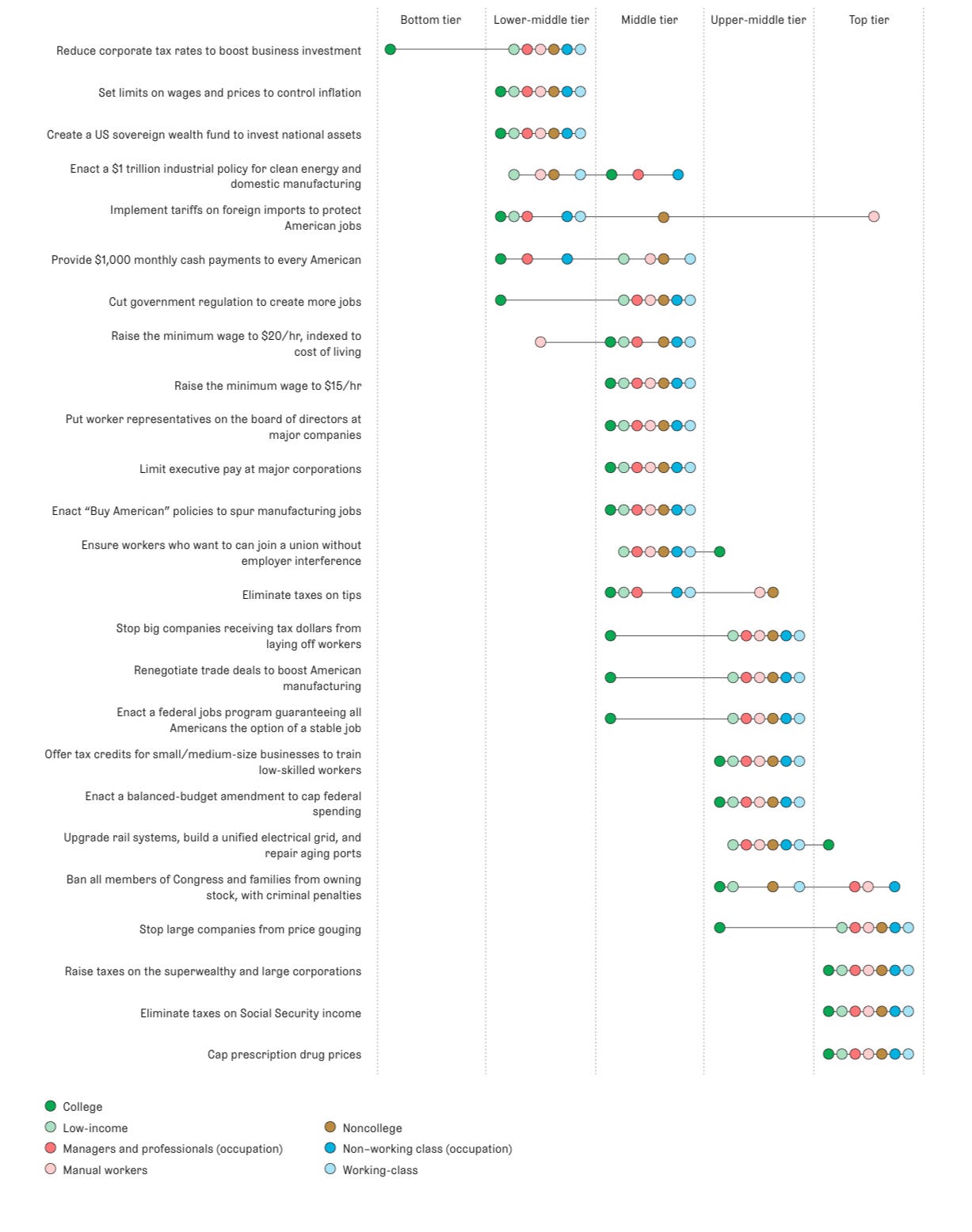
“A core set of fairness-driven, anti-corruption, and economic security-focused proposals consistently landed in the top tiers for both working-class and more affluent respondents, pointing to significant potential for broad-based coalition building around these issues,” the report notes.
Progress Report: There is solid support for things like raising the minimum wage, which explicitly support outcomes, and are what you’d call redistributive, but direct benefits aren’t necessarily as popular as one might expect. At the same time, I’m very interested in how many process-oriented policies are so highly ranked. Does that emphasis on opportunity over outcomes have something to do with American ambition, or is it internalized conservativism about who deserves help?
Abbott: It is important to note that there were a couple of redistribution elements that were really, really popular, like taxing the rich. That was tied for number one among both Democrats and independents. Eliminating taxes on Social Security insurance, that’s also redistribution. And poll after poll shows that people across the board really highly value Social Security and Medicare and even Medicaid.
But there’s other kinds of redistribution that are a little bit more controversial, that might be easier to paint as going to some group that — if I’m some independent or Republican voter — I might think they don’t deserve it.
Things like targeted social welfare programs or programs that are means-tested or other programs that seem — to some people, anyway — to be less about letting me as a working person have the opportunity that I need to lead the life that I want to lead and to have the kind of economic future that I want. To the extent that working people care about pre-distributive policies, there’s a sense that my position in society is strengthened and my social status might even be sort of improved because I might have a good job or I’m doing things, not taking handouts.
Blue collar or working class people really value hard work and pulling yourself up by your bootstraps. They might not be opposed to progressive economics, but the style of progressive economics that you give them really matters.
The Democratic Party Penalty
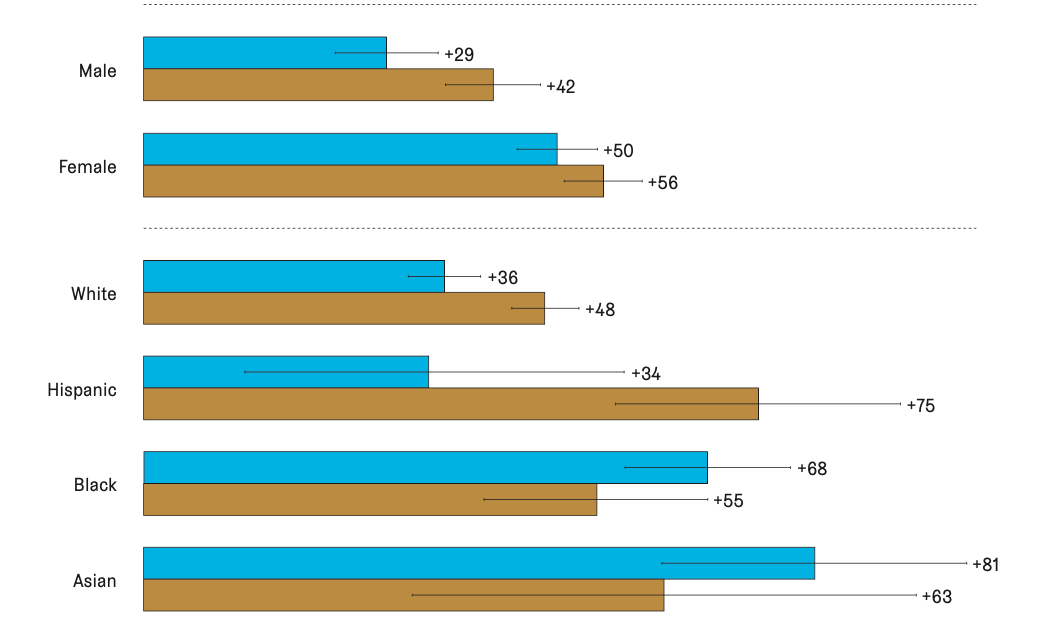
In some places, the best hope for a Democratic Party revival may be just not running Democrats at all. The CWCP study found that independent candidates who use strong populist rhetoric to promote popular ideas poll 8.4 percent better than Democratic candidates who employ the exact same strategy. The gap was especially large among working-class, Latino, rural, and swing voters, the demographics that Democrats have lost in recent years.

This dynamic played a key role in last year’s Nebraska Senate race, when union leader Dan Osborn, who ran as a populist independent, came within seven points of defeating Sen. Deb Fischer while Donald Trump was winning the state by 20 points. Osborn’s strong over-performance has him running again next year, this time against billionaire Sen. Pete Ricketts, and encouraged talk within union and leftist circles about running more independent candidates. The CWPC study found that 57% of voters would back the formation of a new caucus that it called an Independent Workers Political Association, which could provide the infrastructure and credibility for candidates like Osborn outside of the traditional party structure.
Progress Report: Osborn way over-performed, but he also got nailed down the line by GOP ads that said he was basically just a Democrat, since he’d planned to caucus with the party. You didn’t ask about that in the survey, so I’m curious how you think candidates can avoid getting nailed for that.
Abbott: I think it’s going to be a huge challenge, because if he wins, then yeah, he’s going to caucus with the Democrats. Bernie Sanders is slightly different than Democrats, but mainly because he’s just much more anti-corporate and more economically populist than Democrats. But he’s basically on the same page with Democrats on like 90 to 95 percent of the issues. Whereas Osborn, he couldn’t get away with doing that.
He would have to maintain some distance, and it’s going to create challenges where he’s going to feel like a lot of other Blue Dogs in very competitive districts who feel that they have to distance themselves from positions that the Democratic Party takes.
What we really need is a core block of economic populists, people who that’s their thing and that’s what they focus on. You can have some variation in your views on other things, but we want a core group of economic populists that are going to be pushing for big reforms to create a more level playing field for working people. But that caucus doesn’t really exist.
Progress Report: Do you see that caucus as bipartisan? Or a different version of moderate Democrats?
Abbott: It seems kind of far-fetched now because there’s not a lot of the Blue Dogs who might call themselves economic populists. Maybe they’re populists in the sense that they rail against elites and stuff, but their policy profiles don’t necessarily point to strong economic populism in many cases. And in some cases, they point in the other direction.
For an Osborne-style caucus to emerge, you would need to have some kind of space for some diversity ideologically, but a real core focus on breaded and butter economic populist policies. And that doesn’t seem like something that’s likely to happen in the short term.
Progress Report: Right now a lot of the Blue Dog members, like Jared Golden and Marie Gluesenkamp Perez, fit the bill of railing against elites but not actually supporting economic populist policies. Does this study suggest that they’re better off backing actual economic populism, or do you see them sticking to their own really local issues?
Abbott: My impression is that is the last thing that you said: They focus on really, really, really specific economic issues that are salient in their own specific districts. They’re not interested in a broader national agenda because I don’t think they have a vision for what that would look like. And so the best that they can sort of do is say let’s keep our idiosyncratic populist credentials here in our own district. I haven’t seen any broader vision of what an economic populist agenda would look like from them.
Let’s say those guys really were genuine economic populists: would they need to not just downplay their focus on social and cultural issues, but actually move to the right. I mean, it might be, but it’s not actually obvious that it is because, you know, you can... If you focus enough on economic issues, you know, that might blunt some of the concern that people have about other issues. But why they have to go so far in that direction and just sort of assume. You know, that the only option for them is the kind of like, let’s just give up entirely and just, you know, go as far in the right direction as possible. I don’t quite know. I guess I don’t quite know why they do that.
Wait, Before You Leave!
Progress Report has raised over $7 million dollars for progressive candidates and causes, breaks national stories about corrupt politicians, and delivers incisive analysis, and goes deep into the grassroots.
None of the money we’ve raised for candidates and causes goes to producing this newsletter or all of the related projects we put out. In fact, it costs me money to do this. So, I need your help.
For just $5 a month, you can buy a premium subscription that includes:
Premium member-only newsletters with original reporting
Financing new projects and paying new reporters
Access to upcoming chats and live notes
You can also make a one-time donation to Progress Report’s GoFundMe campaign!
People are sick of politicians who are motivated by greed and are willing to compromise on issues that involve their basic rights and peoples lives. Donald Trump took advantage of that by providing the illusion of change despite the fact that he’s taking the American system to its natural extreme.
They can’t! Forget it about it! The democrats are imploding!