

Welcome to a Friday edition of Progress Report.
How do I know I’m a bit of a maniac? It’s still early in my recovery from heart surgery and the only thing that makes me squirm more than the pain in my chest is watching news about democracy tick by from the sidelines. I need to rest and keep the blood pressure down, but when the news is big and my body allows for it, I’ll pop in to explain developments in stories that I’ve been covering for you at Progress Report.


Show Me Humiliation
Thursday was a landmark day for democracy in Missouri, where the state Supreme Court issued monumental rulings in two long-running fights between activists and GOP officials (read my deep dive coverage here)
In a unanimous decision, the high court gave the green light to a citizen-led ballot referendum that would reject the state’s newly gerrymandered Congressional map. In doing so, the court also blocked the new gerrymandered map from being used in the November election, likely denying Republicans an additional seat in the Kansas City area. Instead of a 7-1 GOP map, Democrats will likely retain two seats.
In Missouri, the citizen veto allows voters to weigh in on policies passed by the legislature via ballot referendum. If the initiative makes it onto the ballot, implementation of the law is paused until residents have their say on Election Day.
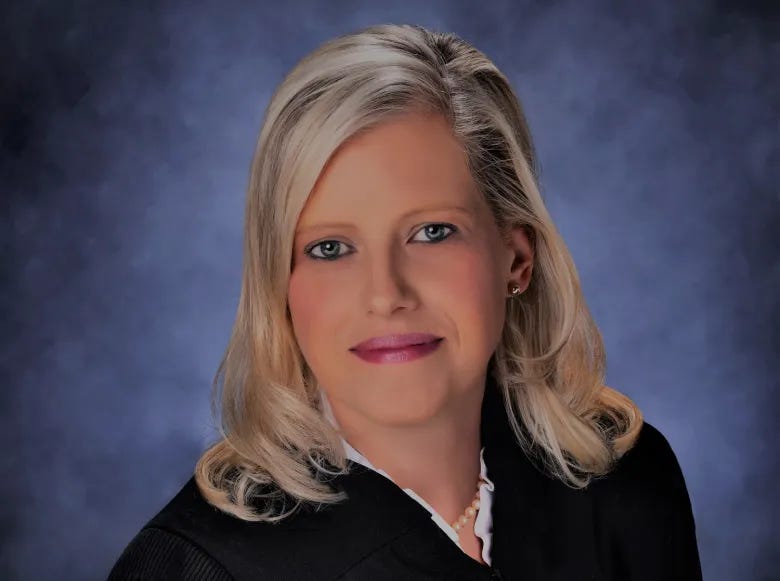
Led by a coalition called People Not Politicians, more than 300,000 Missourians signed petitions in support of a citizen’s veto, which should have easily qualified the initiative for the ballot. But Secretary of State Denny Hoskins refused to tally up the signatures, then declared the whole thing unconstitutional last month, ensuring that Missouri’s primaries were held under the new gerrymandered map. Hoskins argued in court that changing course now would be costly and cumbersome, a disingenuous point that earned a rebuke from Judge Ginger K. Gooch in her unanimous opinion.
“The secretary devotes a significant portion of his briefing to discussing the confusion, expense, and practical difficulties that may result from not utilizing the congressional redistricting in HB 1 for the November 2026 election,” Gooch wrote. “Besides being irrelevant to the secretary’s sole basis for declaring the referendum petition insufficient, these arguments are particularly misplaced given the secretary’s delay created the confusion, expense, and practical difficulties of which he complains.”

It was an unequivocal ruling, but several question marks remain. First Missouri’s Attorney General said she plans on appealing to the US Supreme Court, and there’s really no predicting how they’ll treat what should be an open-and-shut voting rights case. And second, assuming the Missouri high court’s ruling stands, it’s unclear right now how they would determine the nominees in affected districts.
One possibility is running a new primary in November and a belated Election Day after that, a messy scenario that, as Judge Gooch wrote, Hoskins brought upon himself.
The day only got worse for Hoskins and the state GOP when the Supreme Court also ruled in favor of a referendum designed to protect laws passed by citizen initiatives.
In another unanimous opinion, the court once again found that Hoskins was wrong for rejecting signatures and refusing to certify an initiative that would make it nearly impossible for the legislature to amend or overturn voter-approved laws.
The details are strikingly similar to the other case.
First, Republicans in the legislature passed a horrible law meant to circumvent popular will; in this instance, it was a rollback of a wildly popular initiative that guaranteed workers paid sick leave and raised the minimum wage, then indexing it to inflation going forward.
In response, a grassroots populist uprising steered by an idealistic-sounding nonprofit coalition (this one called Respect Missouri Voters) mobilized to protect democracy in the state, collecting signatures to qualify a referendum for the November ballot.
Then, once they’d submitted more than enough signatures (over 350,000 this time), Hoskins refused to accept the petitions, declaring that the whole initiative was unconstitutional — only to have the state Supreme Court tell him to knock it off and order the referendum be placed on the November ballot.
And once again, Hoskins got scorched by Judge Ginger K. Gooch, who essentially called his claims baseless and laughable.
“Because his certificate fails to identify any reason the petition is insufficient under theMissouri Constitution, it does not comply with (Missouri statutes) and preserves nothing for this court’s review,” Gooch wrote. “Even if the secretary had preserved his claims, nearly all assert constitutional violations that may or will occur if the petition is approved. These hypothetical claims are not ripe for review. The two pre-election claims-violation of the single-article and single-subject requirements…lack merit.”
If approved by voters, Amendment 6 will make it virtually impossible for politicians to alter or toss out a citizen-approved initiative or amendment. Doing so would require an 80% vote from the legislature plus voter approval in a statewide election.
Note: This newsletter’s paid subscribers plummeted after I came back from open-heart surgery in November, and now it’s happening again in the wake of my latest heart surgery earlier this month. We’ve dipped below an important paid subscriber milestone, which is going to really hurt the newsletter long-term unless we can pick things back up. I’m working hard to recover and get back to my best in these terrifying times, and your support to help keep Progress Report afloat is crucial right now.
You can also make a one-time donation to Progress Report’s GoFundMe campaign!
Judge Gooch wins Hero of the Week! Go Gooch!
Hoping they can keep it away from the Supreme Court, who is getting worse every day.