
Welcome to a Wednesday edition of Progress Report.
Thanks all for your kind words about Monday’s piece and good wishes on my recovery; I’ve been extra sore lately, from a healing sternum, and still dealing with serious pumphead, but I’m getting there. I’m trying to improve my focus, and writing this newsletter helps.
One bit of news: Activist Cameron Kasky has dropped out of the Democratic primary in NY-12. As I’ve written, I helped Cam with his campaign, and before my surgery, made both his launch video and a viral hit about the nightmare of political fundraising.
Since returning from the West Bank in December, Cameron has worked with Rep. Ro Khanna on a bill that sanctions illegal Israeli settlements. He’s now going to advocate for its advancement in Congress and try to make it a key issue in blue seat primaries.
Okay, now to tonight’s big story: the future of democracy.
Note: The far-right’s fascist takeover of this country is being aided by the media’s total capitulation to Trump’s extortion. It’s never been more critical to have a bold independent media willing to speak up against the powerful. That’s what I’m trying to do here at Progress Report.
Just this week, you can help keep Progress Report afloat and build that network for half off — just $2.50 a month. Every subscription helps!
Thank you to our latest crowd-funding donors: Carl, Cindy, Lauro, and Bruce!


How do you assess the health of a democracy? Is it the ability of residents to protest without being harassed by police or shot in the face by paramilitary? Or the strength of civil rights protections? The competitiveness of elections, in a healthy and fact-driven media environment?
The question is almost academic in a country where every single one of those indicators is deep in the red, alarms blaring. But there’s another fundamental signpost of democracy under attack, one so mundane and taken for granted that its violation wouldn’t really register until it’s too late: whether voters can cast ballots and have faith that they’ll be counted in the first place.
“The vote by mail issue, I think is going to be the issue this year,” says Rebekah Caruthers, the President and CEO of the Fair Elections Center.
The “vote by mail issue” is a multi-faceted one, each an offshoot of President Donald Trump’s long-held desire to throttle or even eliminate ballot access for anybody who isn’t likely to vote for him. Last summer, he vowed to issue an executive order banning vote-by-mail, which accounted for nearly a third of the ballots cast in 2024.
Because the constitution dictates that states run their own elections, Trump has no actual authority over how they’re conducted, a federal court just rejected another executive order aimed at preventing 16 states from counting ballots that arrive after Election Day. Not that pre-established boundaries have never stopped him from attempting to impose his will.
“This president is willing to interfere, put his thumb on the scale, and to meddle into various departments, commissions and agencies that historically are supposed to be outside of the purview of the president,” Caruthers said. “Instead, we’re seeing someone hell-bent on negatively impacting the 2026 elections.”
The strategy is still revealing itself, but there are several ways in which Trump — and Republicans — are also using indirect methods to curtail the functional right to vote and have it counted.
The first is a lawsuit filed by the RNC seeking to do what Trump’s blocked executive order attempted: bar states from counting mail ballots that are received after Election Day, provided that they are postmarked by Election Day. The case, likely to be heard by the Supreme Court this spring, challenges a Mississippi law that counts absentee ballots received up to five days after Election Day, provided they’re postmarked by Election Day.
Legal experts suggest that any fair reading of the law would result in upholding Mississippi’s policy, but this is the Roberts Court, which has frequently prioritized partisanship over even the textualism its majority purports to hold sacred. Worryingly, the Supreme Court today revived Rep. Michael Bost’s lawsuit over Illinois’s two-week grace period, which was filed under the same pretense as the Mississippi suit.
Court cases aside, the administration is also using bureaucratic means to curtail vote-by-mail. In late December, the United States Postal Service formalized a new process that will postmark pieces of mail when it reaches a distribution center, not a retail post office. That’s an extra step, meaning that ballots mailed on Election Day won’t count — and due to other USPS policy changes, that’s a very real possibility.
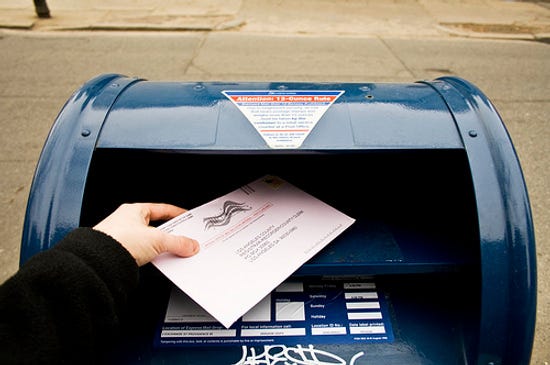
This can be viewed as the second half of a broader logistical attack, which began with the Regional Transportation Optimization program, an ongoing reduction of regional distribution centers and slowdown in rural mail collection and delivery. Together, the USPS is in danger of disqualifying perfectly valid votes — which, is fair to say, is likely the plan, especially in heavy vote-by-mail states like Arizona and Florida.
So what can be done about it? Caruthers and other voting rights’ advocates don’t intend to sit idly as the administration chokes off what could be millions of valid votes from counting. For starters, there are policy clarifications that need to be provided to every state and posted at every post office — that alone will be a battle — and then a fight to come over directing the proper resources to rural postal collection in particular.
Caruthers also points to the USPS’s five open Board of Governors’ seats, which means the board is two governors shy of the quorum required to function. Two of Trump’s nominees have not been acted upon by the Senate, while three seats have no nominees. She also suggests that this can be a leverage point for senators willing to stand up for voting rights.
States, meanwhile, can also take action to mitigate the potential damage. Providing paid postage on return envelopes can significantly reduce the time it takes voters — especially young and low-income people — from sending back their ballots. Introducing more drop boxes and extending polling hours can also provide more off-ramps from mail-in voting for time-strapped voters, and in states like Illinois, New York, and California, these policies should not be difficult to pass or implement.
Wait, Before You Leave!
Progress Report has raised over $7 million dollars for progressive candidates and causes, breaks national stories about corrupt politicians, and delivers incisive analysis, and goes deep into the grassroots.
None of the money we’ve raised for candidates and causes goes to producing this newsletter or all of the related projects we put out. In fact, it costs me money to do this. So, I need your help.
For just $5 a month, you can buy a premium subscription that includes:
Premium member-only newsletters with original reporting
Financing new projects and paying new reporters
Access to upcoming chats and live notes
You can also make a one-time donation to Progress Report’s GoFundMe campaign!