

Welcome to a Sunday edition of Progress Report.
Spring is officially here. We took our three-year-old to the playground twice this weekend. He shared his soccer ball with a kid who returned the favor with some Pringles. They didn’t speak one another’s language — my son’s Spanish is limited to a few words like “leche,” “agua,” and “tigre” — but they had no problem hashing out games (chasing the ball is universal), sharing, or taking turns on the slide. I think this makes them more emotionally qualified to serve in Washington than most people there.
Okay, lots of news to review, so let’s dive in.
Note: I don’t like talking about business or being vulnerable, but I’ll make a rare exception here. Paid subscribers have dropped off a cliff since late November, when I went in for my sixth open-heart surgery, and it’s making life difficult.
I took a few weeks off to heal from surgery but resumed the work way earlier than recommended, diving right in with live-streamed interviews and special election-related projects. I know times are tough, but if you’re reading this and want to pitch in to help keep this independent media project afloat, now would be a great time.


Democrats in Wisconsin: Democrats need to flip two seats to take back control of the state Senate for the first time in nearly two decades, a task that got a bit easier this week after the retirement of one of the state’s most endangered GOP lawmakers.
No longer beneficiaries of an absurd gerrymander and in some cases weighed down by age and personal tragedy, Republicans are starting to bow out from the grind of elected office. This week, longtime state Sen. Van Wanggaard (SD-21) announced that he will retire instead of try to defend a district that was redrawn to favor Democrats.
The 78-year-old Republican has lost all three of his siblings and had a daughter diagnosed with cancer since his last re-election in 2022. While he said that his staff tried to find ways to make another term doable, given the circumstances, the fact that his redrawn district would have narrowly voted for Kamala Harris in 2024 likely made the decision to step aside that much easier. He’d almost downed tools on fundraising, taking in just $36,000 as of January, and faced a strong challenge from Democrat Trevor Jung, the young Racine transit director.
Wanggaard’s retirement means that two of the Democrats’ top three targets will be open-seat races; the most endangered member, Sen. Rob Hutton (SD-5), announced that he’s stepping aside in January. His newly reconfigured district would have voted for Kamala Harris by six points, which was impetus enough to peace out even before Sutton and his wife were awarded $3.5 billion in punitive damages by a local jury in a lawsuit over a fire in their home caused by a faulty dehumidifier (a verdict that is unlikely to stand, to say the least).
Popcorn entrepreneur and powerful House Speaker Robin Vos announced he’d be stepping aside last month, and on Thursday, his counterpart in the state Senate, Majority Leader Devin LeMahieu, revealed that he’d be following him out the door. Both men know that there’s a solid chance they’d be serving in the minority next year due to the confluence of a national blue wave and the new Democratic-leaning districts in the Badger State.
You can dig deeper into the most competitive Wisconsin races in Progress Report’s competitive district tracker spreadsheet.
Workers in Virginia: Governor Abigail Spanberger is expected to sign newly passed legislation that will make Virginia the first state in the South to create a paid family and medical leave program for workers.
Starting in late 2028, employees in the state will be eligible to receive up to 12 weeks of paid time off to have a child, deal with personal health issues, or to help a family member receiving medical care. Workers would be eligible to recieve up to 80% of their average weekly pay, capped at the average state income (just over $1,500 this year). The program will be funded by a small payroll tax on employers and employees, like unemployment insurance.
Virginia will be the 14th state to create a paid family leave program, as well as the 19th state to establish the right to paid sick leave.
Stoners in Vermont: A new bill in the Senate proposes to raise the maximum amount of cannabis that can be purchased at one time from one ounce to two, while also doubling the (unusually low) THC potency limit in legal weed.
Interestingly, the legislator behind the proposal, Sen. Kesha Ram Hinsdale, suggested that it could be an antidote to the social isolation plaguing society, especially in a rural state like Vermont.
“We have seen our cannabis industry follow all the rules, give people a third place, give people the opportunity to find community and they have done it in a more constrained market than the states around us,” Ram Hinsdale said on the floor of the Senate.
Economic fairness in California: A new poll finds that 52% of Californians currently back the proposed billionaire wealth tax, which would impose a one-time, 5% surcharge on the assets of the every billionaire in the state as of January 1st. The partisan split is notable: 72% of Republicans say they oppose the tax, while 72% of Democrats are supportive — this despite most prominent Democratic elected officials in the state coming out against the proposal.

The tax would generate around a hundred billion dollars, most of which would be used to bolster the state’s healthcare system in the wake of draconian cuts made by the GOP’s Big Beautiful Bill. It is being vociferously opposed by most of the state’s billionaires, especially the more reactionary crew in Silicon Valley, where increasingly political oligarchs are pledging tens of millions of dollars to stop its passage.
Given the national climate, the percentage of Democrats who back the tax really should be higher, but I’m willing to bet that the level of support is being suppressed by the fact that many of the state’s best-known elected Democrats have come out in opposition to the proposal. That includes Gov. Gavin Newsom and those who want to succeed him, such as former Rep. Katie Porter. Though Democratic voters have shown a burning desire to replace party leadership this year, there is still an element of the base that falls in line with the most prominent figures with the biggest megaphones.
Democracy in Missouri: A bit of good news in the long gerrymandering saga unwinding in the Show Me State, where if nothing else, voters will not be misled during the upcoming ballot referendum on the GOP’s rigged map in November.
Hold tight, because this might get complicated. Or at least complicated-sounding.
For context: the existing map gives the state five Republican districts and two Democratic districts, while the proposed gerrymandered map makes it 6-1 for the GOP. Republicans passed the gerrymandered map in September, but advocates have a chance to pause its implementation by qualifying a repeal ballot initiative.
The state secretary of state is required to propose wording for initiatives before they officially qualify for the ballot, and the lawsuit was over allegations that GOP Secretary of State Denny Hoskins produced biased language likely to fool voters.
Hoskins actually admitted as much during the trial; his summary called the old map — aka the fair map — gerrymandered and designed to protect incumbents. Essentially, he was inverting reality, which is exactly what Ohio’s secretary of state did in 2024, allowing Republicans to defeat an anti-gerrymandering constitutional amendment.
Hoskins’ admission made it easy for a state judge this week to order him to rewrite the initiative in a more accurate way. That’s the first piece of good news, and assuming the initiative qualifies, Missourians won’t have to decode confusing and dishonest language on the ballot.
There isn’t much question that the initiative will qualify; the real issue is when that will happen and what it means for the rest of this year’s ballot. Hoskins, committed to abusing his power in every way possible, refuses to certify it in a timely manner, hoping that if he waits long enough, the state will have to use the gerrymandered map passed by the legislature in the 2026 elections.
It’s an unprecedented attempt to subvert what is a very clear and established process: once referendums that would repeal newly passed laws qualify for the ballot, they freeze those laws’ implementation until people vote.
So, what does the legal decision mean for this year? Nothing explicit, but according to People Not Politicians, the group backing the initiative, the judge’s language foreshadows a positive outcome in the attempt to freeze the map and use the 5-2 plan in this year’s election. How do they know? The judge in this case is also going to decide the larger map debate.
Get all that? If not, here’s what you need to know: It’s unclear whether Missourians will have a fair or gerrymandered Congressional map this year, but activists are optimistic that it will be the former. And either way, they will definitely get a chance to block the use of the gerrymandered map in future elections.

Donald Trump and Republicans in Congress: It was another bad week for the GOP on Capitol Hill, where the SAVE Act looks doomed and their refusal to extend Obamacare subsidies is coming back to haunt them.
According to a new poll from nonprofit healthcare news outlet KFF (formerly the Kaiser Family Foundation), 80% of respondents who re-enrolled for ACA insurance plans say that their costs are higher this year, with 51% reporting costs that are “a lot higher” this time around. More than half of re-enrollees say they are paring down their spending on other things, including food and basic household items, to afford their monthly premiums and higher deductibles.
Now, those things can’t be inherently bad in Republicans’ eyes, because they undoubtedly knew that people would struggle if they slashed ACA subsidies. You could even say that they are getting their desired policy results. The reason why this pole is likely causing agita among GOP consultants, however, can be found in this tidy infographic from KFF:
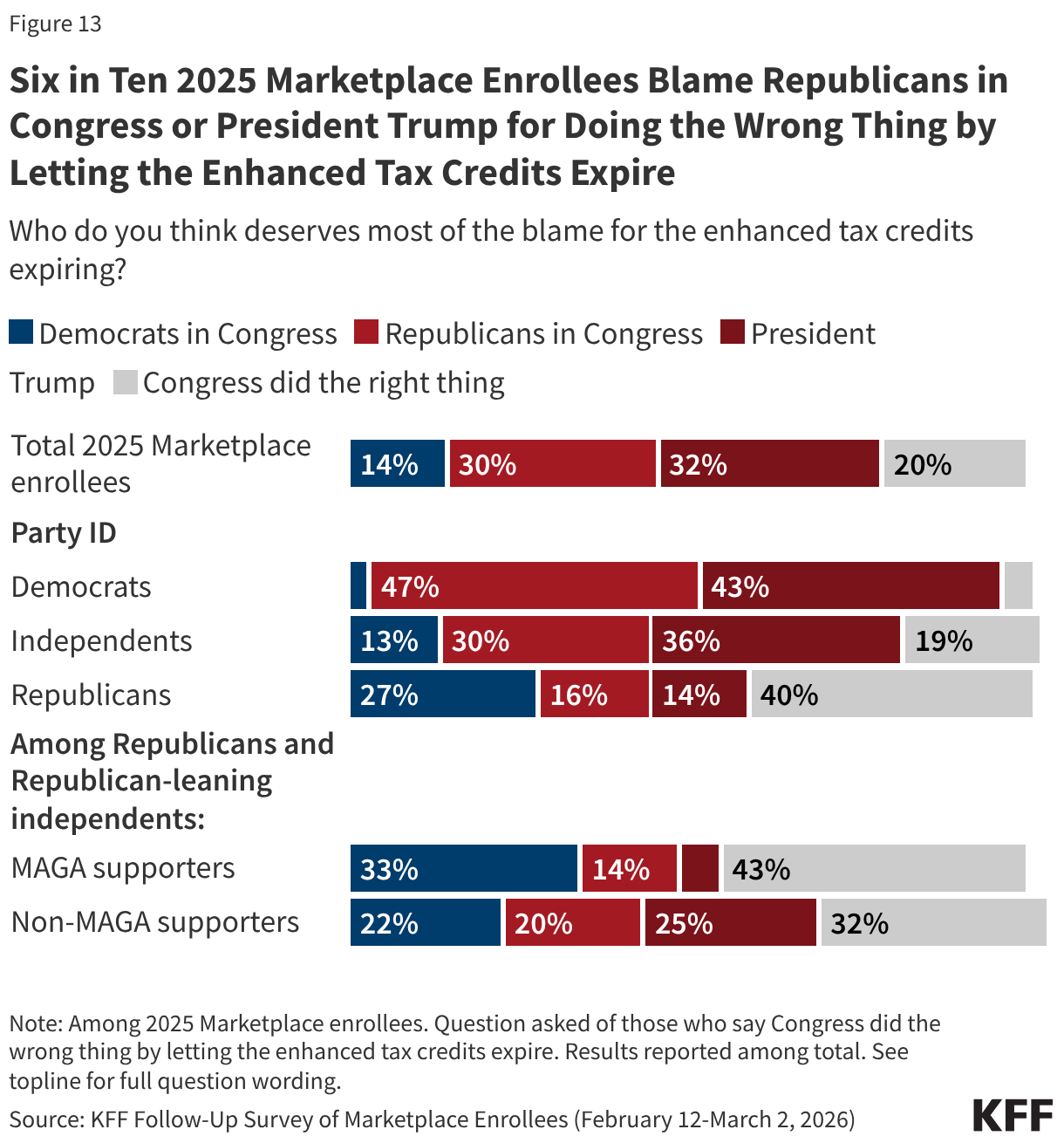
It’s a breathtakingly bad poll for Republicans, as anyone who isn’t a hardcore MAGA supporter blames the party for the explosion in healthcare costs. Republicans writ large blame the GOP (16% blame Republicans in Congress, 14% blame Trump) more than Democrats (27% total), and not even MAGA supporters think Congress did the right thing by allowing the subsidies to expire. It’s looking bleak among independents, too: 66% blame Republicans for the ongoing catastrophe, including 30% who blame Congressional Republicans.
Kids and taxpayers in Texas: Families whose kids never attended public school make up the majority of the applicants to the state’s new private school voucher program, just like Republicans and conservative activists drew it up.
The parents of more than 200,000 students have applied for the vouchers, which cover up to $10,500 a year in private school tuition. Of those students, 71% either attend private school or are home-schooled this year, destroying the farcical notion that vouchers provides choices to kids in public schools. Nearly 30% of applicants are from homes that make above $165,000 per year. Texas will spend $1 billion on vouchers next year.
RFK Jr. and the medical misinformation movement: MAHA has been taking it on the chin lately, and unfortunately, Ivermectin and fishbowl cleaner do not cure embarrassment or shame.
This week brought two particularly stinging court losses. The first ruled against a CDC board’s decision to reduce the number of recommended childhood vaccines. It was a major blow to RFK Jr.’s flagship priority, and comes as the most cursed Kennedy tries to enhance federal compensation for vaccine “injuries.” The judge ruled that Kennedy’s firing of the entire vaccine board and replacing it with antivax hacks compromised the decision-making; the ruling actually stays the appointment of the 13 new members, who have been on the board since last July.
The second ruling concerned the HHS’s declaration that puberty blockers and other treatments for gender dysphoria were inappropriate and dangerous for children, clearing the way for doctors to begin providing them at their discretion. The HHS declaration came without public consultation, review, or opportunity to comment, and the judge who issued the decision was scathing when addressing the illegal process employed by RFK Jr. and the agency.
“The notion that ‘I will go forward and issue a declaration and see if we can get away with it’ is not a principle of governance that adheres to the overarching commitment to a democratic republic that requires the rule of law to be regarded and respected and honored as a sacred,” the judge said in a passage that might as well have been addressed to the entire Trump administration.
AIPAC: The far-right pro-Israel group burned $12 million in an unsuccessful attempt to buy two Congressional seats in Illinois.
Not only did it’s preferred candidates lose, the interest group actually made a fierce enemy out of someone who would have likely otherwise been a solid ally and bridge to skeptical progressives: Evanston Mayor Daniel Biss, whose mom is from Israel, was the subject of early AIPAC opposition because he took a more nuanced stance than “it’s okay to do a genocide in Gaza and colonize the West Bank.”
After he won the IL-09 primary on Tuesday, Biss ripped the organization, accusing it of trying to buy elections.
“AIPAC found out the hard way — the 9th District is not for sale,” Biss said in his victory speech.
Perhaps most damning were the words of Illinois Gov. JB Pritzker, a former major AIPAC donor who dinged the group in an interview with the AP.
“It became an organization that was supporting Donald Trump and people who follow Donald Trump,” Pritzker said. “AIPAC really is not an organization that I think today I would want any part of.”
Pritzker’s strong stance is especially notable because he is almost certainly going to run for president and is seeking out positions that appeal to a broad swath of the Democratic base electorate. AIPAC has become persona non grata among Democrats, a fact that its leaders very much acknowledge. The organization dropped $20 million on races in Illinois, and as has become its won’t, none of the ads or other campaign materials it paid for actually mentioned Israel.
That omission made an AIPAC spokesperson’s spin that Israel was not a determinative issue in this election pretty ironic, and the organization’s usage of benign, progressive-sounding cover groups to spend its campaign money point to just how toxic the subject has become.
Wait, Before You Leave!
Progress Report has raised over $7 million dollars for progressive candidates and causes, breaks national stories about corrupt politicians, and delivers incisive analysis, and goes deep into the grassroots.
None of the money we’ve raised for candidates and causes goes to producing this newsletter or all of the related projects we put out. In fact, it costs me money to do this. So, I need your help.
For just $5 a month, you can buy a premium subscription that includes:
Premium member-only newsletters with original reporting
Financing new projects and paying new reporters
Access to upcoming chats and live notes
You can also make a one-time donation to Progress Report’s GoFundMe campaign!
"That includes Gov. Gavin Newsom and those who want to succeed him, such as former Rep. Katie Porter."
That's pretty disappointing of Katie Porter. Boo on her for this.