

Welcome to a Tuesday night edition of Progress Report.
Tonight we’re going to talk about — you guessed it — Graham Platner.
And on another Democratic primary note, on Thursday evening we’ll be live with Kai Newkirk, the dynamic activist who is challenging Rep. Greg Stanton in Arizona. Keep an eye out for the invite.
Note: The far-right’s fascist takeover of this country is being aided by the media’s total capitulation to Trump’s extortion. It’s never been more critical to have a bold independent media willing to speak up against the powerful. That’s what I’m trying to do here at Progress Report.
You can help keep Progress Report afloat and build that network for just $
5$2.50 a month — every subscription helps!


Maine Senate candidate Graham Platner was accused of sexual assault on Monday by a former girlfriend, the latest in a long line of scandals that seems almost certain to result in his ouster as the Democratic nominee. It’s really only a matter of time — the Maine Democratic Party chair released a video tonight promising an “open, inclusive, transparent, and fair” process for replacing Platner and revealing that his campaign has been trying to shape the process of selecting a new nominee.
What comes next should be easy: Platner needs to drop out of this race. He lied to Mainers time and again, which negates any mandate or claim to represent the wishes of Democratic primary voters. There should be no equivocating, no trying to name his successor, no leverage plays.
That being said, establishment Democratic leaders cannot simply say “told ya so,” do some gloating, and then push some empty suit or corporate stooge when the party picks its nominee later this month. Because despite what all the angry centrist trolls in my Twitter mentions have been screaming for the last 24 hours (welcome to my world), this calamity is not simply a matter of terrible and flimsy vetting and eager leftists investing their hope in a very troubled candidate, though both of those things were of course factors.
Instead, as I wrote exactly one month ago, the Platner phenomenon was a symptom of a bigger problem, one that won’t disappear when the candidate exits stage left:
Graham Platner’s ascendancy is as much a condemnation of a sclerotic national establishment as it is affirmation of his talents. To put it simply, nobody outside of local seafood aficionados would know Graham Platner’s name if Chuck Schumer and the DSCC hadn’t cleared the field for a 78-year-old centrist governor who’s been in public office since the 1980s and didn’t ever seem all that interested in going to Washington.
In the most turbulent and dangerous times of our lives, they went with business as usual. Mainers responded by giving Platner a 64-26% lead in April.
Is Platner that compelling? He’s a decent speaker with a compelling background, but he’s no rock star or Barack Obama, and it’s safe to say that he would probably not be drawing massive crowds at raucous rallies if there were some other candidate who was willing to speak truth to power, channel populist outrage, and promise to work on behalf of working people.
If Democrats had welcomed a competitive primary and backed a half-decent elected official with a pulse, Graham Platner probably never would have been recruited by outsiders, much less become the presumptive nominee for Senate.
About a week ago, a report in NOTUS about Chuck Schumer’s heavy involvement in candidate recruitment essentially confirmed the most important element of this thesis: the DSCC wanted Gov. Janet Mills as its nominee from the start and warned off other younger, progressive, and presumably less problematic potential candidates, using the specter of a massive fundraising and institutional disadvantage to prevent them from running.
There were some denials from Schumer’s camp in the story, but it was really a matter of semantics, as the DSCC acknowledging that it had “made clear from the start that it would back Mills’ potential candidacy.”
A few other candidates did declare for the race, but with the thumb on the scale for Mills and Platner gaining steam — he was the one who did not heed the DSCC’s warning and jumped in before the governor — there was just no oxygen for a third contender. Considering how poorly Mills campaigned and how little money she raised, it’s very feasible that without the DSCC staying neutral could have made it a three-way race.
Instead, they wound up with a charismatic sociopath, a selfish and violent man, a black mark on the party and a black eye for people who thought better was possible.
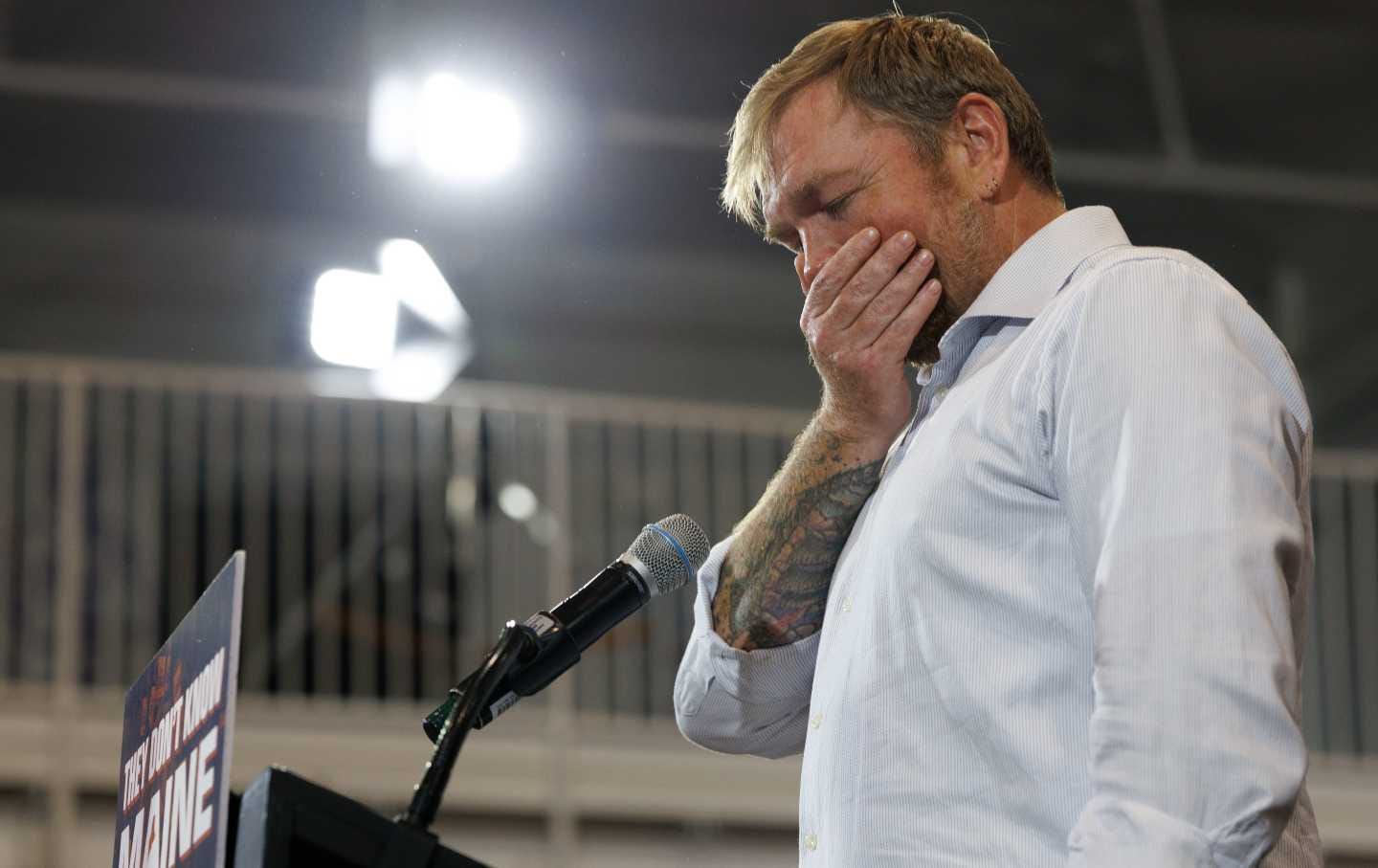
That voters flocked to Platner was indicative of the desperate thirst for populism, for something new and uncensored, for somebody who understands the financial and existential struggles that they face and won’t respond to them with platitudes and expiring tax credits. Graham Platner wasn’t just a tatted up ex-Marine oysterman and his appeal wasn’t just aesthetic: he stood against outrageous wealth inequality, backed Medicare for All, and had no problem calling what Israel is doing in Gaza a genocide. He was walking, talking proof that “electability” was no longer code for moderate, milquetoast, and poll-tested, and that people who never pay attention to politics can be activated by an authentic, inspiring leader.
People thought they could believe in Graham Platner, which, along with the fact that the guy seemingly hurt a lot of women, is the larger tragedy here. He was a legitimate populist phenomenon; people who had never before engaged in the political process packed his town halls in the most rural parts of Maine, waited hours to meet him, volunteered for a movement that looked poised to realign the state.
But the people who recruited Graham Platner were so eager for something and something new that they failed to vet him, ignored all the red flags, foisted him on the public, promised that he was the real deal, took their time and money and belief. And in exchange, all voters got was disappointment and more reason to be cynical, with the easy takeaway being that anyone who offers them the hope of something better is full of shit. Worse, this sloppy and disastrous operation sends the message that regular people can’t run for office, that working people aren’t to be trusted and should just leave governing to the “professionals” and forget about even being involved.
We need more oyster farmers — people who work with their hands, who make money off labor and not investment income — in Congress. This feels like a setback on that front.
It should be a lesson for the left, too, because even avowed socialists are prone to searching for a savior and worshipping a hero. It’s easy to start making excuses for people, to rationalize their flaws, to say maybe this time, it’s other people who are lying and that our guy is the victim even in absurd circumstances. For what it’s worth, I was never fully sold on Platner, even if I did — and still do — believe that we need candidates who break the mold and the death grip that the party establishment as on the nominating process. Here’s what I wrote way back in October, when the Nazi tattoo story first broke:
Let’s be objective: Platner is a history buff who apparently liked taking his shirt off at big parties. Is it really possible that he went nearly two decades without either stumbling across the image of the SS Totenkopf or having someone tap him on the shoulder and politely inform him that he had the insignia of the Nazi concentration camp guards above his right nipple?
Criticizing Israel’s government and genocide has opened the left to deeply cynical and unfair accusations of antisemitism, but it’s going to be that much harder to combat them if activists stick with a guy who had a giant Nazi tattoo for nearly 20 years. This isn’t to say that Platner is actually a Nazi or that he’s lying about his political convictions, but the bar for a political candidate has to be higher than broad ideological agreement, especially when it comes to this particular subject.
If Platner can prove that he really didn’t know the significance of his tattoo up until this month, I’m happy to retract my skepticism, but if we’re going to call out conservatives for believing Trump’s lies because they love tax cuts and ICE raids, we should think twice about buying such a far-fetched story.
Our democracy, with its individual candidates in a first past the post system, almost demands cult of personality around politicians, which invests them with far too much power. Graham Platner was the avatar of this movement, but it does not belong to him. Whoever gets the nomination after him should be somebody who can galvanize, not simply satisfice in a year where real change is in the air.
The process should be as democratic as possible, with no maneuvering by party insiders to promote one candidate over another. Platner didn’t work out, but his voters should not be punished. They showed faith and a rare desire to involve themselves in politics, so the only way for Democrats to make anything positive out of this mess is by honoring the message they sent.
Wait, Before You Leave!
Progress Report has raised over $7 million dollars for progressive candidates and causes, breaks national stories about corrupt politicians, and delivers incisive analysis, and goes deep into the grassroots.
None of the money we’ve raised for candidates and causes goes to producing this newsletter or all of the related projects we put out. In fact, it costs me money to do this. So, I need your help.
For just $5 a month, you can buy a premium subscription that includes:
Premium member-only newsletters with original reporting
Financing new projects and paying new reporters
Access to upcoming chats and live notes
You can also make a one-time donation to Progress Report’s GoFundMe campaign!
One of the best Platner analyses I've read in the past 48 hours. The public wants change, and he offered that, despite his many blemishes. In today's environment it takes guts to run for office with the knowledge that all of your flaws will be exposed. Let's hope that someone with integrity, charisma and an understanding of the issues at stake can step up to the plate.
Perhaps something good will come from this. Platner's campaign created an organization that could serve as a springboard for a sustainable political movement that could transform Maine politics. There is too much emphasis on particular politicians. Politicians are a necessary evil in our peculiar system of government. We need a politic that focuses instead on constituent needs. That can only come from a citizen led organization.